
6 Minutes
Los Angeles is about to get a close look at where OLED is heading next, and LG Display is arriving with a clear message: the race is no longer just about sharper screens. It is about efficiency, lifespan, flexibility, and how displays fit into everything from cars to robots.
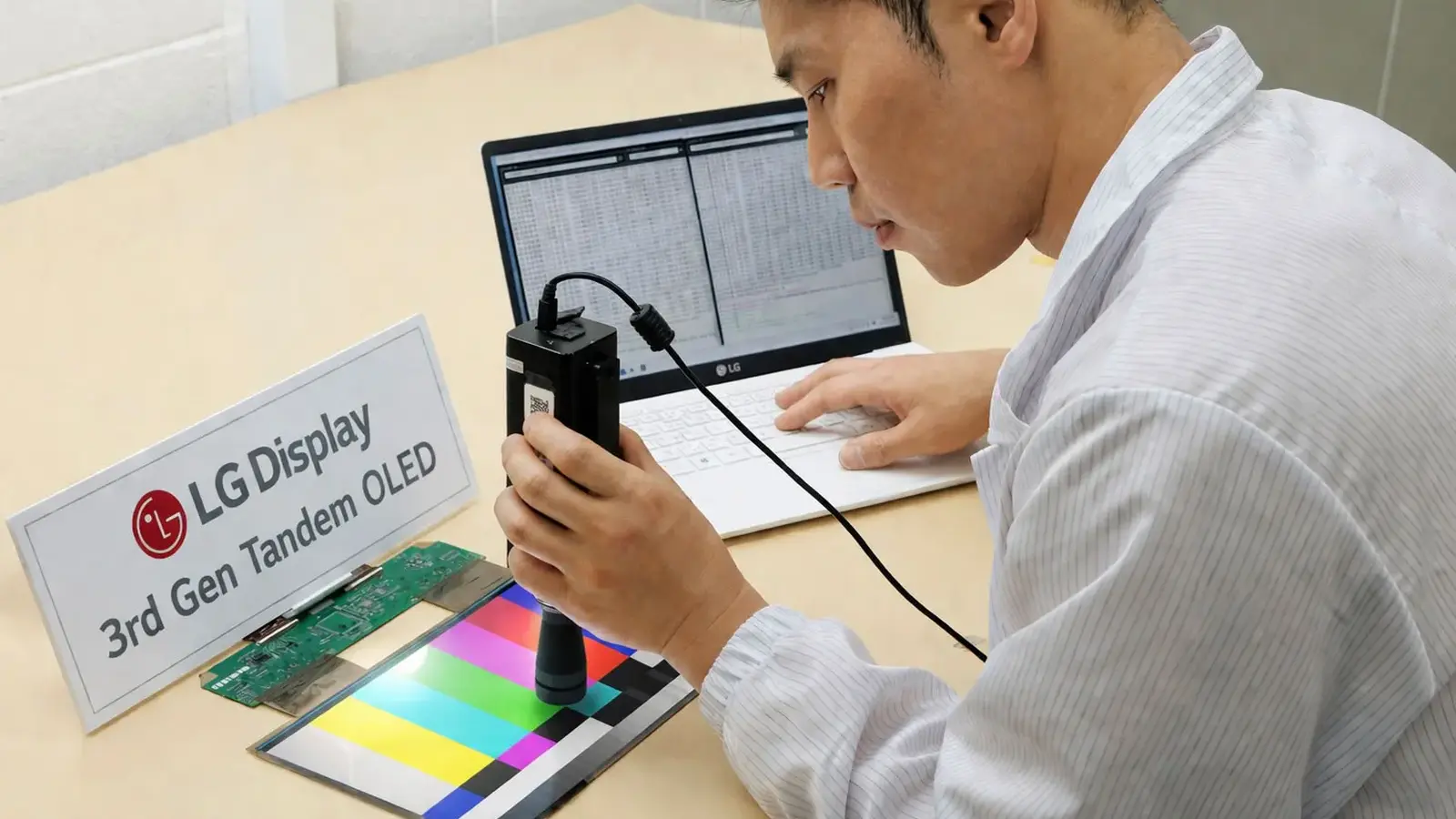
At SID Display Week 2026, running from May 5 to 7 at the Los Angeles Convention Center, LG Display will publicly show its third generation Tandem OLED technology for the first time. The company is presenting the lineup under the banner “OLED Evolution for the AI Era,” but the real story is more concrete than any slogan. This is LG Display trying to prove that OLED can handle tougher jobs, longer use, and more demanding environments than ever before.
The headline act is a new automotive panel built on third generation Tandem OLED. Tandem OLED works by stacking multiple organic light emitting layers, a design approach that helps raise brightness while improving power efficiency and durability. LG Display first brought the technology to market in 2019, and this latest version marks a notable step forward. The company says the new panel cuts power consumption by 18 percent and delivers more than double the lifespan of the previous generation.
That matters a lot more in a car than it does on a phone or even a TV. Vehicle displays have a rough life. They sit in direct sunlight, endure freezing mornings and sweltering afternoons, and often stay active for long periods. Drivers expect them to work flawlessly for years. LG Display says its new automotive Tandem OLED can reach 1,200 nits of brightness and maintain performance for over 15,000 hours at room temperature without meaningful degradation.
The improvements come down to the chemistry and physics inside the panel. LG Display says it has developed a new OLED element that better manages the movement of holes and electrons, which helps reduce wear while keeping image quality uniform across the screen. It is also using a deep blue dopant to improve color purity, brightness, efficiency, color reproduction, and long term stability. In plain English, the panel is being tuned to look better for longer without burning through as much energy.
Mass production of this first third generation automotive Tandem OLED panel is scheduled for this year, with broader expansion into IT devices and other categories expected later on. That future is already visible in the rest of the company’s Display Week lineup.
More than a car screen story
LG Display is dividing its exhibit into three broad tracks: Tandem WOLED, Tandem OLED, and a grab bag of experimental technologies that push beyond familiar product categories. Expect large OLED TV panels, monitors, laptop and tablet displays, gaming focused screens, automotive solutions, and concept hardware designed to show where flexible displays could go next.
One of the most unusual showcases will be the company’s first P OLED solution for humanoid robots. Instead of thinking about a display as a flat rectangle, LG Display is treating it as a surface that can become part of a machine’s face or body. The demo uses automotive grade Tandem OLED expertise, which means high brightness, longer lifespan, strong durability, and stable operation across difficult temperature conditions. That is a serious hint about where display makers think the next wave of demand may come from.
There is also plenty for the traditional premium screen crowd. LG Display plans to show an 83 inch Tandem WOLED TV panel rated for 4,500 nits peak brightness with 0.3 percent reflectance, a combination aimed at improving contrast and visibility even in brighter rooms. On the gaming side, the company is bringing a 27 inch OLED panel with a 720Hz refresh rate, alongside a 39 inch 5K2K curved OLED display that leans into the ultra wide, high immersion market.
Laptop users are part of the pitch too. LG Display will present a 16 inch Tandem OLED panel built to be thinner, lighter, and more power efficient than conventional OLED alternatives. According to the company, that could extend battery life by up to 2.3 hours, a claim that will likely catch the attention of both PC makers and mobile professionals who are tired of choosing between image quality and endurance.
What makes this year’s showcase interesting is not any single spec on its own. It is the breadth of the strategy. LG Display is not treating OLED as a premium TV technology anymore. It is framing it as a platform for the next generation of vehicles, portable computing, gaming hardware, and even robotics. If that sounds ambitious, it is. But that is exactly why Display Week matters. It is one of the few places where companies stop teasing the future and start putting prototypes and production plans side by side.
From an industry perspective, the third generation Tandem OLED debut may end up being the most consequential piece of the whole exhibit. Better efficiency and longer panel life are the two arguments OLED needs if it wants to keep expanding into categories where reliability matters as much as visual quality. Cars are the perfect test case. If the technology can survive there, it becomes much easier to imagine it spreading everywhere else.
LG Display’s booth in the South Hall should offer a clearer sense of how close that future really is. And if the demos hold up in person, this could be one of the more meaningful OLED moments of the year.


Comments
Armin
Seen OLED fade in a car after a few yrs, so if LG really fixed blue degradation that's massive. curious about repairability, price and long term service
v8rider
Looks flashy, but 720Hz gaming panel... who needs that? still neat for pros, i'd wait for real battery tests tho
mechbyte
Whoa, 15,000 hours at 1,200 nits? If true that's huge, but car interiors are brutal, hope they tested sun + heat properly. fingers crossed

Leave a Comment