
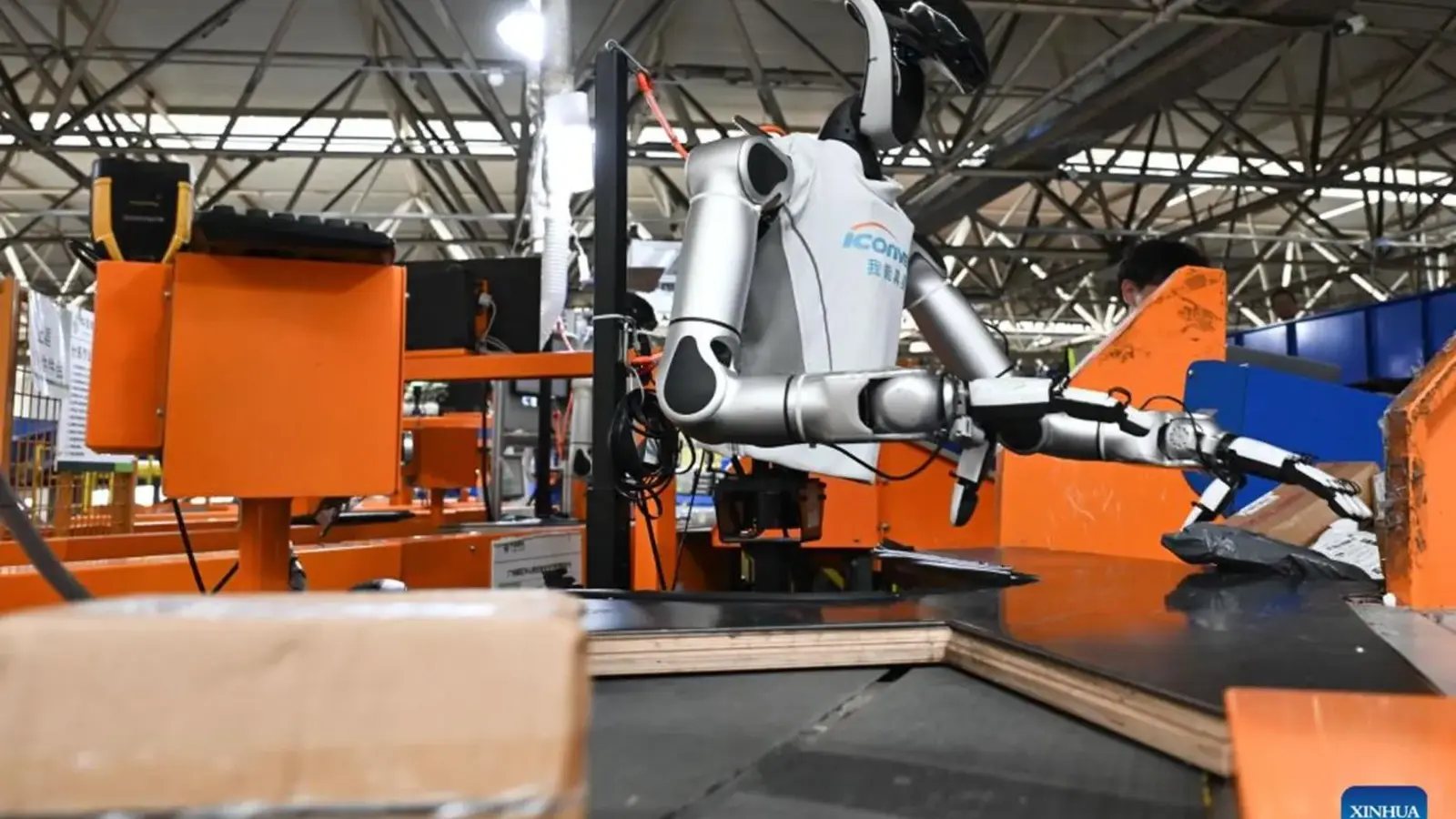
In a noisy Guangzhou sorting hall, a machine lifts a parcel as if reading its barcode with its fingertips. Short pause. Then another. The scene looks like an assembly-line ballet—precise, tireless, and oddly human.
Chinese state media report that China Post Group has brought humanoid robots into one of its major processing centers in Guangzhou to help with parcel sorting. The robots are said to be capable of handling about 1,200 packages per hour, integrated alongside conventional robotic arms and autonomous forklifts in a facility that moves roughly 6.5 million items a day.
Why Guangzhou’s post centre picked humanoids
Social posts and local coverage point to the Xingdong M7 from RobotEra as the machine on the floor. It doesn’t walk. Instead, the design trades legs for a fixed pedestal, parking itself beside conveyor belts and reaching into the flow. Sensors include 3D LiDAR, full 360-degree vision, seven-axis arms and hands with a dozen joints—tools built to read, grasp and place a bewildering variety of parcels.
Why humanoid form at all? Because some tasks still favor dexterity over brute force. Grasping awkward shapes. Turning a box to find a barcode. Fine finger work where a simple picker would struggle. In other words: the robot borrows human gestures to solve human problems.
But the headline figures invite scrutiny. An earlier trial by a US robotics company found a human trainee processed 192 more parcels than their test robot over a 10-hour shift, even allowing for breaks and meals. Numbers like that remind us that choreography does not equal superiority, at least not yet.
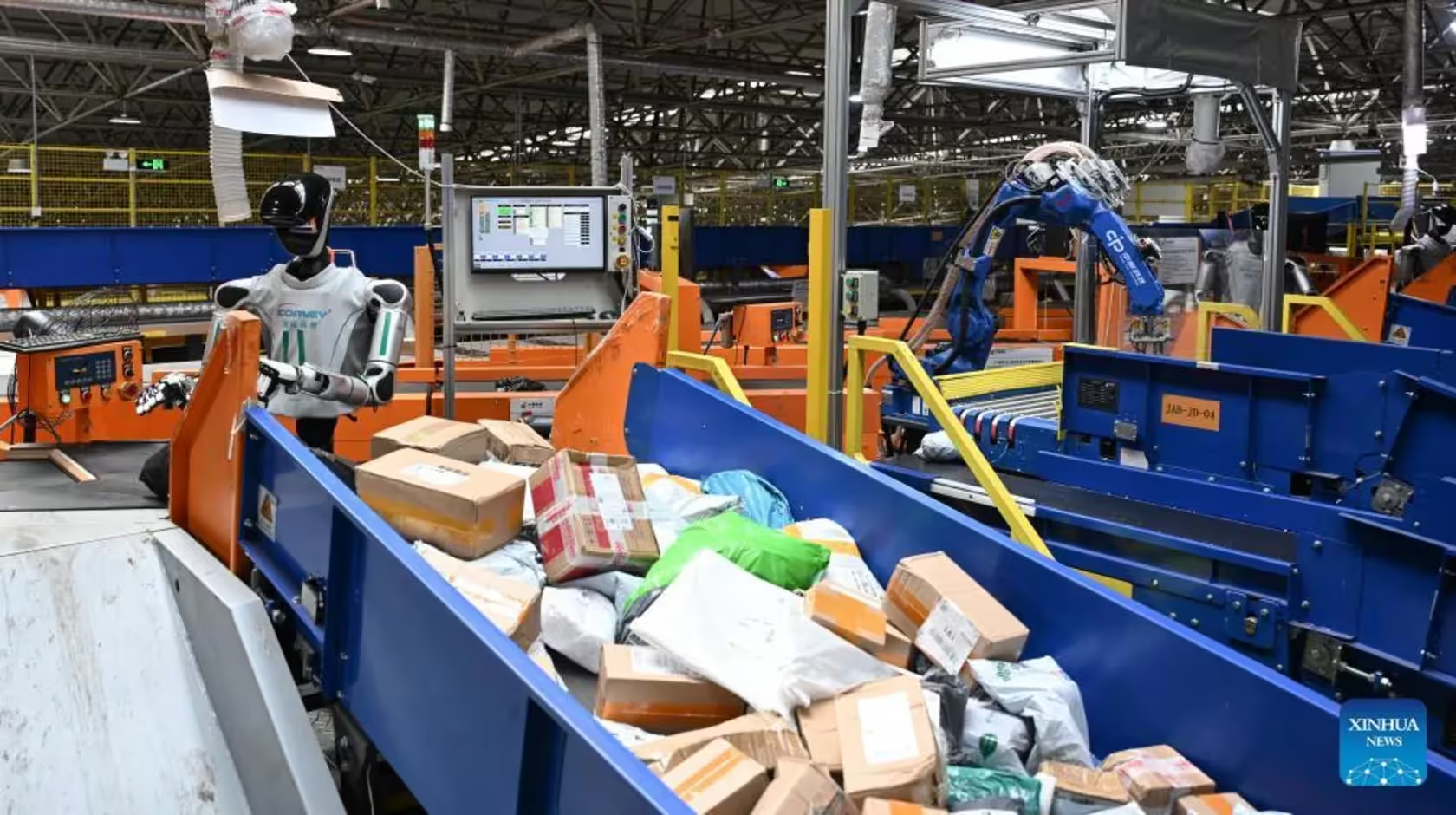
Still, placing these machines inside a state-run postal facility carries symbolism. It’s a signal that the government trusts domestic robotics to operate at scale in critical infrastructure. It’s also pragmatic: fixed humanoid units are easier to integrate into existing lines than fully mobile platforms, and they play well with established automation like gantry arms and self-driving forklifts.
Expect iterative improvements. Software updates. Sensor tweaks. A steady march toward fewer misreads and faster picks. Will the robots overtake humans on speed and error rates? Maybe. Will they replace every warehouse worker? Not overnight. The immediate gain is about consistency and the ability to handle peak volumes without bringing in extra seasonal staff.
For logistics watchers, Guangzhou’s experiment is a useful test case. It shows how humanoid form factors are being adapted to industrial realities rather than sci-fi fantasies. It also raises practical questions: integration costs, uptime, and how well these machines cope with the messy variety of packages that still confound many automation systems.
Whatever the answer, the image is vivid: hands that move with intent, stations that breathe more quietly, and a postal center where the line between human and robot work is becoming a shared rhythm.

“I cover emerging technologies, digital innovation, and the intersection of tech and everyday life. My goal is to make complex trends accessible and inspiring.”

Discussion
Leave a Comment
Comments (2)
Is this even real? fixed humanoid seems smart for sorting, but 1,200/hr feels optimistic. curious about maintenance costs and downtime
wow that robot ballet is eerie but kinda cool. 1200 pkgs/hr sounds wild, hope no glitches, if it trips up though… job shifts get messy