
3 Minutes
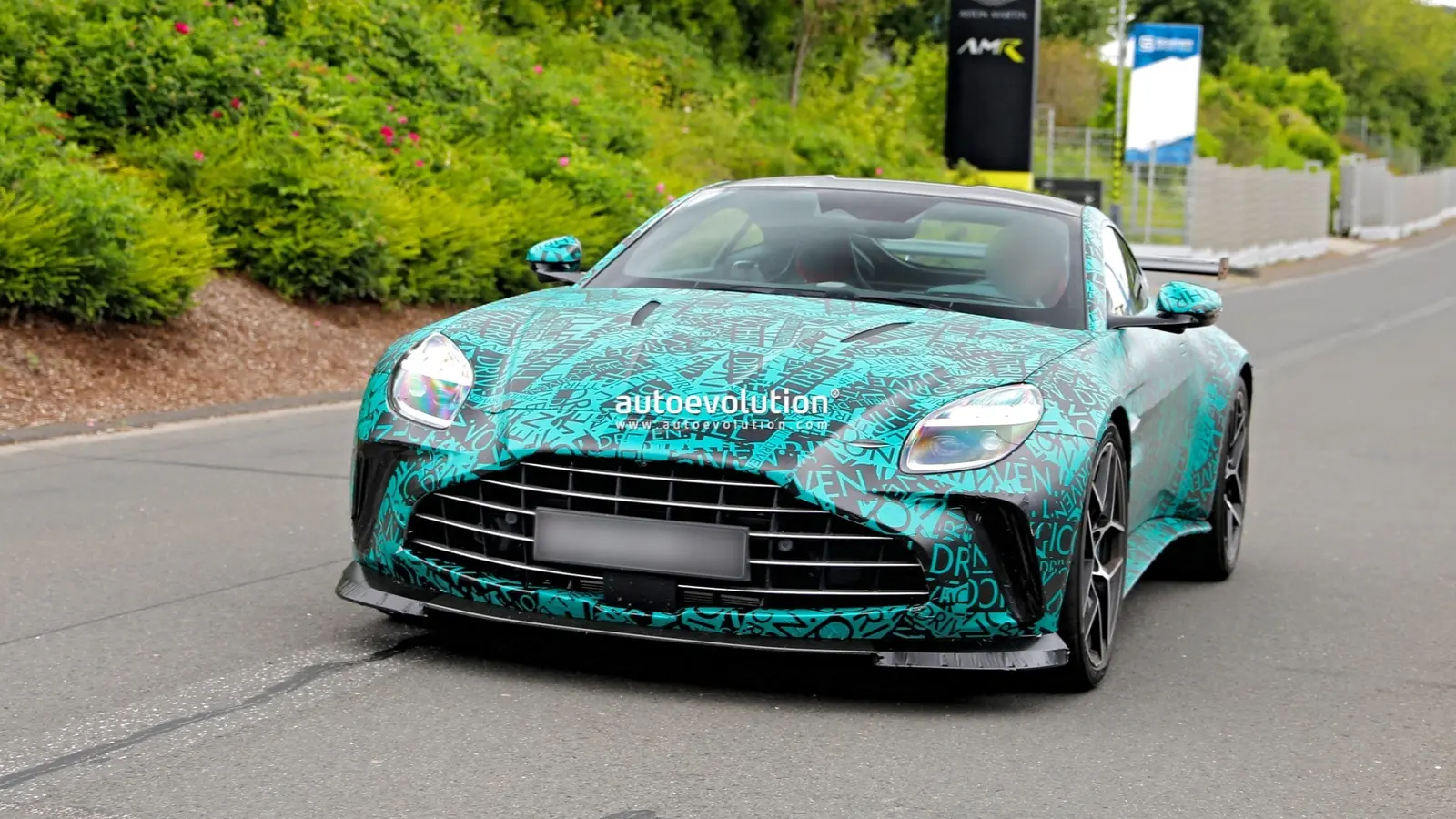
When a heavily disguised Vantage rolled past the barriers, it felt less like a test mule and more like a declaration. The camouflage may hide paint and curves, but not intent. This is clearly a near-production machine, one tuned to push the little Aston into territory usually reserved for full-blown supercars.
Look closely and the clues are everywhere. A fixed rear wing sits where it will live on showroom cars, bolted to the deck in a way that suggests track days are part of its brief. The diffuser has been reshaped to house four tailpipes clustered in the center. The exhaust layout alone promises a different kind of soundtrack and a bolder rear profile.

Details that change the drive
The front end wears a deeper chin spoiler, reportedly carbon fiber, and larger side intakes that seem aimed at brake cooling and taming wheel-arch turbulence. Side skirts have been beefed up, too. All of it reads like aerodynamic surgery: small shifts that add up to measurable gains when speed rises.
Tire choice is telling. Pirelli P Zero R rubber hugs those twin-spoke wheels, with the rear rubber measuring 325/30 on 21-inch rims. The ZR marking signals a high speed rating, beyond 240 kilometers per hour. Green brake calipers peek out from behind the spokes, and the hardware looks like it could be carbon-ceramic — lighter and more fade-resistant, shaving roughly 27 kilograms of unsprung weight compared with the standard setup.

Inside the cabin the prototype wears carbon-fiber shells derived from the Valkyrie program. They are not fashion statements. They save kilos where it counts and hint at a focus on lap-time performance over plush backseat space.
So what powers this sharpened Vantage? Under the hood sits Aston Martin’s AMG-sourced V8, upgraded from the Vantage S numbers of around 670 horsepower and 800 newton-meters. Engineers have options. One obvious route is to borrow turbocharger technology from the Valhalla program. Aston has already used similar upgrades elsewhere, and those tweaks turned out meaningful gains — examples show larger compressor wheels, revised internal geometry, and reduced exhaust back pressure can net significant extra output.

For context, related Aston projects nudged similar V8s well past their original ratings. Mercedes-derived flat-plane architectures and track-focused calibrations have produced engines in the 700-plus horsepower band. With the GT Black Series setting a 720 horsepower marker, it would be no shock if this Vantage RS wants to join that club or at least flirt with 700 horsepower.
Expect the final reveal in 2027. If those quad-center pipes are anything to judge by, Aston Martin aims to give the Vantage a throatier voice and a sharper bite. Compact, aggressive, and unapologetically loud: this could be the most ferocious Vantage yet.
Source: autoevolution



Leave a Comment