

5 Minutes
Arthur Hayes reduces ETH exposure after recent accumulation
Arthur Hayes, the BitMEX co-founder, has exited a sizable Ethereum position at a loss, according to on-chain tracking. Lookonchain reports Hayes acquired roughly 5,900 ETH over several days at an average price near $1,793, then sold 6,000 ETH for about $10.14 million at an average of $1,690 — realizing an estimated loss of roughly $606,000. This move comes amid a broader market backdrop where other large holders are increasing their ETH exposure around a key support area.
Context: transfers and market timing
The sales followed a June 15 transfer that saw a wallet linked to Hayes receive 3,000 ETH (about $5.42 million) from market maker Flowdesk, a move that coincided with a temporary market rally after easing geopolitical tensions boosted risk appetite. Despite Hayes’ retreat, multiple whale-sized purchases were logged around the same time, signaling divergent strategies among major crypto participants.
Whales keep buying near the $1,700 support zone
Lookonchain highlights two notable accumulation events that offset, in part, Hayes’ sale. Investment firm K3 Capital reportedly withdrew 10,000 ETH (around $16.9 million at the time) from Binance, while a wallet linked to entrepreneur Chun Wang purchased approximately 7,650 ETH (close to $12.9 million). These on-chain buys underline continued interest in accumulating ETH around critical support levels.
Why whales are attracted to this price band
Several technical and liquidity-based signals identify the $1,700–$1,800 region as a battleground. On the daily chart, Ethereum sits close to the 78.6% Fibonacci retracement level near $1,703 — a common zone traders watch for stabilization after steep pullbacks. Meanwhile, a major liquidity cluster appears around $1,800, which often draws large traders looking to add size or capture liquidation-driven moves.

Ethereum daily price chart — June 19
Technical indicators show mixed momentum
Price action since the June low near $1,507 has been choppy. ETH staged a recovery but stalled beneath the 61.8% Fibonacci level around $1,856. Momentum oscillators are not yet signaling a decisive bullish turn: the daily Relative Strength Index (RSI) remains below the neutral 50 line, and the MACD is still under the zero mark, indicating momentum is tilted toward sellers for now.
Liquidation and liquidity heatmap implications
Liquidation maps from CoinGlass point to significant concentration of leveraged positions between $1,780 and $1,820, with a heavy pocket near $1,800. These bands can act as short-term magnets for price action because liquidation cascades and stop hunts often unfold there, producing sudden volatility and directional moves.

Ethereum liquidation heatmap
Chart structure: range-bound with a decisive breakout level
Market commentators such as Team LAMBO have pointed out that ETH appears to be trading in a defined range between roughly $1,500 and $1,800. A decisive break above the $1,800 liquidity pocket and the descending trendline that has capped rallies since early May could expose higher targets, including the $1,856 zone. Conversely, failure to defend the $1,700 support increases the probability of retesting $1,620 and potentially the June low near $1,507.
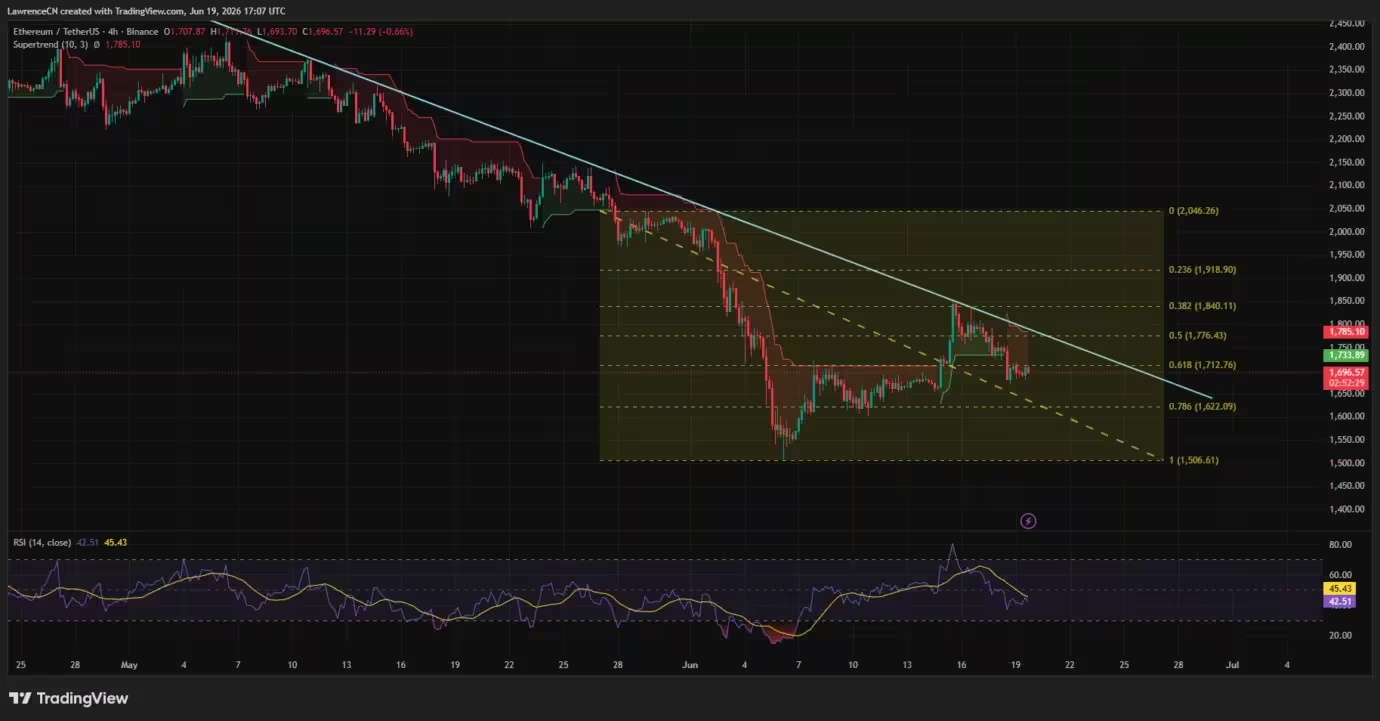
Ethereum 4-hour price chart — June 19
Short-term outlook and what traders should watch
For traders and investors focused on Ethereum and ETH price action, the near-term priorities are clear: monitor whether buyers can clear the converging resistance around $1,780–$1,800 and watch orderbook liquidity for signs of sustained demand. On-chain flows — including further withdrawals by institutional buyers like K3 Capital or large wallet transfers linked to notable figures — will also influence market sentiment. Meanwhile, persistent weakness in momentum indicators suggests a cautious stance until a confirmed breakout or a clean hold of the $1,700 support.
In sum, Arthur Hayes’ loss-taking sale is only one piece of a broader market picture where large on-chain buyers continue to accumulate near a technically significant support zone. The contest between liquidity hunters and long-term accumulators will likely determine Ethereum’s next substantive move.
Source: crypto



Leave a Comment