

Nineteen days. That is how long it reportedly took xAI to rack up and network roughly 100,000 Nvidia graphics processors and bring a new mega cluster online. Short sentence. Big implication.
Jensen Huang, Nvidia's chief executive, did not speak in technical diagrams. He offered a verdict: what Elon Musk and his team pulled off was singular. Huang called the achievement unprecedented, a feat the industry had not seen at that pace and scale. He singled out the speed and coordination behind Colossus, xAI's flagship system, and treated the rollout as a milestone worth noting.
Speed as a strategic weapon
Colossus went live in Memphis in 2024 and quickly became one of the largest AI compute platforms in operation. xAI uses it to train the Grok family of models and has publicly signaled plans to grow the active GPU count into the several hundred thousands. Building this kind of infrastructure usually takes months or even years. So why does this case matter beyond the impressive headline numbers?
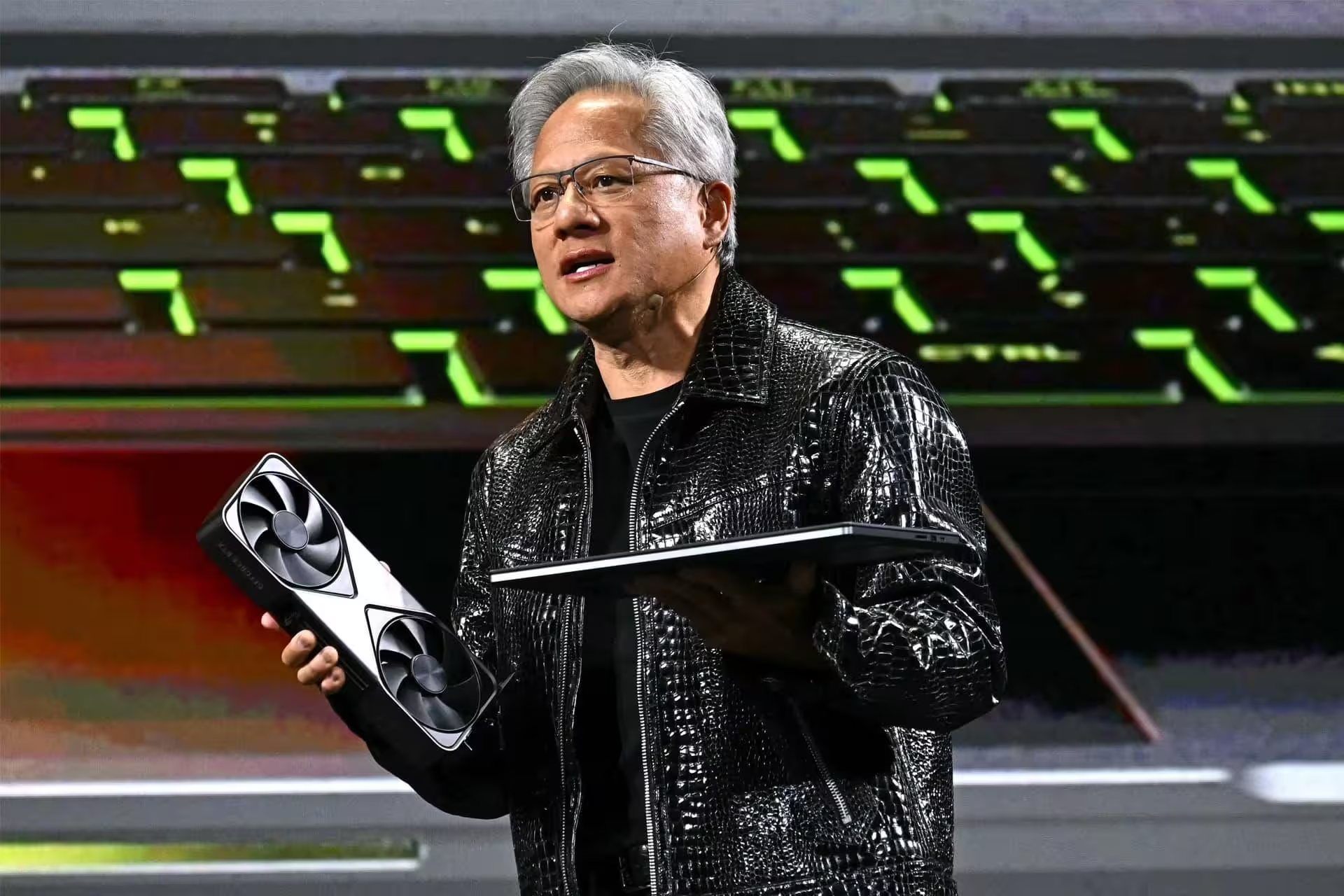
Because modern foundation models demand immense parallelism. Today’s cutting edge architectures often rely on clusters composed of tens of thousands of accelerators to reach competitive training runtimes. The ability to provision that much raw compute faster than rivals confers a practical advantage: faster iteration, quicker experimentation, and a shorter time to field real products that can outpace competitors.
There are logistical puzzles behind such a rapid deployment—supply chains, power and cooling, software orchestration, and on-the-ground teams working around the clock. xAI’s success suggests they solved those problems at an uncommon tempo. Whether by design or culture, the result was a functioning supercomputer capable of supporting large-scale model training in weeks not months.
Huang’s praise does two things. It acknowledges technical merit from a peer in the chip industry and it underlines the rising intensity of the compute arms race. Tech firms now measure progress not only by model quality but by how quickly they can scale the hardware that makes those models possible. Speed is part logistics and part strategy.
For observers, the episode is a reminder: raw compute remains a decisive resource in AI. Engineering bravado and operational excellence can translate into measurable lead time. And as companies chase ever-larger clusters, the real competition may be less about chips alone and more about who can integrate machines, people, and software into a working whole fastest.


“I love exploring gadgets, apps, and trends that redefine how we connect, work, and play in a digital world.”

Discussion
Leave a Comment
Comments
No comments yet. Be the first.