
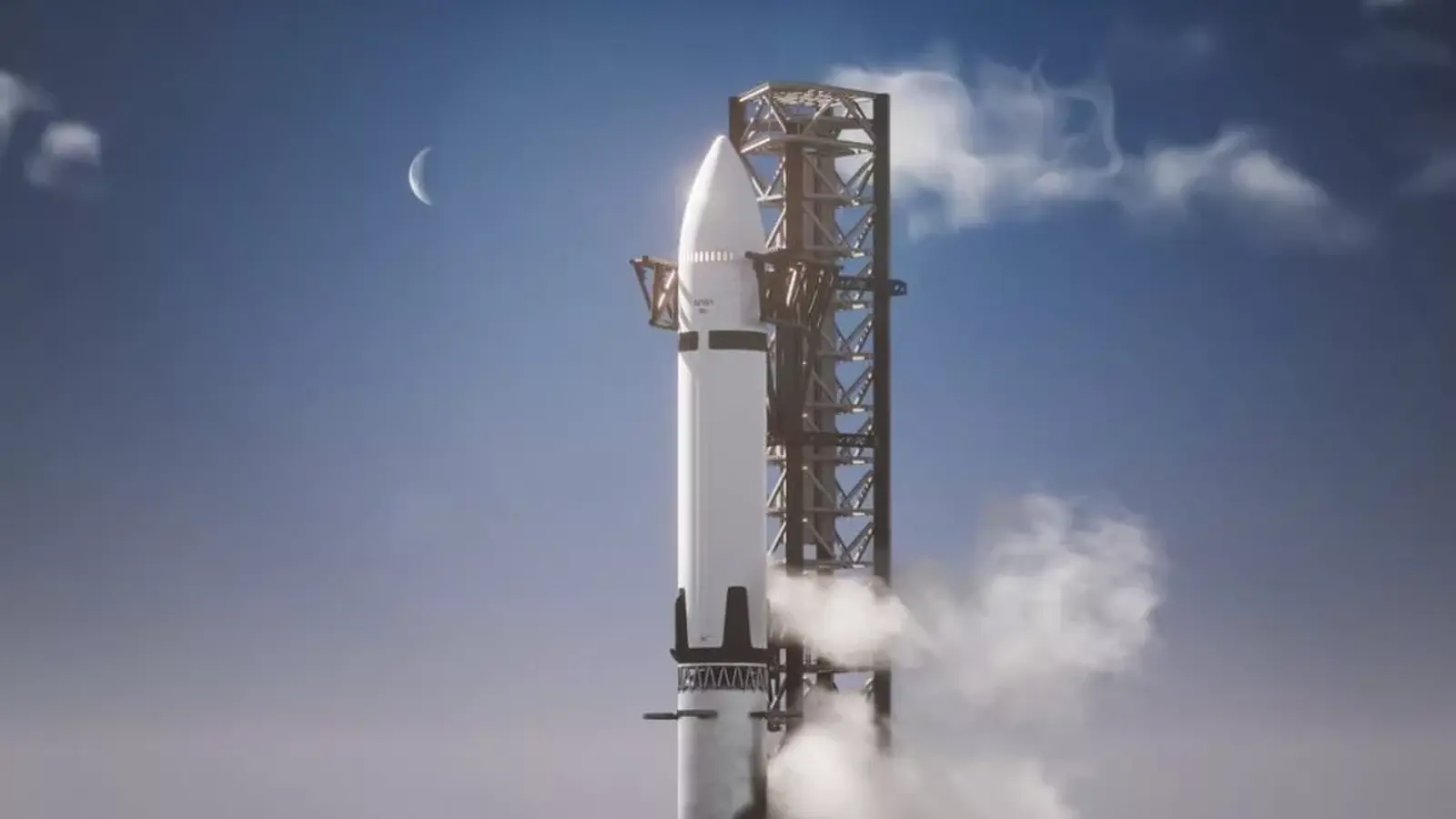
SpaceX has released new renderings of the interior of its Starship HLS — the Human Landing System variant intended to ferry astronauts from lunar orbit down to the Moon. The images underscore how large the vehicle could be, showing four astronauts seated beside windows and ample room to move, and they arrive as NASA prepares for the Artemis 3 mission aimed at returning humans to the lunar surface.
Room to work and live: a new kind of lunar lander
The published visuals highlight Starship’s unusually spacious cabin for a lunar lander. SpaceX’s HLS design stretches to roughly 10 meters in diameter, giving crew teams significantly more habitable volume than the Apollo lunar module. In its mission description, SpaceX points out that Starship can carry more people and much larger payloads than the Apollo lander — a capability that could transform how scientists stage equipment, habitats, and experiments at the lunar south pole.
Why size matters for Artemis 3
Imagine transferring from NASA’s Orion capsule in lunar orbit into a roomy lander with standing room, windows and cargo space — that’s the operational promise of Starship HLS. For Artemis 3, which aims to put astronauts on the Moon’s south polar region, internal volume helps with crew mobility, suit donning, and safe stowage of scientific instruments and sample containers. Larger payload capacity also means more advanced payloads — seismometers, rover components, and longer-duration life-support systems — could be delivered in a single landing campaign.

Technical hurdles: refueling, launches, and hard-surface landings
Despite the optimistic renderings, significant technical hurdles remain. SpaceX must demonstrate reliable orbital refueling for Starship: current planning indicates an HLS descent to the lunar surface will require staging multiple tankers in orbit, potentially up to ten Starship launches to assemble enough fuel before the trans-lunar descent. The company also needs to prove a controlled touchdown on a hard surface — tests have so far included a recent flight that ended with a soft ocean recovery about an hour after launch, but firm evidence of a safe, precise ground landing on solid terrain is still outstanding.
Schedule and program-level competition
NASA has targeted Artemis 3 for a 2028 timeframe. Whether the Starship HLS will be fully ready by then is uncertain. Development and pad infrastructure challenges have slowed work on the launch and landing systems. Meanwhile, NASA leadership has signaled openness to other providers: acting NASA Administrator Sean Duffy has noted the agency may also use alternatives such as Blue Origin, reflecting the program’s desire for redundancy and assured mission success.

Scientific and programmatic implications
If SpaceX’s Starship HLS proves operational, the mission architecture for lunar exploration could change fast. Larger-capacity landers reduce the number of launches needed for scientific hardware and could accelerate sustained presence at the Moon. But until orbital refueling, precision landings, and repeated flight demonstrations are routine, Starship remains a promising — but not yet proven — element of NASA’s return to the Moon.


“My work centers on sustainability, energy, and environmental science — examining how innovation can lead to a greener future.”

Discussion
Leave a Comment
Comments (2)
Nice visuals, windows and space look awesome. But they keep skipping hard landing proof, feels overhyped, need more demos asap
Orbital refuel x10? Really? Sounds risky, one failed tanker and mission stalls. How sure are they about precise landings tho…