
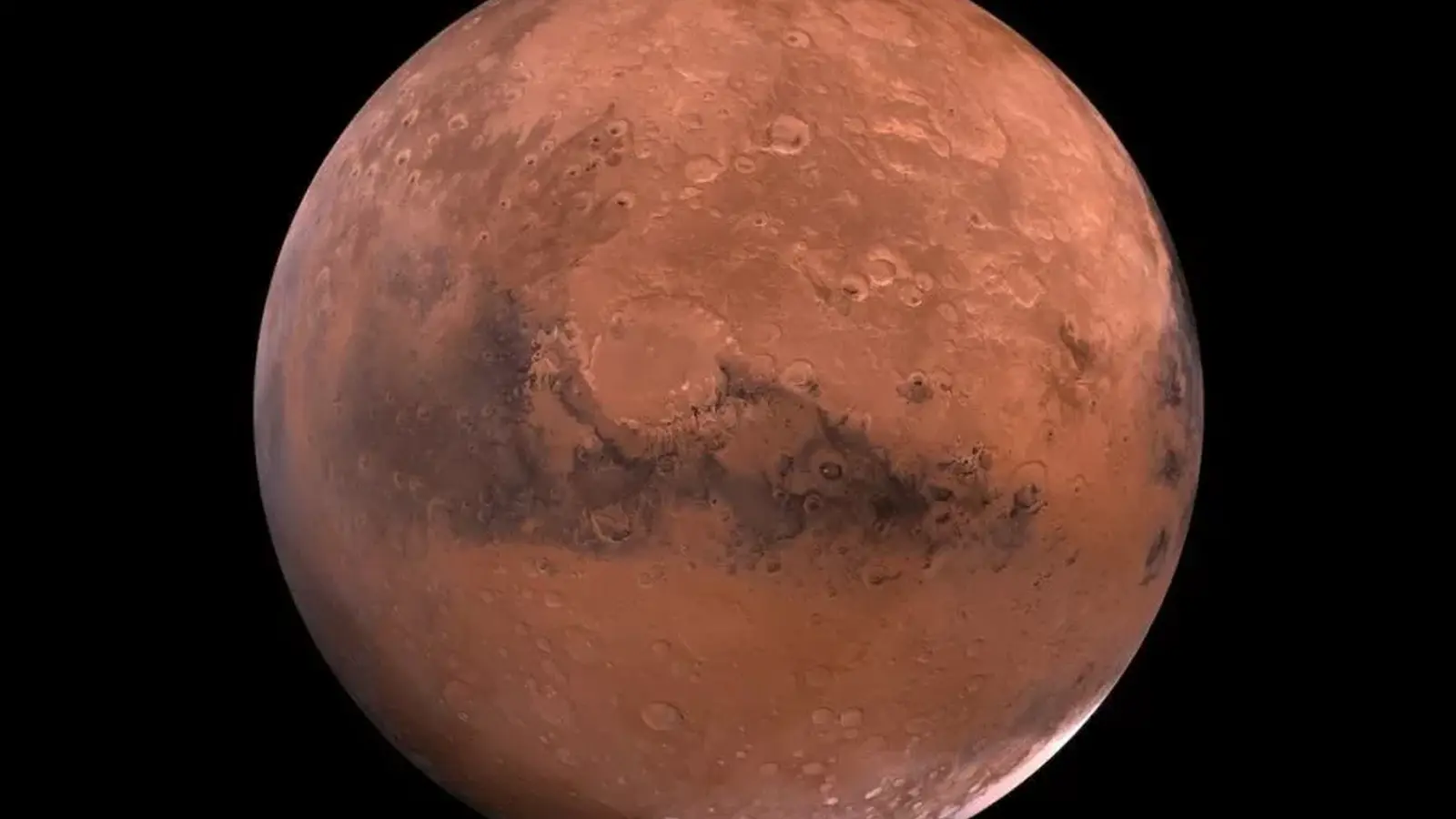
Albert Einstein’s prediction that gravity affects the flow of time is not just a thought experiment — recent calculations from U.S. scientists show it in action across the solar system. According to a new study, clocks on Mars tick slightly faster than identical clocks on Earth. That tiny mismatch—measured in microseconds per day—matters more than you might expect for navigation, communications and future interplanetary infrastructure.
Why clocks on Mars run faster
The effect springs directly from general relativity: mass curves spacetime and stronger gravity slows time. Because Earth is more massive and has a stronger gravitational pull than Mars, a clock sitting on Earth experiences greater gravitational time dilation and thus ticks more slowly compared with one on the Martian surface.
Researchers at the U.S. National Institute of Standards and Technology (NIST) solved a four-body problem that includes the Sun, Earth, Moon and Mars to compute the net relativistic effects on timekeeping. Their calculations show that, on average, time on Mars advances about 477 microseconds (µs) per day faster than on Earth. That average can vary by as much as 226 µs/day because Mars follows an elliptical orbit and its distance to the Sun changes.

Balancing effects: gravity vs. orbital motion
Two competing influences determine the final result. First, Mars’ weaker gravity tends to speed up clocks (the dominant factor). Second, Mars orbits the Sun more slowly and is further out, which also affects time but in the opposite direction. When scientists combine gravitational and kinematic relativistic effects for all four bodies, the net outcome still favors faster time on Mars.
For context: earlier work by the same team estimated that clocks on the Moon run about 56 µs/day faster than Earth’s.
Engineering consequences for exploration and communications
A few hundred microseconds per day seems negligible at human timescales, but modern navigation and telecom systems demand extreme precision. Global navigation satellite systems (GNSS) and advanced communication networks rely on timing accuracy on the order of tenths of a microsecond. If mission planners and engineers fail to account for a 477 µs/day offset, positioning errors for astronauts and rovers on Mars could grow to kilometers, and synchronization for an interplanetary internet would break down.
Space agencies will need to bake these relativistic corrections into Martian GPS designs, time-transfer protocols, and network clocks well before large-scale human missions or colonies become reality. The study was published in The Astronomical Journal and underscores how fundamental physics directly constrains practical engineering in space.
Broader implications and next steps
This research illustrates a recurring theme in space science: tiny relativistic effects accumulate and must be corrected for precise systems. As we expand persistent robotic and human presence beyond Earth, accurate timekeeping across planets will be as essential as reliable power and propulsion. Future work will refine models by including additional perturbations, spacecraft motion, and localized geology-related gravitational anomalies on Mars.
In short, Einstein’s century-old insight continues to guide 21st-century engineering—reminding us that timekeeping in space is both a physics problem and a critical technology challenge.


“The cosmos has always fascinated me. I write about space missions, astronomy, and the technologies pushing humanity beyond Earth.”

Discussion
Leave a Comment
Comments (2)
Is this even true? 477 microseconds seems tiny, can that really cause km-level errors? curious how they fold in sensor noise, local mass anomalies...
man, wow.... clocks on Mars faster by 477 µs/day? Mind blown, and this actually matters for GPS? if we mess that up astronauts could get lost, wild