

Elon Musk has once again framed SpaceX's Starship as more than just a rocket — he argues it could be ranked among the pivotal events in the history of life on Earth. Speaking recently on a podcast, Musk described Starship's design and potential to enable rapid, full reusability as a technological leap whose long-term importance is not yet fully appreciated.
Why Musk calls Starship a historic milestone
Musk told the podcast audience that Starship represents a new class of launch architecture: a vehicle designed for repeated, rapid reuse at large scales. In his view, that change in accessibility to space could place human expansion to other worlds alongside major evolutionary and geological milestones — items like the rise of single-celled life, multicellularity, and the acquisition of mitochondria in early cells.
Put simply, lowering the cost and increasing the cadence of launches is what makes Starship central to these claims. A fully reusable heavy-lift vehicle capable of carrying large payloads to orbit — and beyond — would reshape how scientists, industry and governments plan Moon and Mars missions, large-scale space telescopes, and even industrial activity off Earth.

Technical reality: breakthroughs and setbacks
Design and capabilities
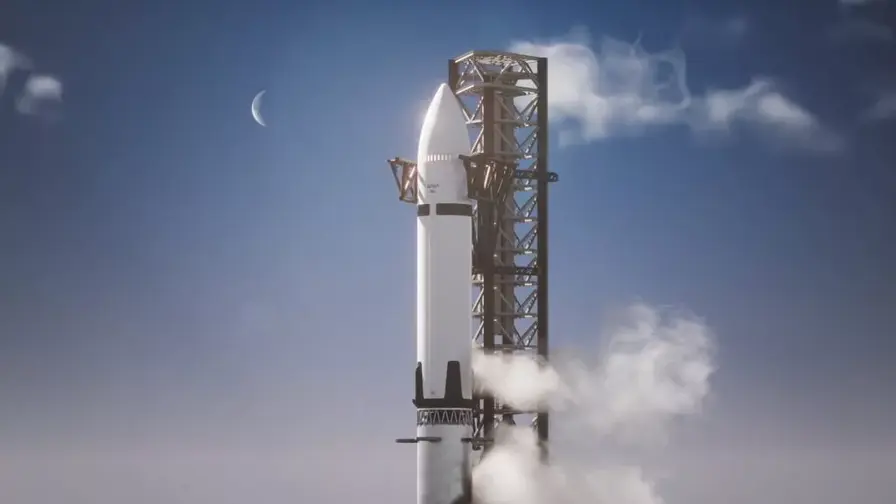
Starship combines high-thrust Raptor engines, stainless-steel construction, and large-volume cargo capacity to pursue ambitious goals: crewed Mars missions, lunar landings, and bulk cargo delivery to orbit. The architecture emphasizes full reusability to drive down marginal launch costs — a key metric for sustained interplanetary operations and satellite deployment at scale.
Flight tests and challenges
However, the program has been marked by difficult test flights. Multiple prototypes experienced failures during ascent, staging or landing phases. These high-profile setbacks have prompted agencies like NASA to evaluate alternate designs for the Artemis lunar lander program while SpaceX iterates on Starship hardware and software.
- Why the failures matter: rocket development frequently involves destructive tests to find design limits and software bugs early.
- Why the successes matter: each incremental improvement moves reusable, high-capacity launch closer to operational reality.
Implications for exploration and industry
If Starship achieves reliable reusability, the implications span science and commerce. Lower launch costs would expand opportunities for planetary science missions, large observatories, and sustained human presence on the Moon and Mars. For advocates of a "multi-planetary" future, that capability is the strategic enabler for long-term human settlement beyond Earth.
Whether historians decades from now will place Starship among the top evolutionary or technological events depends on the program's long-term success and how broadly it changes access to space. For now, the debate blends engineering realities with big-picture visions about humanity's future in the solar system.

“My work centers on sustainability, energy, and environmental science — examining how innovation can lead to a greener future.”

Discussion
Leave a Comment
Comments
No comments yet. Be the first.