
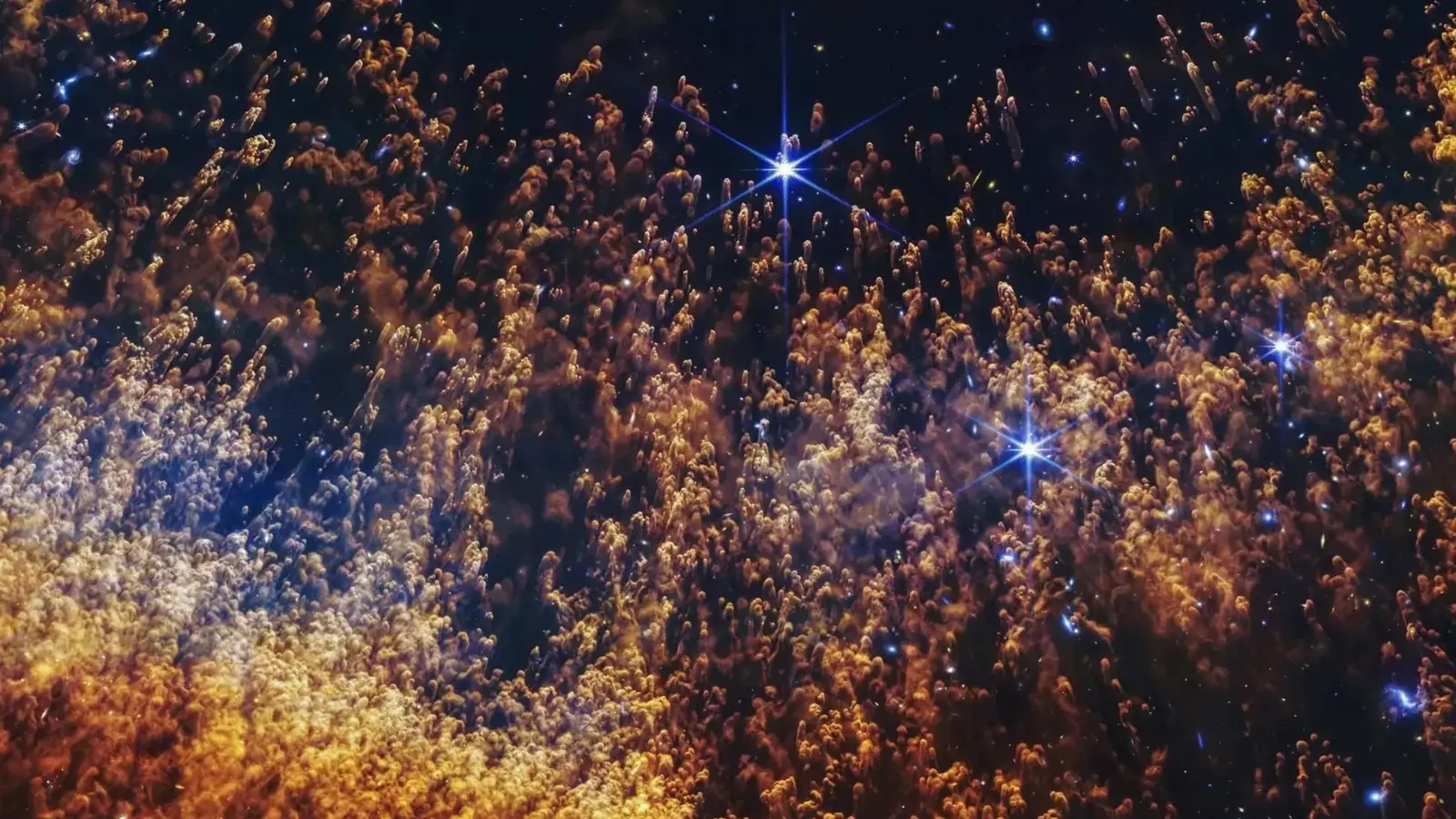
The new James Webb image of the Helix Nebula feels like a close-up portrait of a dying star—intimate, detailed, and oddly beautiful. Tiny comet-like pillars stream away from a hot central white dwarf. They look delicate, but they are the workhorses of a vast recycling system that will seed future generations of stars and planets.
What Webb shows and why it matters
Often called the "Eye of God" or the "Eye of Sauron," the Helix Nebula is one of the nearest and most photographed planetary nebulae. Webb’s near-infrared camera (NIRCam) has peeled back layers that earlier telescopes only hinted at, revealing thousands of dense, knotty structures—so-called cometary knots—whose tips face the central star and whose tails stream outward. Some are burnt orange. Others glow gold. These colors are not ornamental; they map temperature and chemistry across the nebula.
Close to the white dwarf, ultraviolet radiation ionizes gas and makes it shine with a blue-white glow. Move outward and temperatures fall. Molecular hydrogen begins to dominate, radiating in the near-infrared and registering as yellowish hues in Webb’s filters. Farther still, cooler dust—reddish in the image—marks regions rich in solid grains that can act as the raw material for future planets. The picture, in short, is a cross-section of dying-star physics and galactic recycling in action.

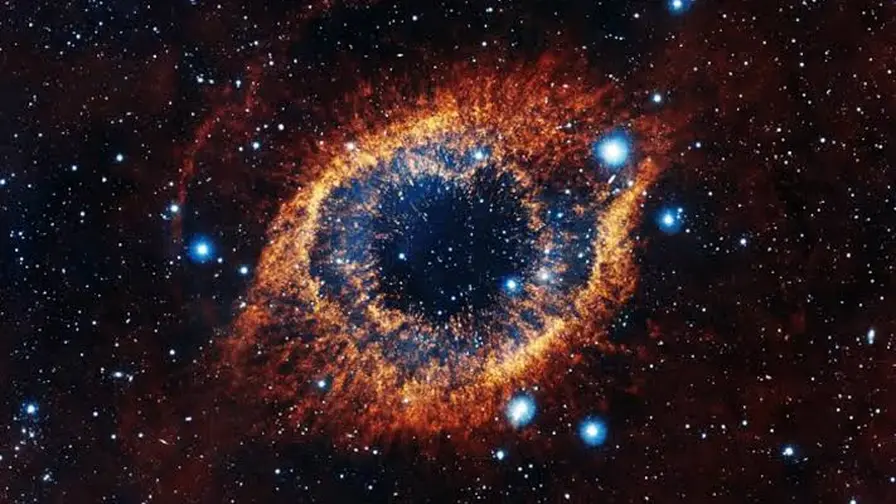
Planetary nebulae are misnamed relics. They are not planets. They are the outer layers of stars—mainly hydrogen and helium, with heavier elements mixed in—that a sunlike star sheds as it exhausts nuclear fuel. At the center remains a compact, hot white dwarf that bathes that expanding shell in intense radiation, sculpting it into rings, filaments, and knots. The Helix Nebula’s spiral-like morphology and its dense cometary knots are perfect laboratories for studying how mass loss, radiation pressure, and gas dynamics interact at the end of a star’s life.
Beyond aesthetics, the physics is consequential. The expelled envelope carries carbon, oxygen and nitrogen—elements forged during stellar evolution—back into the interstellar medium. These are the same elements essential for rocky planets and, ultimately, life as we know it. In that sense, the Helix Nebula is less a funeral pyre than a cosmic compost heap, enriching the galaxy one stellar death at a time. And yes: this provides a plausible sketch of our Sun’s fate in roughly five billion years, when it expands into a red giant and leaves behind a white dwarf wrapped in a similar glowing shell.
Instruments, filters and the science behind the colors
Webb’s near-infrared observations use multiple filters to tease apart temperature and molecular signatures. Different wavelengths highlight distinct components: hot ionized gas near the white dwarf; warm molecular hydrogen in the knotty tails; and cool dust grains farther out. Although human eyes cannot see these wavelengths, astronomers translate them into visible colors to emphasize physical contrasts. The result is both scientifically informative and visually striking.
These detailed views also show how fast stellar winds from the dying star interact with previously expelled, slower-moving shells. The cometary knots act as miniature shields. When high-speed winds slam into denser, cooler clumps, they carve out tails and compress the clumps’ heads. Under compression, conditions can become favorable for the formation of more complex molecules—stepping stones toward the organic chemistry that eventually appears in star-forming regions.
Context matters. Webb does not operate in isolation. Comparisons with Hubble optical images and X-ray views from Chandra, for example, allow scientists to build a multiwavelength picture of the Helix Nebula’s structure and evolution. Together, these datasets refine models of mass loss and help quantify how much material returns to the interstellar medium from a single solar-mass progenitor star.
Expert Insight
"What Webb gives us is clarity," says Dr. Elena Marquez, an astrophysicist who studies late-stage stellar evolution. "We can now trace how radiation sculpts clumps on sub-astronomical-unit scales, and that feeds directly into models of dust survival and molecule formation. Those details change our estimates for how efficiently dying stars enrich the galaxy with planetary building blocks."
Looking ahead, deeper and complementary observations—spectroscopy to measure chemical abundances, time-series imaging to watch changes, and higher-resolution mapping of dust grains—will sharpen our understanding of how common structures like the Helix’s knots are and what they portend for planet formation. For the public, the image is a reminder: star death is not silent or wasteful. It’s an act of creation on a cosmic timescale, transforming stellar ashes into the seeds of future worlds.
When you look at Webb’s view of the Helix, you’re not just seeing a nebula. You’re watching a star hand its legacy back to the galaxy—slowly, beautifully, and inexorably.

“My work centers on sustainability, energy, and environmental science — examining how innovation can lead to a greener future.”

Discussion
Leave a Comment
Comments (2)
Are those colors real or just translations? Looks stunning but how much is art vs data? I wonder if ppl will mistake color mapping for actual sight
Wow, that Webb shot is haunting and weirdly tender. The comet-knots look fragile but so important. Feels like cosmic recycling, makes me think of our sun someday… kinda sobering, not just pretty