
5 Minutes
Picture a once-ordered family of moons circling a distant ice giant, an elegant clockwork of circular orbits and predictable paths. Then imagine a new, enormous body arrives on a backward, slicing trajectory and shatters that order. Chaos follows. That is one plausible origin story for Nereid, Neptune's eccentric, oddball moon.
Neptune stands out among the gas giants. It tilts oddly and hosts moons unlike those around Jupiter or Saturn. Triton, Neptune’s largest satellite, spins the wrong way. Its retrograde orbit marks it as an interloper, almost certainly born in the Kuiper Belt and later captured by Neptune’s gravity. That capture may have been violent enough to wipe out most of Neptune’s original satellite system.
Fresh eyes on an old mystery
Nereid has long been a puzzle. Discovered by Gerard Kuiper in 1949, it remained Neptune’s only known companion aside from Triton until Voyager 2’s 1989 flyby. The Voyager image is still our best close-up record of Nereid.

Our best ever image of Nereid, taken by the Voyager 2 probe in 1989.
Its 360-day, highly elliptical orbit made many astronomers assume Nereid was itself a captured Kuiper Belt Object. But new observations with JWST’s Near-Infrared Camera changed that calculus. When astronomers aimed JWST at Nereid for the first time in infrared light, the moon’s surface told a different story.
Instead of the dark, rough, carbon-rich signature expected of captured KBOs like Phoebe around Saturn, Nereid shows abundant, water-rich ice signatures and crater textures more akin to native icy moons of Uranus and Saturn. In short, Nereid looks like something that formed near Neptune, not far beyond it.
When simulations recreate violence
Observations alone do not explain Nereid’s strange path. To probe cause and effect, the research team turned to dynamical modeling with the REBOUND integrator. They started with a hypothetical, orderly Neptunian moon system: dozens of small moons on near-circular, prograde orbits. Then they introduced Triton as a captured KBO on a highly eccentric retrograde trajectory.
The result was devastation. Collisions, gravitational slingshots, and ejections followed. Most of the original moons either smashed into pieces or were flung out of the system. The simulations show that debris from this violent era could settle into the faint rings we see today and spawn small, irregular satellites such as Proteus.
Crucially, the models also produced rare survivors. In about one-fifth of simulated runs, one moon avoided total destruction but was gravitationally kicked into a distant, highly elongated, and tilted orbit. That outcome closely mirrors Nereid’s present-day trajectory.
What Nereid can teach us
If Nereid is indeed a native moon displaced by Triton’s capture, it becomes a valuable time capsule. Because its new orbit kept it relatively isolated, its surface and internal structure may preserve evidence of Neptune’s primordial satellite system and the conditions that prevailed during the planet’s early evolution.
That makes Nereid more than an eccentric curiosity. It becomes a witness to a cataclysmic reshaping of a planetary system, one that transformed Neptune’s moon architecture in a single dramatic episode.
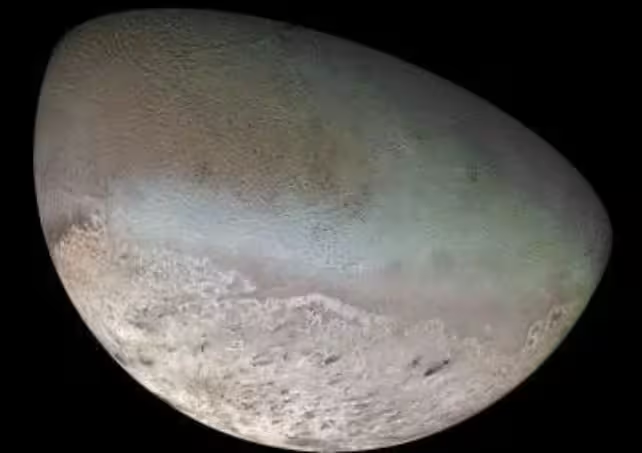
A global color mosaic of Triton, taken by Voyager 2 in 1989.
Why this matters for planetary science
Understanding whether a moon is captured or native matters for reconstructing the Solar System’s family history. Captured bodies tell us about outer-disk populations and migration processes. Endogenous moons reveal local formation physics and the circumplanetary environments that build satellites. Reclassifying Nereid from captured outsider to battered native reframes how we read Neptune’s past.
It also underlines the power of combining high-resolution infrared spectroscopy and dynamical modeling. JWST supplied the fingerprint; REBOUND supplied the forensic reenactment. Together they produce a coherent narrative that resolves a decades-old ambiguity.
Expert Insight
"Finding native ice signatures on Nereid changes the questions we ask," says Dr. Lara Menon, an imaginary planetary dynamicist with two decades studying outer planet systems. "We no longer start from the assumption that every eccentric satellite is captured. Instead, we look for dynamical paths that can preserve a moon while upending its orbit. That opens new routes to probe early satellite formation around ice giants."
Her point underscores a practical reality. Direct exploration remains the gold standard. Remote sensing and simulations give strong, converging evidence. But only an in-situ mission could sample surface materials, measure internal structure, and date events precisely.
Conclusion
JWST’s infrared view and targeted simulations suggest a striking conclusion: rather than being an interloper from the Kuiper Belt, Nereid is likely a survivor of a violent makeover of Neptune’s moons triggered by Triton’s arrival. If so, Nereid is not merely odd. It is a preserved witness to a moonpocalypse that remade an entire satellite system. Future missions to the ice giants would turn that witness into a primary source, and our picture of how planetary systems evolve would grow sharper as a result.
Source: sciencealert


Comments
skyspin
whoa, moonpocalypse? didnt see Triton as such a party crasher coming lol. Nereid surviving is wild now I want close pics.

Leave a Comment