
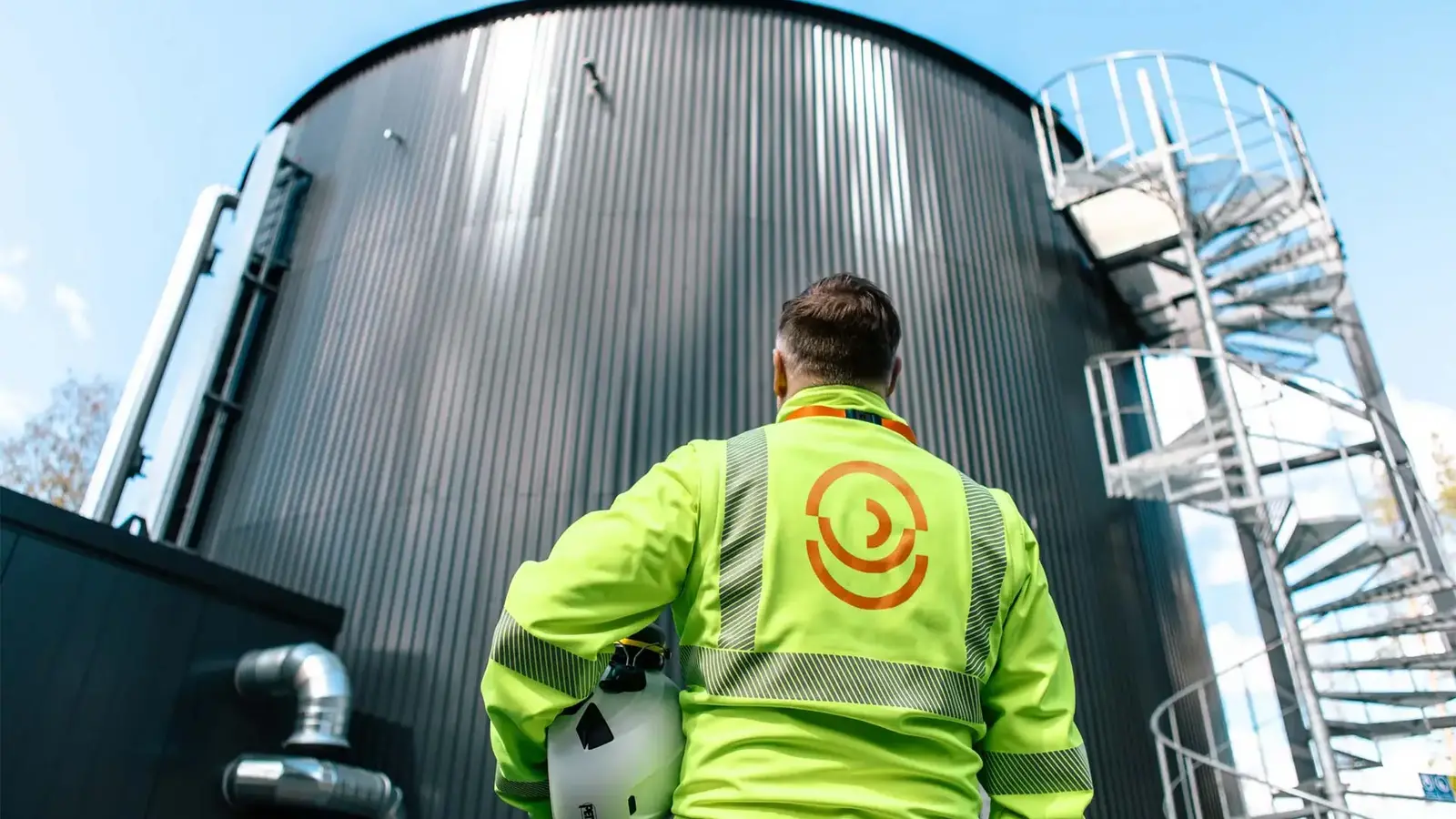
A tall steel cylinder filled with 2,000 tonnes of crushed soapstone is quietly changing how a Finnish town keeps warm. It looks ordinary from a distance. Up close, it is an experiment in patience and physics: surplus wind and solar energy is turned into heat, stored for weeks, then released as hot water or steam when people need it most.
How the sand battery stores renewable energy
The device in Pornaainen, a town near Helsinki, is a thermal storage system built by Polar Night Energy and operated by Loviisan Lämpö. The structure measures roughly 13 metres tall and 15 metres across and holds soapstone, a metamorphic rock chosen for its high heat capacity and stability. When renewable sources produce more electricity than the grid requires, electric heaters pump heat through pipes buried in the rock bed. The energy stays trapped as sensible heat and can remain useable for hours, days or even weeks.
When demand rises, the stored heat is recovered as hot water, steam or warm air for district heating or industrial use. Think of it as a seasonal battery that trades electrons for calories; the conversion losses are surprisingly small. Measured over its first year, the unit delivered above 85 percent round-trip efficiency, meaning most of the energy put in could be taken back out when required.
That practical simplicity is part of the appeal. Soapstone is abundant, the construction uses well-known materials and the system requires no rare metals or complex chemistry. Maintenance is mechanical and electrical rather than chemical. In an energy system where intermittency is a persistent problem, such a thermal reservoir directly addresses timing mismatches between production and consumption.

Real-world performance from the first year
Commissioned in June 2025, the Pornaainen sand battery quickly exceeded expectations. Polar Night Energy reports the system met all its performance targets and enabled a roughly 70 percent reduction in greenhouse gas emissions from the local heating network. During summer months it stored roughly a month’s worth of the town’s heat demand; in winter it covered about one week of peak heating need.

Loviisan Lämpö’s CEO, Miko Pajanan, said, "The first year was even better than we expected. Start-up went smoothly and the system showed excellent operational reliability. There were no interruptions to district heating supply."
The operational statistics were similarly strong: uninterrupted reliability for regional heating, a sixty percent cut in biomass consumption and the complete elimination of oil from the heating mix. Those figures point to both environmental and economic benefits. In certain periods, operators could charge the system using electricity priced 70 to 80 percent below the market average, and in some months the discount exceeded 90 percent. That flexibility dampens price spikes and provides resilience against supply shocks.
So why does this matter beyond one Finnish town? Because district heating is a major component of many northern European energy systems. Replacing fossil fuels and cutting biomass use at scale would significantly lower national emissions while smoothing demand for the electricity grid. Sand batteries can absorb surplus renewable generation, preventing curtailment and making wind and solar farms more valuable.
Expert Insight
Dr. Elena Koskinen, an energy systems researcher at Aalto University, commented on the technology’s role in decarbonisation: "Thermal storage like this translates cheap, abundant renewable electricity into a reliable heat supply. It is not a magic bullet, but it is a pragmatic tool. The key questions now are scale and integration. If planners combine sand batteries with demand response and smarter heat networks, the gains add up quickly."
Her point underlines a central challenge: scaling from demonstration to mainstream deployment. Larger cities and denser networks present different technical and regulatory constraints. Space, connection points and interaction with existing heat plants all affect feasibility. Still, the Finnish case offers a working template for other municipalities considering a shift from fossil or biomass fuels toward renewables.
Conclusion

The Pornaainen sand battery shows that long-duration thermal storage can be efficient, robust and cost-effective in real operating conditions. It also demonstrates how straightforward engineering—steel, pipes and rock—can unlock strategic advantages for renewable integration: lower emissions, reduced fuel consumption and cheaper systemic energy costs during surplus periods. The next step will be replication and adaptation: larger arrays, different geological conditions and tighter coupling with grid operations. If those follow, sand batteries could become a practical building block of decarbonised heating systems across cold-climate regions and beyond.

“My work centers on sustainability, energy, and environmental science — examining how innovation can lead to a greener future.”

Discussion
Leave a Comment
Comments (2)
Sounds neat but is this really city-friendly? 13m x 15m per unit eats space, plus grid rules, permits and uptime worries. Want hard data on long-term losses.
wow a sand battery! 85% round trip is nuts. Love the simple tech, but curious about rock settling, pipe corrosion over years, and who pays for scaling up..?