
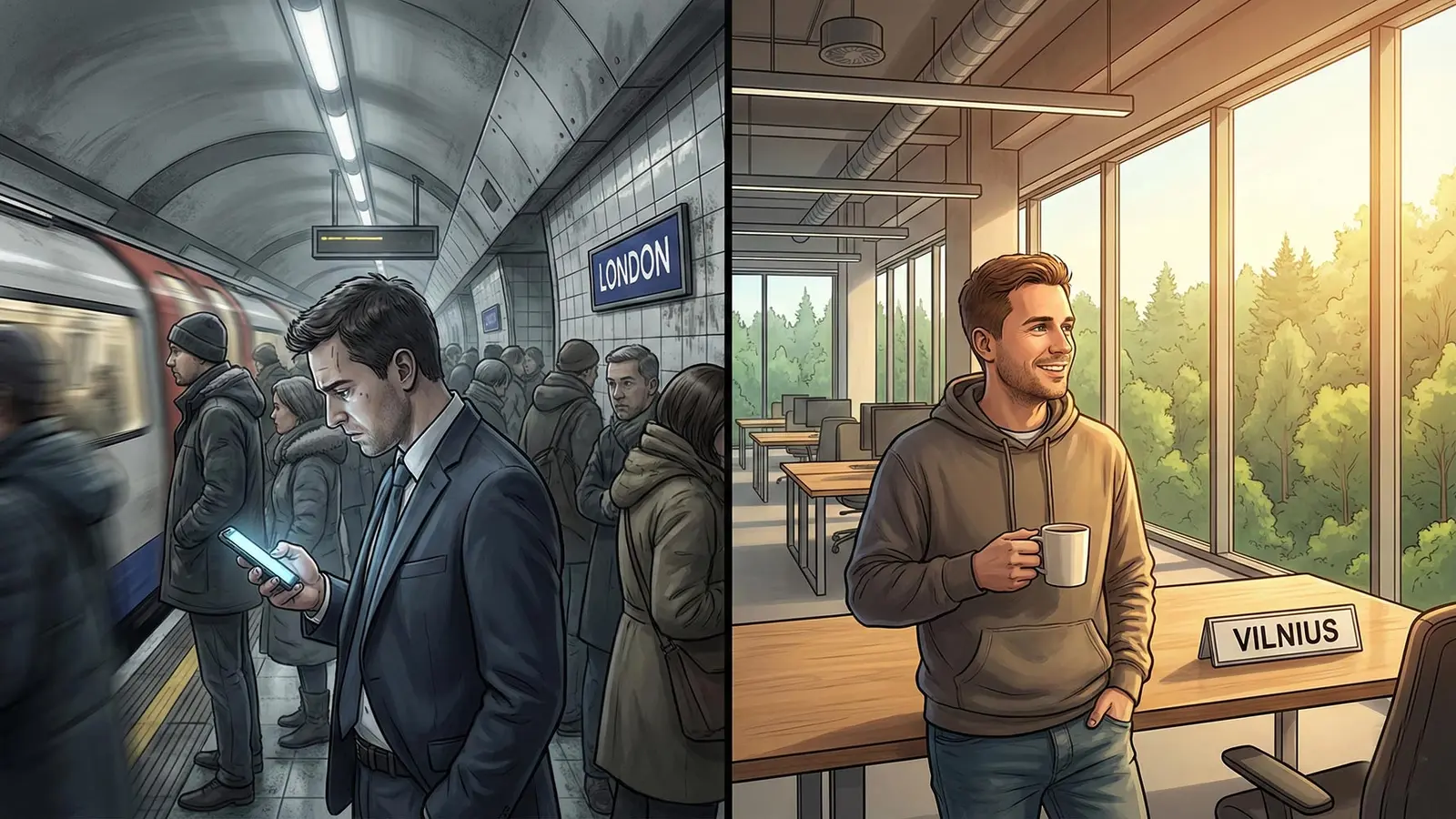
For two decades, the flow of talent in Europe was a one-way street. It was a simple, brutal law of physics: gravity pulled everything West. If you were a brilliant coder in Krakow, a visionary product manager in Bucharest, or a cybersecurity genius in Kaunas, your destiny was written in a boarding pass to London, Berlin, or Amsterdam. The East was for outsourcing; the West was for headquarters.
But as we stand here in late 2025, looking ahead to 2026, the gravitational poles have shifted. The "Brain Drain" that plagued Central and Eastern Europe (CEE) since the 90s has not just stopped; it has reversed. We are witnessing "The Great Return."
Why are senior engineers packing up their apartments in Kreuzberg and Shoreditch to move back to Žirmūnai and Mokotów? The answer isn't just nostalgia—it’s cold, hard economics.
In this deep dive, Smarti Live analyzes the socio-economic tectonic shift that is turning the Baltics and CEE into the new "Quality of Life" capitals of European Tech.
Part I: The Purchasing Power Illusion
Let’s start with the money. For years, the argument for moving to London was the salary. "You can make £90,000 in London versus €45,000 in Vilnius!" recruiters would scream.
In 2026, smart talent has stopped looking at the "Gross Salary" and started looking at "Disposable Income."

Following the inflationary crises of 2023-2024, the cost of living in Western Europe didn't just rise; it exploded. Let’s look at the math of a Senior Backend Engineer (5+ years experience) in late 2025:
London Scenario:
Salary: £110,000 (€128,000)
Tax (approx): 40%
Rent (1-bedroom, Zone 2): £2,800/month
Commute & Utilities: £600/month
Quality of Life: 1-hour commute on a crowded tube, small apartment, high crime rates.
Disposable Income: High on paper, low in reality.
Vilnius Scenario:
Salary: €68,000 (Senior level in 2025)
Tax: Significantly optimized (tech incentives).
Rent (Luxury loft in Old Town/Naujamiestis): €1,100/month
Commute: 15 minutes (often walkable or e-scooter).
Quality of Life: Forest proximity, safety, modern infrastructure.
Result: A developer in Vilnius might save more absolute cash at the end of the month than their counterpart in London, while living like a king rather than a student.
As Lukas, a Product Lead who recently moved back from Berlin to Vilnius, told us:
"In Berlin, I was sharing a flat at 32 years old because the housing market was broken. In Vilnius, I bought a house near the forest within two years. The salary number is smaller, but my life is bigger."
Part II: The "Glass Ceiling" Has Shattered
Ten years ago, if you wanted to work on "world-changing" technology, you had to leave. The Baltics were seen as "Code Monkeys"—good at executing tickets, bad at strategy.
That narrative is dead.
By 2026, the region has produced a staggering number of Unicorns and "Soonicorns." We are not just talking about Vinted or Nord Security anymore. We are seeing deep-tech, defense-tech, and biotech firms leading global innovation from this region.
The "Headquarters" Shift: Companies like Bolt (Estonia) or UiPath (Romania roots) proved you can scale globally from here.
The Seniority Trap: In London or Silicon Valley, a talented Lithuanian developer often hits a "foreigner ceiling." They are excellent engineers but rarely promoted to VP or C-level over locals. Upon returning to Vilnius or Warsaw, these professionals are instantly slotted into CTO, VP of Engineering, or Co-Founder roles. They are trading a "small fish in a big pond" status for "architect of the ecosystem" status.
Part III: The Burnout Epidemic and The "Slow" Life
Western Europe is tired. If you talk to tech workers in Paris or Berlin in 2025, the prevailing sentiment is exhaustion. Strikes, failing public transport infrastructure (looking at you, Deutsche Bahn), and bureaucratic nightmares have chipped away at the "Western Dream."

Conversely, cities like Vilnius, Tallinn, and Wrocław have optimized for "Frictionless Living."
The 15-Minute Reality: It is not a buzzword here; it is city planning. You can drop your kids at a high-quality international school, go to the gym, and be at your desk by 9:00 AM without stress.
Digital Governance: While Germans are still faxing documents in 2025, residents in the Baltics are signing mortgages and registering cars with a thumbprint on their phones. For a tech-native generation, living in an analog bureaucracy is torture. They are coming back to where the society runs on the same operating system as they do: Digital First.
Part IV: Safety and Geopolitics – The Paradox
We must address the elephant in the room: The War. In 2022, when the geopolitical situation in the region heated up, many predicted a mass exodus. The opposite happened.
The threat created a sense of "Resilient Community." The tech sector in Lithuania and Poland became deeply integrated with national defense and security. There is a sense of purpose here that is lacking in the West. Engineers aren't just building another food delivery app; they are building cybersecurity shields, drone software, and critical infrastructure resilience.
Furthermore, regarding physical safety: crime rates in major Western cities have spiked. For young families, the clean, safe streets of Vilnius or Warsaw—where you can walk alone at 3 AM without fear—are a luxury that money in London cannot buy.
Part V: The Ecosystem Matures (B2B over B2C)
The startups of 2015 were about "Growth at all costs." The startups of 2026 in this region are about "Unit Economics" and "B2B Efficiency."
The region has pivoted to its strengths:
Fintech & Compliance: Lithuania is the undisputed king here.
SaaS & Manufacturing: The Czech Republic and Poland.
Cybersecurity: Estonia and Lithuania.
This maturity attracts a different kind of talent. We aren't just attracting 22-year-old graduates anymore. We are attracting the 35-year-old Senior Architect with a spouse and two kids. This demographic shift is permanent. They aren't here for a gap year; they are here to build roots.
Conclusion: The New Center of Gravity
The outdated map of Europe showed a wealthy, innovative West and a developing, imitative East. Tear that map up.
As we head into 2026, the lines have blurred. The "North-East Tech Corridor" (connecting the Nordics with the Baltics and Poland) is becoming the most dynamic, digital, and livable region on the continent.
For the talent returning home, it’s not a retreat. It’s an upgrade. They have realized that the "American Dream" or the "London Dream" was just good marketing. The reality is being built right here, on the banks of the Neris, the Vistula, and the Baltic Sea.

“The cosmos has always fascinated me. I write about space missions, astronomy, and the technologies pushing humanity beyond Earth.”

Discussion
Leave a Comment