
People often ask which single event produced the loudest sound ever recorded on Earth. The short answer is: it depends. ‘Loudest’ can mean the highest pressure at the source, the greatest decibel level measured near human ears, or the most globally detectable acoustic pulse. Natural disasters, cosmic impacts and even laboratory blasts all compete—each measured differently and each revealing limits of our instruments and vocabulary.
Historic contenders: Krakatoa, Tunguska and Hunga Tonga
When historians and scientists list the loudest known events, three stand out. The 1883 eruption of Krakatoa (Krakatau) in Indonesia, the 1908 Tunguska airburst over Siberia, and the 2022 underwater eruption of Hunga Tonga–Hunga Ha'apai all produced enormous pressure waves that propagated across the globe.

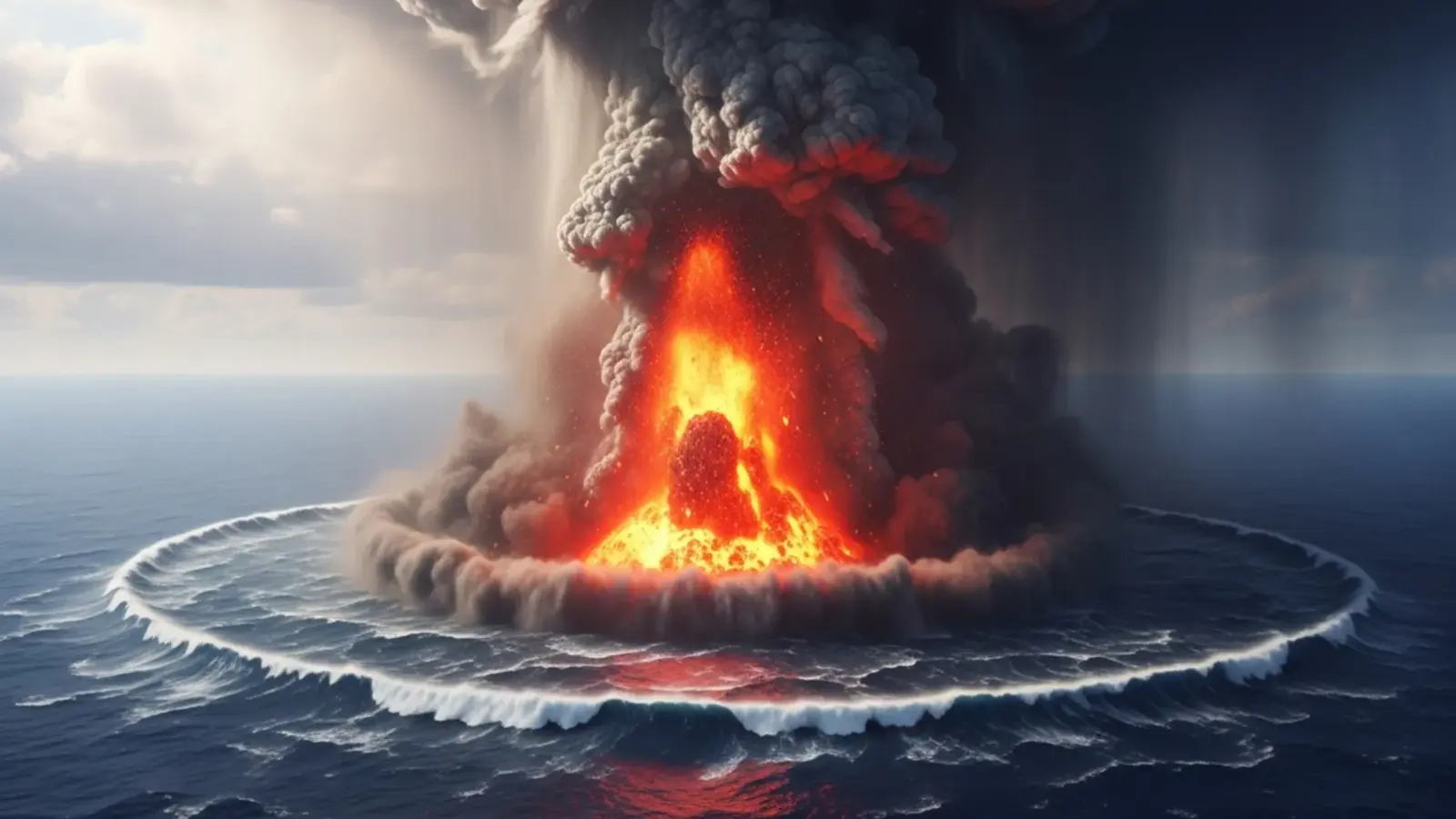
Image: The underwater eruption of Hunga Tonga–Hunga Ha'apai produced one of the loudest recorded sounds in history.
Krakatoa is the classic example most people learn about. Contemporary accounts reported the blast was heard more than 3,000 kilometres away; barometers worldwide recorded the pressure pulse; and sailors closer to the island later claimed that the sound could rupture eardrums. Modern reconstructions estimate the Krakatoa explosion reached effective levels near 310 decibels—an almost unimaginable figure—while its shock wave reportedly circled the planet multiple times.
Tunguska is a different kind of candidate: a rapidly moving meteoroid or small comet exploded in the atmosphere over Siberia in 1908, flattening forests across hundreds of square kilometres. The energy release is estimated to be comparable to a large explosion on the order of many megatons of TNT, and pressure transients consistent with a very loud blast were registered at distant observatories. Reconstructed peak intensities put Tunguska in the same ballpark as Krakatoa—roughly 300–315 decibels by some estimates—though again, no one was close enough with modern instruments to directly measure the source peak.
In the modern era, with dense global monitoring networks and digital data, one event stands out: the undersea eruption of Hunga Tonga–Hunga Ha'apai in January 2022. That blast generated a powerful acoustic and shock wave that circled the Earth multiple times and was detected by instruments—and even heard—thousands of kilometres away, from Alaska to central Europe.
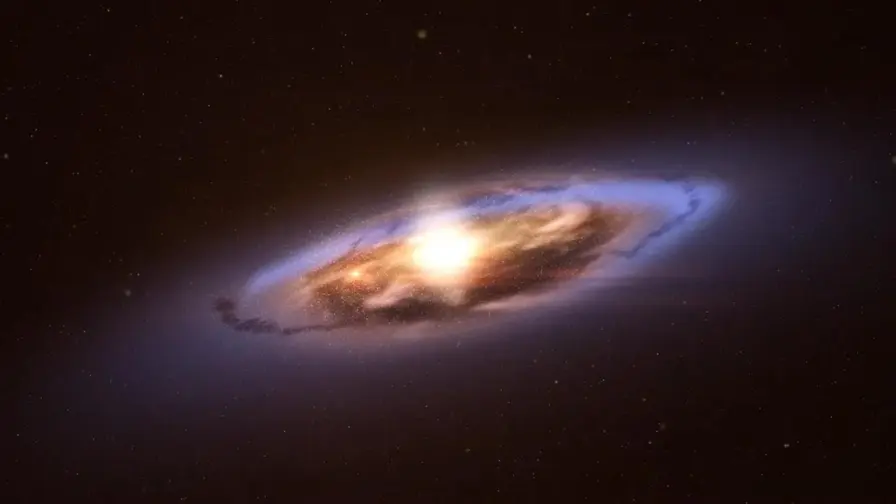

Image: A view of Mount Krakatoa in Indonesia; its 1883 eruption is often cited among the loudest sounds on record.
How do scientists define and measure “loudest”?
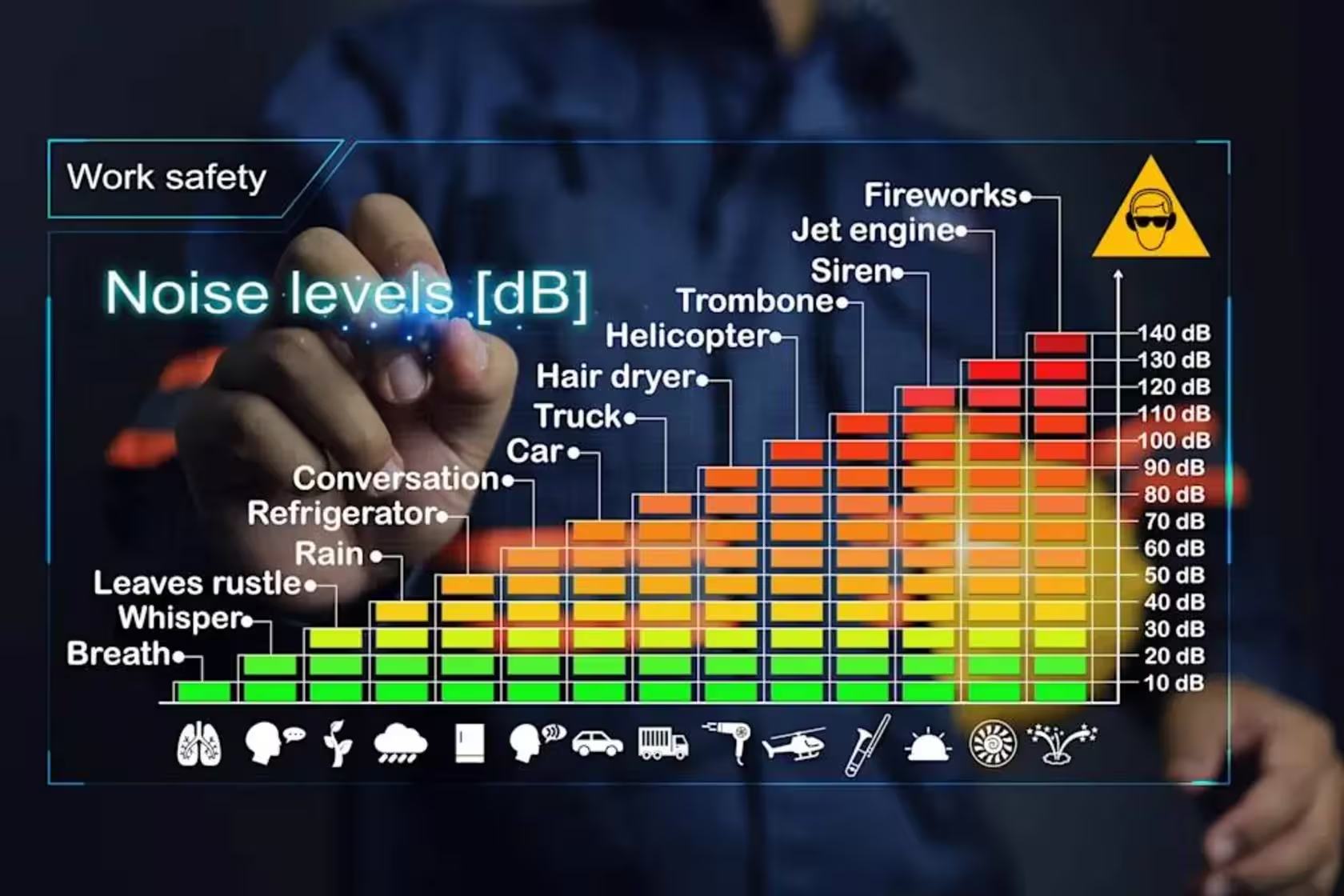
Part of the confusion is definitional. Decibels (dB) are a logarithmic measure of sound pressure level relative to a reference pressure. Human hearing is roughly between 0 dB (threshold of hearing) and about 120–140 dB (pain threshold, depending on frequency and duration). But extreme events produce pressure pulses and shock waves that do not behave like everyday sound. Around 194 dB in air, ordinary sound waves begin to form shock fronts—sharp, nonlinear jumps in pressure similar to those produced when objects move faster than sound.
For historical eruptions and explosions, researchers often reconstruct source pressures from distant instruments (barometers, infrasound sensors) and eyewitness reports. For Krakatoa, barographs around the world recorded the atmospheric pulse; for Tunguska, seismic and pressure data were used later to infer the energy release. Hunga Tonga was recorded digitally by modern infrasound networks, satellites and weather stations, giving a much clearer global picture.
Decibels, Pascals and what they mean
- Decibels (dB) measure relative sound pressure on a log scale. Small dB changes represent large pressure differences.
- Pressure can also be expressed in pascals (Pa); converting between Pa and dB depends on the reference pressure and whether the sound is a normal acoustic wave or a shock.
- At extreme pressures, an event’s physical behavior (shock-dominated, with supersonic flow) makes simple dB comparisons misleading. A reported 270 dB in a vacuum experiment, for example, does not translate to a sound we could hear.
Modern measurements and laboratory experiments
Hunga Tonga’s 2022 eruption offers the clearest modern benchmark. Because scientists captured the event with global networks of barometers and infrasound sensors, researchers could quantify the pressure rise at various distances. Some stations only tens of kilometres away recorded intense overpressures—one nearby scientific site about 68 kilometres from the vent measured roughly a +1,800 pascal pressure jump. Translated to an equivalent dB value gives numbers in the mid-200s, but specialists caution this comparison is imperfect: close to the eruptive source the signal behaved like a blast-driven high-speed airflow rather than a conventional audible sound.
Scientists also try to recreate extreme pressure pulses in laboratories. A notable experiment used an X-ray laser to vaporize a tiny water jet, creating a sudden micro-explosion that generated a pressure spike estimated near 270 dB. That is numerically louder than historical rockets (the Saturn V was estimated around 203 dB at close range), but the lab experiment occurred in a vacuum chamber. Without a dense medium (air, water, or solid material) to carry the wave as ordinary sound, the pressure spike was essentially silent to human ears—more like a pure mechanical impulse than a sound wave.

Milton Garcés, director of the Infrasound Laboratory at the University of Hawai‘i, summarized this distinction: such pressure spikes in near-vacuum are not the same as the acoustic experience of a blast in atmosphere or water. In short, amplitude alone does not always equal audible loudness.
Human hearing, risk and context
For practical purposes—what humans can hear and what will damage hearing—the numbers that matter are those inside atmosphere and at human distances. Most people tolerate up to roughly 140 dB for very short bursts; sounds above that are painful and can cause immediate damage. Public-health guidance notes that long exposures to 85 dB or higher can cause hearing loss over time, 14 minutes at 100 dB can be harmful, and even a few minutes near 110 dB risks damage. By comparison, a vacuum explosion or a supersonic shock at the source of a volcano is not a useful benchmark for everyday hearing safety.
So which event wins the title? If you ask which explosion produced the largest globally detected acoustic pulse with modern instrumentation, Hunga Tonga (2022) takes the lead. If you ask which single event likely generated the highest pressure at source, Krakatoa (1883) or Tunguska (1908) remain strong historical contenders, but their peak values are reconstructed, not directly measured.
Expert Insight
Dr. Rebecca Alvarado, an acoustical physicist at the Caltech Atmospheric Dynamics Group, offers perspective: "When people ask 'what was the loudest sound ever,' they often conflate loudness as we perceive it with the energetic magnitude of a pressure pulse. Krakatoa and Tunguska were enormous energy releases; they produced shock waves that were globally detectable. Hunga Tonga, however, was recorded with modern networks and demonstrates how a single event can be traced clearly across the planet. For scientists, the latter matters because we can quantify it. For historians and the public, eyewitness reports of shattered glass and ruptured eardrums during Krakatoa retain dramatic weight."
Conclusion
There is no single, unambiguous answer to "the loudest sound in history." The winner depends on the metric: raw source pressure, human-audible intensity at distance, or detectability by modern networks. Krakatoa (1883) and Tunguska (1908) remain the iconic historical candidates for raw power; Hunga Tonga (2022) is the clearest modern example because it was recorded and analyzed by global arrays of instruments. Laboratory blasts can reach extreme peak pressures numerically, but without a medium to carry conventional sound they do not translate into audible loudness.

Understanding these events requires mixing historical records, contemporary instrumentation and a careful reading of what decibel numbers actually represent. In the end, the question invites not just curiosity about noise but deeper inquiry into how energy travels through the atmosphere and how humans measure, perceive and are affected by extreme physical events.

“My work centers on sustainability, energy, and environmental science — examining how innovation can lead to a greener future.”

Discussion
Leave a Comment
Comments (3)
Interesting take but feels a bit hyped, they compare lab spikes in vacuum with real blasts? not the same, imo. if that’s the benchmark then...
Is the 270 dB in vacuum even comparable? feels like apples vs rockets, numbers get thrown around without context...
Wow, that Hunga Tonga bit blew my mind! 1883 Krakatoa sounds like straight outta legend, and those decibel numbers… unreal 😲