
A quiet engineering win is unfolding inside Samsung's chip labs. Soft smiles, scribbled notes, repeat runs of the same benchmark. The rumor is blunt: Exynos 2700 outpaced Qualcomm's top-tier Snapdragon 8 Elite Gen 6 Pro in internal tests. Insiders say the suite covered CPU, GPU, neural performance and real-world power use, and the numbers were consistent enough to make people take notice.
Benchmarks that turned heads
On Geekbench 6.5 multicore, the Exynos 2700 posted a roughly 9.5 percent advantage over the Snapdragon 8 Elite Gen 6 Pro and about 19 percent over the non-Pro Elite. Short sentence. Clear gap.
GPU testing details are sketchier. The specific benchmark wasn't named, yet the Samsung chipset managed about a five percent edge over Qualcomm's Pro chip in one run. Under a strict 2.5 watt power cap, the picture sharpened: the Exynos GPU reportedly outscored the Elite Pro by roughly 22 percent and the standard Elite by about 24 percent. That kind of efficiency under throttled conditions says something important about design priorities: raw frame rates matter, but sustained performance and thermal headroom matter more when the phone is in your hand.
Power figures backed up the efficiency story. In simulated real-world usage the Exynos 2700 drew 161 milliamps compared with 185 milliamps for the Elite Pro. Less current. Longer runtime. Same day, better battery experience.
AI performance is no longer an afterthought. Using Llama 3.1 8B, the Exynos returned answers about 18 percent faster than the Snapdragon variant in the tests cited by sources. That improvement matters for on-device assistants, image generation pipelines and any feature that leans on local model inference.
Context matters here. Qualcomm has confirmed it will ship two Elite-branded chips this cycle: Snapdragon 8 Elite Gen 6 and Snapdragon 8 Elite Gen 6 Pro. It also signaled a price increase for its flagship silicon. For Samsung, that shift in vendor pricing is not academic. Samsung MX, the smartphone group, and Samsung LSI, the chip-design arm, operate independently. Still, lower procurement costs for in-house Exynos silicon make a measurable difference to device sourcing choices.
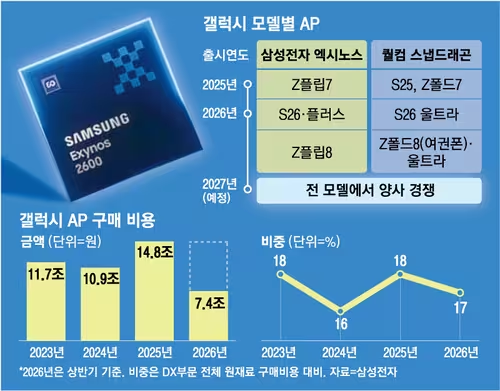
Industry data cited by Korean outlets shows Exynos being used in roughly 16 to 18 percent of Samsung phones. That share, and the associated spend, has fluctuated over time, and these benchmarks could push MX to expand Exynos in key markets. Expect Exynos-powered Galaxy S27 models to be plausible in Korea, Europe and other regions if the performance holds up in final silicon.
Finally, manufacturing: the Exynos 2700 is said to be slated for production on Samsung's SF2P node, the company's second-generation 2-nanometer Gate-All-Around process. If the chip's performance translates to mass production, it becomes both a smartphone differentiator and a showcase for Samsung Foundry's roadmap—useful for courting external customers who care about advanced process wins.
If these results scale to shipping devices, Samsung just strengthened two narratives at once: it can build competitive flagship silicon and its foundry tech is ready to sell that success.


“I cover emerging technologies, digital innovation, and the intersection of tech and everyday life. My goal is to make complex trends accessible and inspiring.”

Discussion
Leave a Comment
Comments (2)
Is this even true? internal tests often cherry picked… 9.5% on Geekbench ok but curious about final silicon and thermal throttling.
wow didnt expect Exynos to beat Snapdragon like that, kinda hyped but also curious if these are real world gains. fingers crossed