
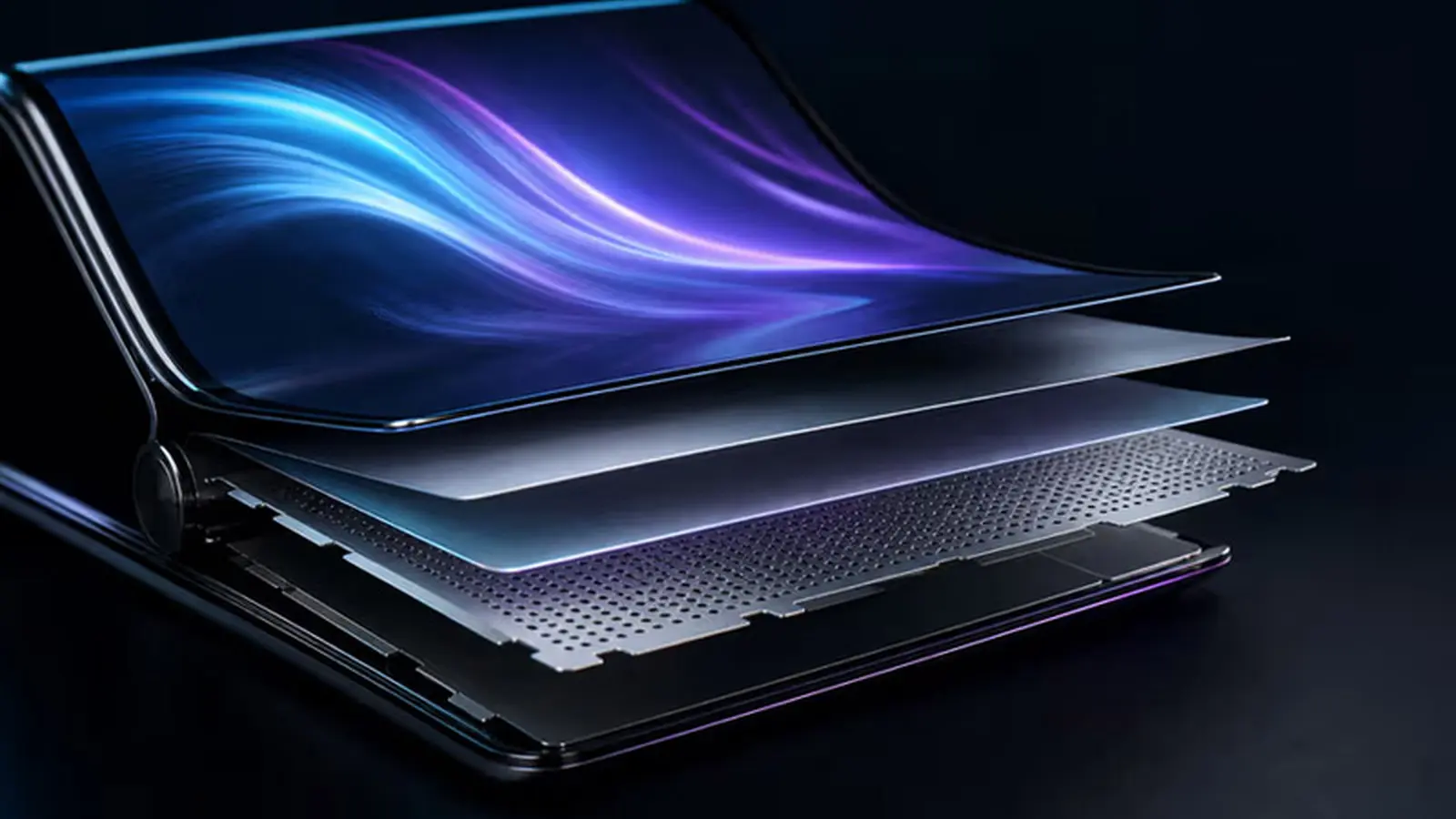
Unfold a Galaxy Z Fold 8 and the first thing you notice is not the hardware, but the silence — the crease that once announced itself with every glance has been tamed. Small victory. Big implications.
Why titanium suddenly matters inside a screen
Samsung has long flirted with titanium as a premium material for phone frames and watch cases. This time the company went deeper. Instead of just using titanium around the phone, it buried a new titanium alloy layer inside the display stack itself. The result is a fundamentally stiffer display substrate that resists deformation where traditional polymer layers would give way.
The new panel is a five-layer sandwich: a top protective layer, ultra-thin glass, the OLED panel, a titanium-alloy insert, and finally the rear titanium sheet. That extra alloy layer sits directly beneath the OLED, adding mechanical strength to the whole assembly. Samsung says the alloy-backed substrate is up to 20 times stronger than the usual polymer constructions. That’s not marketing puff. It translates to less visible crease, better resistance to pressure, and a display that ages more gracefully.

Think of it this way: folds are a stress concentrator. Any flexible surface will accumulate wear where it bends most. Replace the soft material around that hinge with a tougher, more stable metal alloy and the stress is spread out. Scratches and micro-folds stop developing into a deep, permanent seam. The panel stays flat, touch responsiveness remains truer, and the screen looks newer for longer.
For now, Flex Titanium is reserved for the horizontal fold models — the Galaxy Z Fold 8 and the Z Fold 8 Ultra. Early hands-on impressions point to the smoothest, most uniform fold Samsung has produced. Meanwhile, the vertical clamshell in the lineup, the Galaxy Z Flip 8, keeps the conventional layered display without the internal alloy layer. The difference may be subtle at first glance, but it’s the kind of hardware tweak that tells over months of daily use.
Will it change everything about foldables? No single improvement flips the category overnight. But small engineering gains like this one add up. Less crease, improved durability, and a screen that resists long-term deformation: those are the practical wins buyers notice when the novelty fades and the handset becomes part of everyday life.
If you follow hardware evolution closely, Flex Titanium is a reminder that innovation often lives in the materials and the invisible layers beneath the display. It’s a technical refinement with a very visible payoff.


“I cover emerging technologies, digital innovation, and the intersection of tech and everyday life. My goal is to make complex trends accessible and inspiring.”

Discussion
Leave a Comment
Comments
No comments yet. Be the first.