
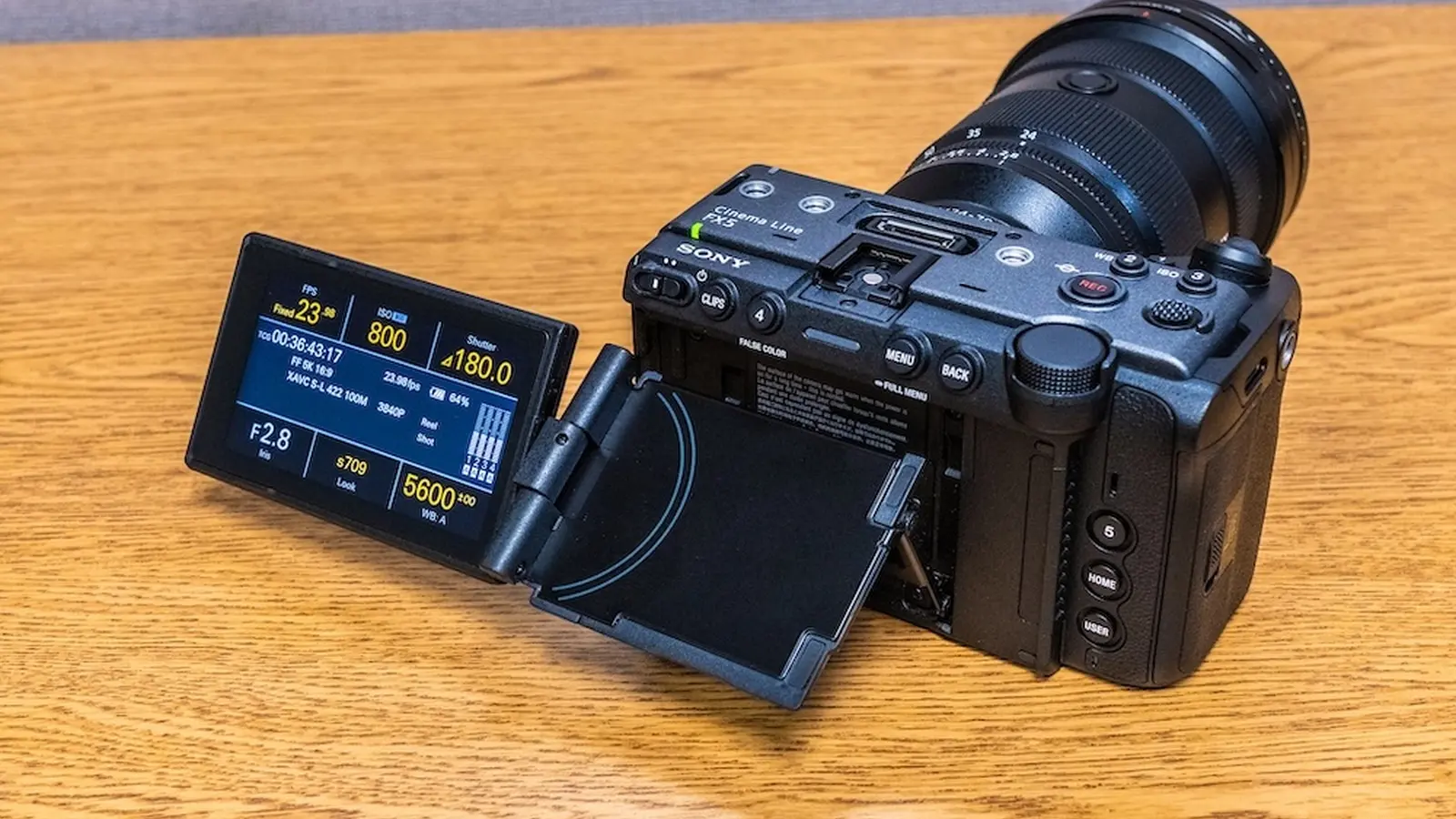
Picture framing a vertical shot and realizing you never had to crop away pixels. That small, practical freedom is exactly what Sony is selling with the new FX5.
Open gate: every pixel finally matters
This is not a simple FX3 update dressed in fresh paint. Sony built the FX5 around a 16.6MP full-frame, fully-stacked Exmor RS sensor and the BIONZ XR2 engine with on-board AI acceleration. The immediate payoff: native 5K at 60fps and 4K at 120fps. A promised firmware update will push those ceilings further to 5K at 120fps and 4K at 240fps.

But the feature that changes how you shoot is open gate recording. Rather than constraining video to a cropped portion of the sensor, open gate lets the camera use the sensor's entire width and height to produce a 3:2 image. For vertical content creators and anyone who needs maximum pixel economy, that’s a practical revolution. You get full sensor real estate for reframing, stabilizing, or delivering multiple aspect crops from a single take.
Sony didn’t stop there. The FX5 records 16-bit linear RAW internally—no external recorder required. Out of the camera, you can capture the full 3:2 5K output in RAW at 60fps today, and at higher frame rates once the upgrade rolls out. Sony’s professional X-OCN codecs (LT, C1, C2) offer different compression tiers so productions can balance quality and storage demands.

Dynamic range and low-light behavior get serious attention. The FX5 is the first in Sony’s FX line to adopt Dual Gain Shooting, which blends low- and high-gain outputs to widen usable latitude and reduce noise. Three base ISOs—800, 4000, and 12800—give shooters flexible exposure options for tasks that range from daylight exteriors to near-dark interiors. Sony is advertising upwards of 15 stops of dynamic range, a claim that puts this body in contention with larger cine rigs.
Autofocus gets an AI boost: human pose estimation improves subject detection and tracking, while Auto Tracing White Balance uses both visible and IR sensors to stabilize color in mixed-light scenarios. Want control? You can disable in-camera noise reduction. Shooting anamorphic? There’s a de-squeeze function, though autofocus is disabled in that mode.
Ergonomics and workflow follow the pro playbook. A larger 3.5-inch touchscreen (2.76 million dots) articulates fully, a built-in cooling fan keeps extended takes honest, and power/data versatility comes through dual USB ports and a wired LAN connection. The camera accepts larger NP-SA100 batteries and borrows a more cinema-grade menu system from Sony’s CineAlta line.

Sony chose to keep the viewfinder modular. The FX5 ships without an integrated EVF, but the new DVF-EL1 detachable viewfinder is available as an option. There’s also an XLR-H2 handle for on-body audio and controls.
Practical question: what does this cost? The FX5 body is priced at about €4,510, and the kit with the XLR-H2 handle comes in around €5,060. Sony plans mid-August availability.
For filmmakers weighing compact flexibility against traditional cine boxes, the FX5 stakes a convincing claim. It’s compact but uncompromising: a camera designed for creators who want the full width of the sensor, professional RAW workflows, and modern autofocus wrapped in a package built for long days on set.


“I love exploring gadgets, apps, and trends that redefine how we connect, work, and play in a digital world.”

Discussion
Leave a Comment
Comments (2)
Love that native 5K vertical, finally no insane cropping. Wallet... not happy though lol
Open gate sounds awesome but 4K240 w/ a firmware? Really Sony... if that hits, game changer, but I'm skeptical about heat and battery life