
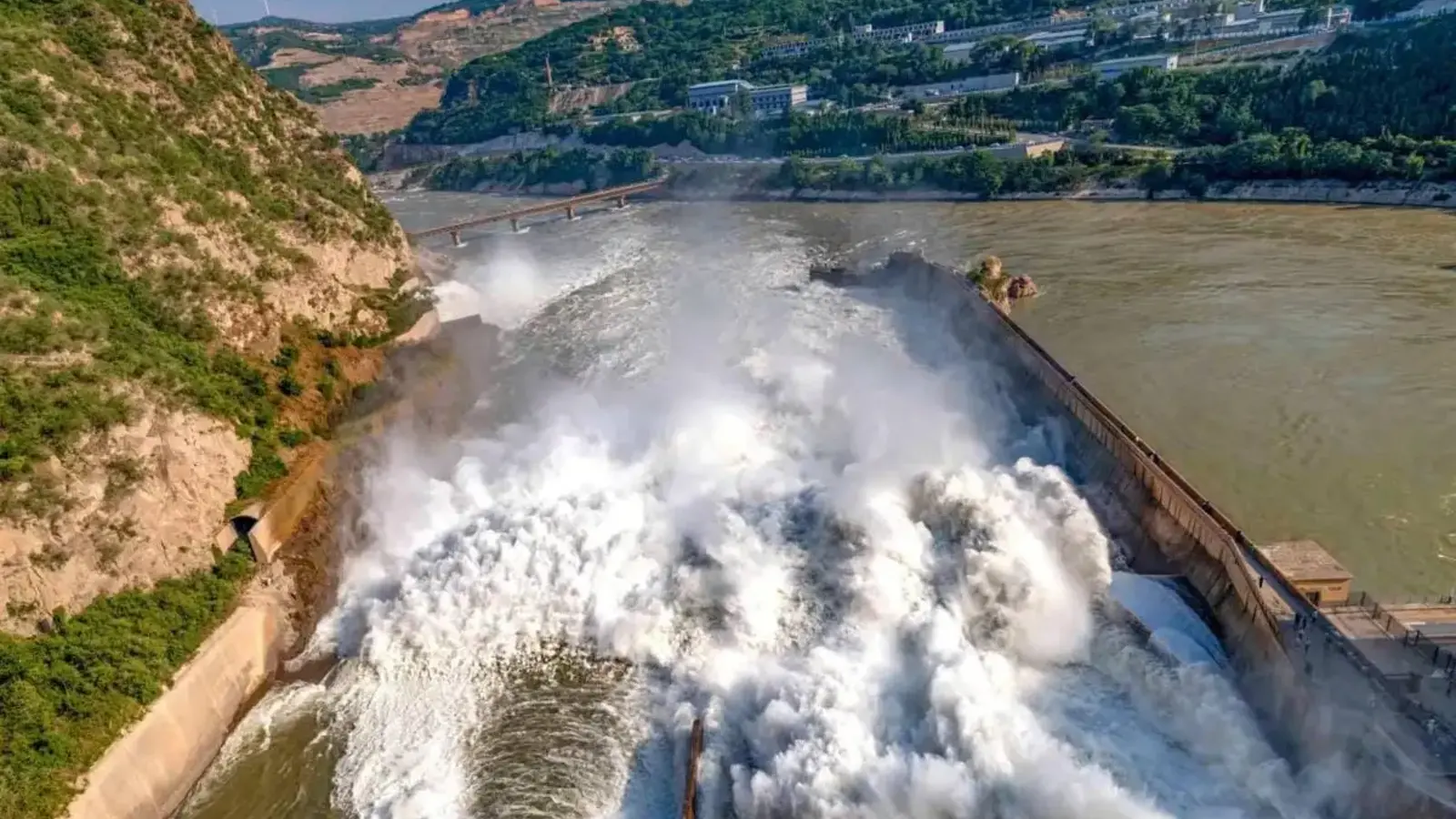
Mud and sand pile up in silence. Years pass. Behind concrete and steel, storage space shrinks until reservoirs can no longer do what they were built for: hold water.
The slow choke: how reservoirs lose capacity
When a river is dammed, it does not simply stop. It carries its sediment load—silt, sand and gravel—straight to the new basin, where flow slows and particles settle. That accumulation is gradual, almost invisible at human timescales, but relentless. The trapped sediment reduces the volume available for water, degrades operational flexibility for flood control and hydropower, and can undermine structural safety. It also starves downstream ecosystems of the sediments that sustain deltas, beaches and riverine habitats.
A global team led by Kai Liu at the Chinese Academy of Sciences in Nanjing combined satellite imagery, sedimentation records and machine-learning models to quantify that process at scale. Their analysis covered more than 550,000 reservoirs worldwide, producing a first-of-its-kind global assessment of how quickly storage is being lost.

Scale and consequences
More than half of the world’s freshwater reservoirs could become functionally dead by 2060.
The researchers use a working definition called "functional death": a reservoir is considered functionally dead once sediment fills more than half its capacity. Under current trends, more than 50 percent of reservoirs could reach that threshold by 2060. The loss of storage is not trivial. Globally, sedimentation removes over 36 cubic kilometers of storage each year—roughly equivalent to the entire volume of China’s Three Gorges reservoir.
Impacts will be uneven. Arid and semi-arid regions face the sharpest decline: the team projects roughly 75 percent of reservoirs in dry zones will be functionally dead by 2060, compared with about 50 percent in humid regions. Country-level differences are striking. Australia could see nearly 85 percent of its reservoirs cross the functional-death threshold, Spain about 75 percent. In Namibia more than 99 percent of dams are at risk. Western Australia’s coastal reservoirs show a similar pattern, with almost 96 percent threatened.
The stakes are high. At the current loss rate of more than 7 percent of global freshwater storage per decade, the study warns that reliable water supplies for more than two billion people could be jeopardized. Agricultural systems are on the front line: over one-quarter of the world’s irrigated land depends on reservoir storage that may shrink, putting food security at risk in vulnerable regions.
Why this is accelerating
Two main drivers intensify the problem. First, land-use change and upstream erosion increase the sediment delivered to rivers. Deforestation, poorly managed agriculture and construction all loosen soil. Second, climate change is altering rainfall patterns. More intense storms can flush far larger sediment loads into catchments than steady, lighter rain.
Ian Wright, a researcher at Western Sydney University, described the phenomenon bluntly: "Sedimentation is like a cancer—slow, often unnoticed, and progressively reducing a reservoir’s capacity." He warned that climate-driven changes in rainfall intensity will likely accelerate sediment delivery into reservoirs.

What can be done
There is no single fix. The study outlines a portfolio of watershed management and engineering measures to slow or reverse loss of storage.
Upstream landscape actions
- Reforestation and vegetation buffers to reduce soil erosion.
- Soil stabilization and sustainable farming practices across catchments.
- Targeted erosion control in key tributaries and gullies.
Engineering interventions
When preventive measures are insufficient, active removal or bypass becomes necessary: dredging to recover storage, and construction of bypass or sediment diversion tunnels to route sediments around reservoirs. These operations are costly at scale. The team estimates a global program of dredging and engineered sediment-skip systems could approach about €93 billion.
Decisions will be local and political. For some aging reservoirs, decommissioning could be the most sustainable choice. For others, retrofitting and operational changes—such as timed flushing during high flows—can extend useful life.
Policy and planning implications
Planners rarely budget for lost storage. Design life assumptions for many reservoirs did not anticipate decades of intensified erosion and shifting climates. That mismatch now creates an urgent need to integrate sediment risk into water security planning, infrastructure investment and agricultural policy.
Because sedimentation is driven by upstream activities, solutions must cross administrative boundaries. Watershed-scale governance, financing mechanisms that reward soil conservation, and investment in monitoring systems—satellite-based and ground measurements—are essential. The very data used in this study point to a practical path: better monitoring can target the most vulnerable reservoirs for early intervention.
Expert Insight
Dr. Elena Márquez, a hydrologist specializing in water infrastructure resilience, offers a practical view: "We need to stop treating reservoirs as isolated assets. The sediment problem is a landscape problem. Prioritize catchment restoration where it delivers the largest reduction in sediment yield, and pair that with targeted dredging where no alternative exists. It’s about triage—where to act, and when it’s better to adapt."
Where this leaves us
The paper, published in Nature Sustainability, reframes sediment as a central threat to global water security. The clock is not ticking toward sudden failure; it is measuring a slow decline. That slowness offers a window for action—but only if policy, funding and science move together. Otherwise, countless reservoirs will continue to lose usefulness, silently undermining water, food and energy systems around the world.


“My work centers on sustainability, energy, and environmental science — examining how innovation can lead to a greener future.”

Discussion
Leave a Comment
Comments (2)
Ive worked on watershed projects, and yeah sediment sneaks up on you. Replanting helped some basins but dredging? painful, expensive, politics kills projects.
Is the math solid here? 550k reservoirs sounds huge, but models can mislead. If that's real then... where's the raw data?