
5 Minutes
Imagine a spacecraft that can pick the best route home for its data the way a smartphone chooses the fastest Wi-Fi. Simple idea. Big implications. That is the promise behind NASA’s Polylingual Experimental Terminal, known as PExT, which recently completed a milestone demonstration and is now running an extended mission to push the concept further.
PExT launched in July 2025 on a York Space Systems BARD platform and set out to prove a single hardware terminal can speak to more than one communications network. Historically, spacecraft have been locked to a single relay or ground network, limiting flexibility and resilience. PExT changes the script by using widely adopted Ka-band frequencies so a single terminal can transmit through government relays and commercial satellite systems alike.
The demonstration met its primary goals in December 2025 when PExT successfully sent data via NASA’s Tracking and Relay Satellite System as well as through commercial operators Viasat and SES Space and Defense. That validation was enough for NASA to greenlight extended operations starting January 2026, now planned through April 2027, to explore additional partners and scenarios.
Routing choices in orbit
Why does multi-network capability matter? Because space communications are becoming busier, more complex, and more mission-critical. Tomorrow’s exploration will involve constellations of small satellites, crewed missions, robotic landers, and scientific platforms that all need timely, reliable links. Flexibility in routing can improve coverage and reduce the chance of a single-point outage affecting operations.
PExT’s extended campaign includes more than 50 direct-to-Earth sessions using SSC Space’s global ground station network, with Weilheim, Germany serving as a primary testbed. Those sessions are not just handshake checks. They are deliberate exercises to see whether a mission can switch between relay-based routes and direct ground-station links depending on availability, bandwidth needs, or orbital geometry.

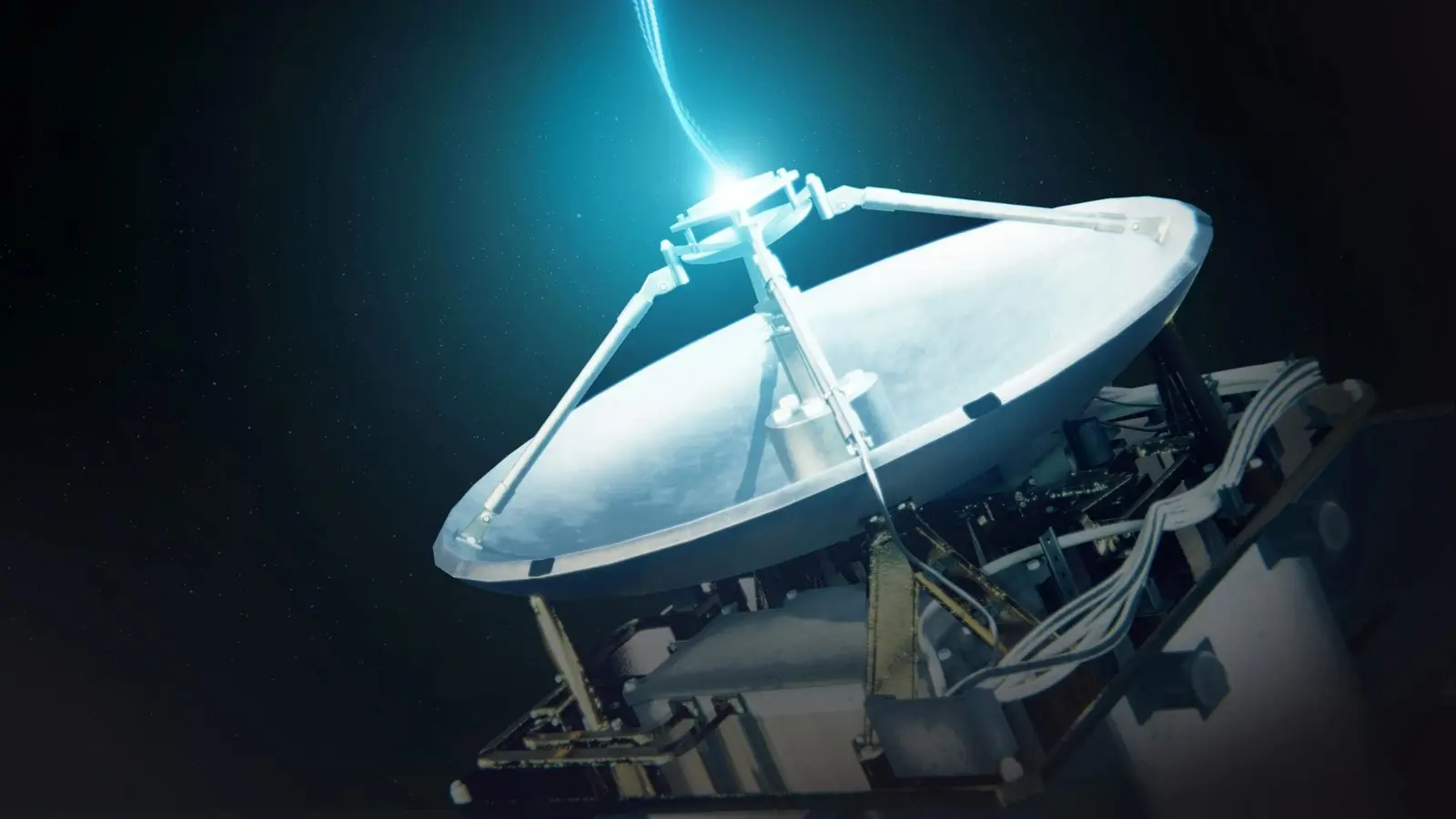
An artist’s concept of the Polylingual Experimental Terminal (PExT) communicating direct-to-Earth.
Think of it as path selection for spacecraft data. Route via relay when latency matters. Go direct-to-Earth when you need raw throughput. Mix both when you want redundancy. The technologies involved are standard radio frequency engineering, but the real advance is the software and systems that decide which path to use and when.
Software and partnerships that matter
NASA is not only testing radios. The agency is evaluating enterprise-level service management with Aalyria Technologies’ Spacetime platform. Enterprise service operations are the control plane for a multi-network environment: they plan, coordinate, and track communications services across missions so operators know what links are available and how to request capacity.
That software comes out of a string of collaborations, including work with the U.S. Defense Innovation Unit under the Hybrid Space Architecture program and earlier investments from NASA’s NextSTEP-2 initiative. By leveraging commercial platforms and shared service frameworks, NASA aims to reduce operational friction and give missions clearer visibility into communication options.
The project is funded and managed by NASA’s Space Communications and Navigation Program in partnership with Johns Hopkins Applied Physics Laboratory. The mix of government and commercial partners reflects a broader industry trend toward interoperable networks that can scale with growing traffic and diverse mission needs.
Technically, PExT is showing that Ka-band wideband radios can be treated as network-agnostic endpoints. Operationally, it is teaching agencies how to orchestrate those endpoints across competing providers. The result could be a more resilient space internet that supports science, commerce, and human exploration with fewer interruptions.
Expert Insight
"PExT is not about a single radio winning the day," said Dr. Elena Morales, a fictional senior systems engineer with decades of mission operations experience. "It is about building an ecosystem where missions can request the best available service and trust that the network can deliver. That trust is what unlocks new mission concepts and reduces operational risk."
Looking ahead, the lessons from PExT will inform how future spacecraft are designed and how ground networks are provisioned. As traffic in low Earth orbit and beyond grows, the ability to move data across multiple networks intelligently will be a cornerstone of dependable space operations.
Conclusion
PExT is a pragmatic demonstration with outsized consequences. It does not rewrite the physics of radio links, but it rewrites operational practice. Flexibility, interoperability, and intelligent service management are the levers that will let the next wave of missions share the orbital commons without becoming tangled in communications bottlenecks.
Source: scitechdaily


Comments
astroset
So Ka-band for govt and commercial, but who mediates priority in congestion? Commercial wins? govt control? sounds messy, anyone seen policy plans?
atomwave
Wow didnt expect spacecraft to pick routes like phones. Smart idea, curious how it handles interference, latency spikes... promising but skeptical.

Leave a Comment