
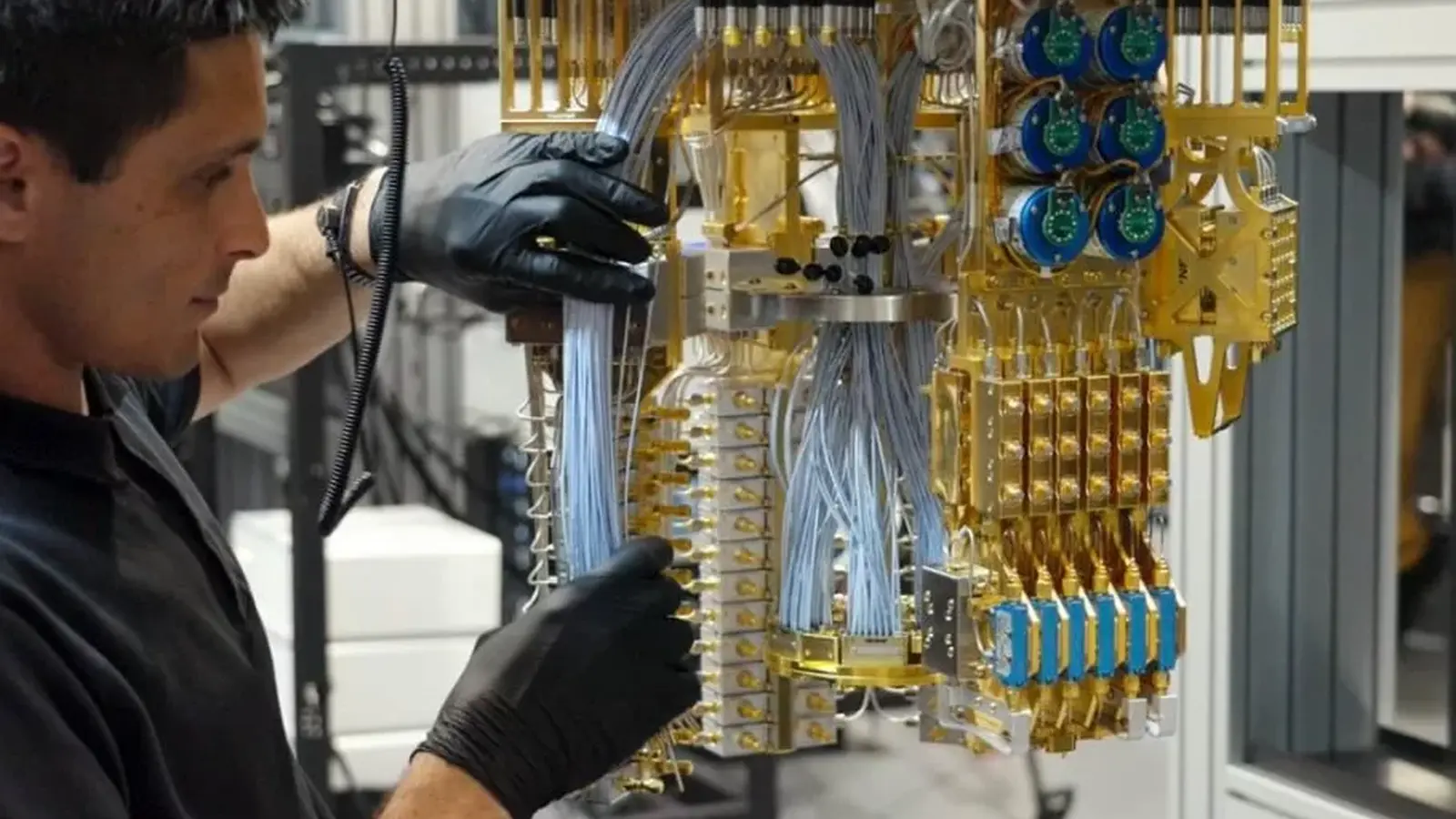
Picture a modest rack of machines solving chemical puzzles that stump today’s most powerful supercomputers. That future, according to Amazon’s head of AI and hardware, may arrive sooner than many expect.
Peter DeSantis, who now leads Amazon’s new organization focused on AI models, chips and quantum computing, told CNBC he expects the first commercially useful quantum computers to appear within five to seven years. He didn’t promise overnight miracles. Instead, he sketched a trajectory: small, practical quantum systems will arrive, then steadily grow in scale and capability year after year, tackling progressively harder problems.
The early battleground for quantum advantage
Why does that timeline matter? Because quantum machines are not simply faster versions of the tools we use today. Qubits behave differently than classical bits. They can be zero, one, or a blend of both at once, enabling new algorithms that address classes of problems classical architectures struggle with. In plain terms: expect different, not just quicker.
Amazon isn’t speaking in isolation. The industry is crowded. Google, Microsoft and IBM — plus a host of startups — are racing to turn laboratory breakthroughs into products. Last year Amazon unveiled a quantum chip called Ocelot, designed to help with error correction, one of the technology’s thorniest challenges. That’s a practical step toward usable machines, rather than an academic proof of concept.

Predictions vary. Some companies have said useful applications are only a few years away. Others have urged caution, placing realistic commercial milestones further out. The argument hinges on how quickly researchers can tame noise, scale qubit counts, and build software that exploits quantum behavior.
Which fields will benefit first? Chemistry and materials science top the list. Simulating molecular systems at high fidelity is a natural fit for quantum hardware. These simulations could accelerate drug discovery, catalyst design and the search for novel materials in ways classical simulations cannot match.
Expect early quantum systems to be specialized tools for niche but high-value problems, expanding their reach as error correction and scale improve.
That phrasing echoes DeSantis’s comparison to a Moore’s Law–like progression, where capability compounds over time. If that pattern holds, the industry could move from small, domain-specific quantum devices to more versatile systems that chip away at broader classes of problems.
The real race now is less about raw qubit count and more about error rates, control systems, and software stacks that translate real-world questions into quantum-friendly formulations. Amazon’s push, combined with rival efforts, makes the next half decade one of the most consequential windows in computing history.

“I love exploring gadgets, apps, and trends that redefine how we connect, work, and play in a digital world.”

Discussion
Leave a Comment
Comments
No comments yet. Be the first.