
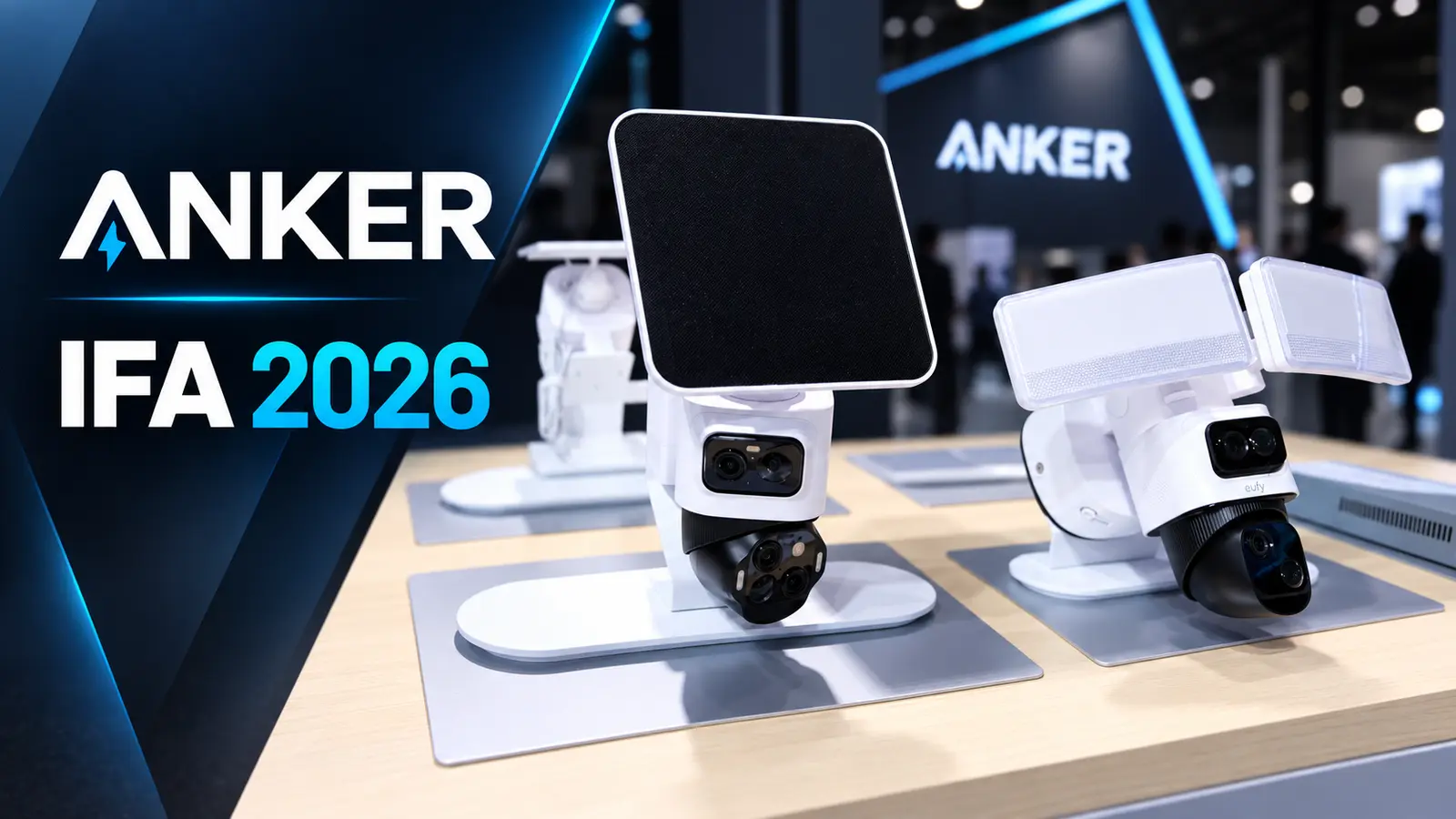
Anker used IFA 2026 to show how far its portfolio now stretches beyond the chargers and power banks that built the brand. At its Berlin showcase, two sides of that strategy were particularly visible: a new AI-driven smart-home platform built around Anker MindBase and eufy security products, and a fresh generation of charging accessories focused on faster wireless charging, smarter thermal management and travel-friendly designs.
During our visit, representatives from the eufy and Anker teams walked us through the products they considered among the key launches of this year's show. The most ambitious was MindBase, a new locally powered smart-home hub designed to connect security cameras, sensors and other Matter-compatible devices, while Anker's charging division showed products ranging from the new MagGo 2 Pro magnetic power bank to multi-device charging stations and a universal travel charger.
MindBase is Anker's attempt to give the smart home a local AI brain
The centerpiece of Anker's smart-home presentation was MindBase, a new hub designed to act as a central intelligence layer for devices around the home.
According to the representative we spoke with, the idea is broader than home security. MindBase is designed to work with Matter-compatible products and eventually manage different areas of the home, including security, energy and other connected devices.

At the core of the system is what Anker calls an AI Core, providing local computing power so that events can be analyzed within the home rather than relying entirely on cloud processing.
Anker has confirmed that MindBase uses a dedicated 26-TOPS AI Core and is designed to process smart-home data locally. It also functions as a Matter controller and can provide expandable local storage of up to 48TB.
That local-first approach was one of the main points emphasized during our demonstration. Security footage and event data can remain locally stored, with Anker positioning the system as a way to provide advanced AI-driven monitoring without requiring a monthly subscription for its core local functionality.
The MindBase Security Kit starts with the perimeter of the home
Security will be the first major application for the new platform.
Anker's MindBase Security Kit combines the central MindBase hub with a new family of eufy cameras and sensors intended to work together rather than operate as isolated devices.
One of those components is the Smart Security Shield, designed to monitor the perimeter of a property. Anker says the sensor uses dual radar to detect strangers at distances of up to 15 metres, while its DSKey credential system can recognize household members from as far as 30 metres away.
That distinction allows the system to respond differently depending on who is approaching. A recognized family member does not need the same security response as an unknown visitor.

TrackLight Cam S1 can follow an intruder with light
The next part of the security chain is the eufy TrackLight Cam S1.
Rather than simply recording someone after they enter the property, the camera is designed around active deterrence. During the booth demonstration, the representative explained how it can identify and track a suspicious person and direct a concentrated beam of light toward them.
Anker describes the TrackLight Cam S1 as a 4K security camera with 180-degree dual-radar detection and an auto-tracking light designed to follow potential intruders.
The same lighting system can behave differently when a recognized family member arrives, illuminating the path instead of acting as a deterrent.
That is an important part of the MindBase concept: individual devices are not simply collecting data; the hub is intended to interpret the context and decide how the system should respond.

Video Doorbell S4 brings a panoramic view to the entrance
Closer to the front door, Anker showed the eufy Video Doorbell S4.
The new wired doorbell combines the traditional role of a video doorbell with a wider security-camera view. Its 180-degree panoramic field of view is designed to reduce blind spots around the entrance, while eufy's OmniTrack technology follows visitors and delivery couriers as they move across the scene.
The representative described this as another layer in a wider yard-and-home security system. Entry and motion sensors can also feed information into MindBase, allowing the hub to evaluate events across several devices before deciding which notifications are important enough to send to the user.
A Smart Display provides one screen for the system
Anker also showed a dedicated smart display for viewing camera feeds and managing the security system from one place.
Rather than checking individual cameras separately, users can access multiple streams and system information through a centralized screen.
That reinforces the broader idea behind MindBase: creating one local control layer above a collection of cameras, sensors and other compatible smart-home hardware.

A new 4K Wall Light Cam adds RGB lighting
Beyond the MindBase Security Kit, eufy also brought a new generation of its Wall Light Cam to IFA.
The upgraded model combines a 4K camera with manually adjustable positioning and a lighting system that now supports RGB colors rather than being limited to white illumination.
The light can therefore serve different roles. A warmer setting can be used as ordinary welcoming exterior lighting, while security modes can use more attention-grabbing colors.
The product shown at IFA corresponds with the newly introduced eufy Wall Light Cam S4, which features a 4K/8MP camera, 60GHz mmWave radar with detection up to 12 metres, adjustable white, warm and RGB lighting, and solar power.
eufy is also experimenting with a camera that sticks to your window
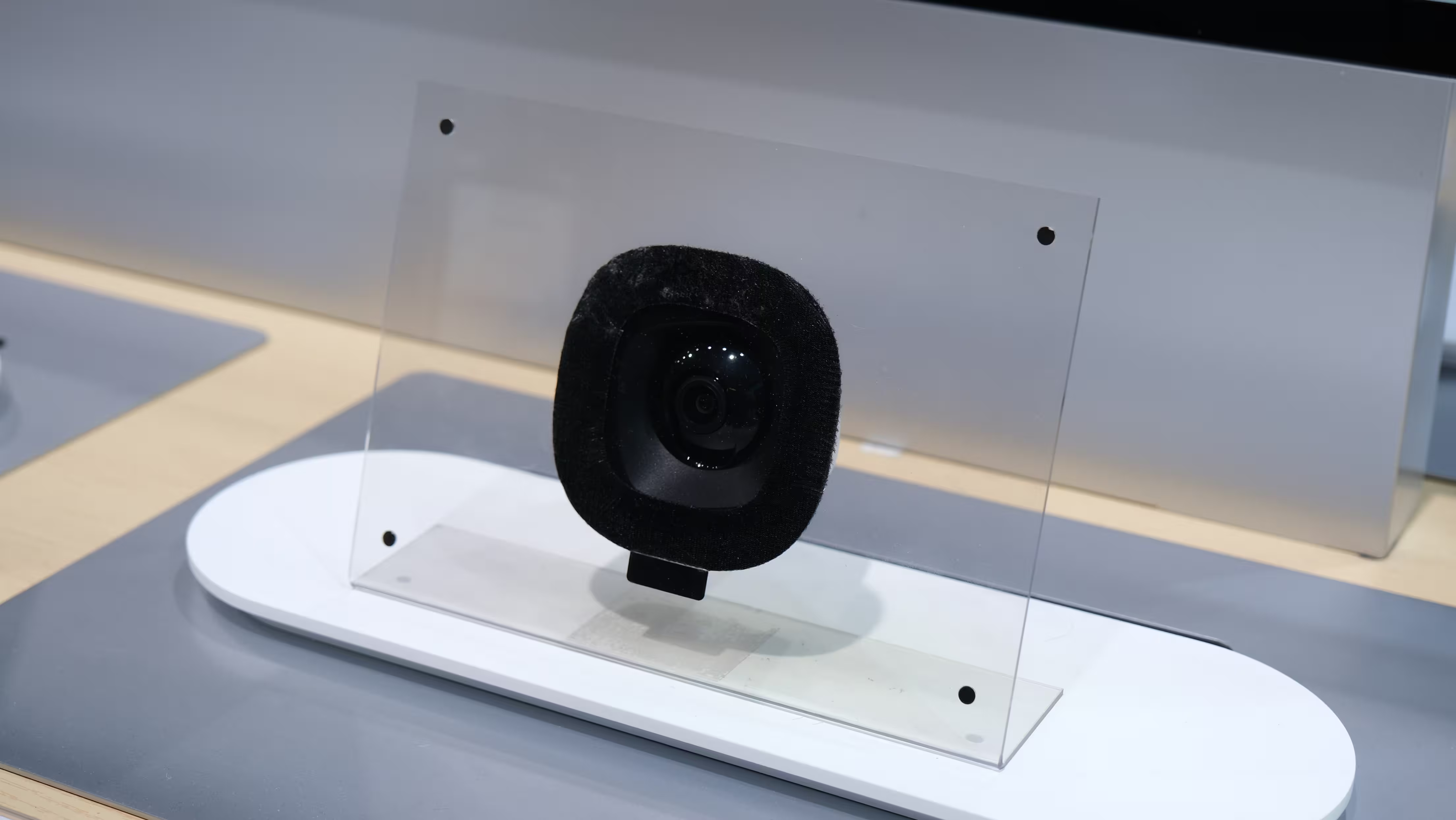
One of the smaller but more unusual products on display was the new eufy Window Camera E10.
Instead of mounting a conventional outdoor security camera to a wall, the E10 is designed to attach to the inside of a window and monitor the area outside.
That could make it particularly interesting for apartments, rented homes or locations where drilling into an exterior wall is impractical.
Anker has confirmed the Window Camera E10 as a new $69.99 model designed to mount directly to glass, using anti-reflection optics to reduce glare while recording through the window.
During our presentation, we were told that the Window Camera is expected to reach the market later this year, although availability will vary by region.

Anker's other side of IFA: faster and smarter charging
The second part of our booth visit shifted away from home security and back toward the category most closely associated with Anker: charging.
Anker representative Ivy introduced several of the company's key charging products for IFA 2026, beginning with the Anker MagGo 2 Pro.
The new magnetic power bank supports Qi2.2 wireless charging at up to 25W, a substantial increase over the 15W ceiling common to earlier Qi2 magnetic products.
Anker also integrates its SnapCool active cooling system, which uses active thermal management to help maintain higher wireless charging speeds without excessive heat buildup. The MagGo 2 Pro additionally offers a 45W USB-C wired output and a built-in color display that can show information such as charging power, temperature and battery status.
According to Anker's booth presentation, the battery itself can recharge to 80 percent in around 42 minutes.

Smart displays are moving onto chargers, too
Several of the new charging products on display featured integrated screens.
Rather than simply indicating whether a device is charging, these displays can provide information such as real-time wattage and charging status.
Anker is also increasingly using what it calls Care Mode, which adjusts charging behavior with the goal of managing temperature and reducing long-term battery stress.
The company's current 45W Smart Display Charger, for example, uses a three-stage charging system and Care Mode. Anker says its internal testing found that the mode can keep a connected phone battery up to 5°C cooler than comparison charging conditions.
During our IFA demonstration, Anker showed the same philosophy extending to larger chargers intended for laptops and multi-device setups.

One bedside station for a phone and multiple USB-C devices
Another product shown to us was a bedside charging station designed around a magnetic phone charging surface.
The unit also integrates a retractable USB-C cable and an additional USB-C connection, allowing multiple devices to be charged from a single compact station.
Anker's representative highlighted Care Mode here as well, positioning the charger not only around speed but around managing the charging curve and temperature during longer sessions such as overnight charging.

A 10-port hub aimed at both work and gaming
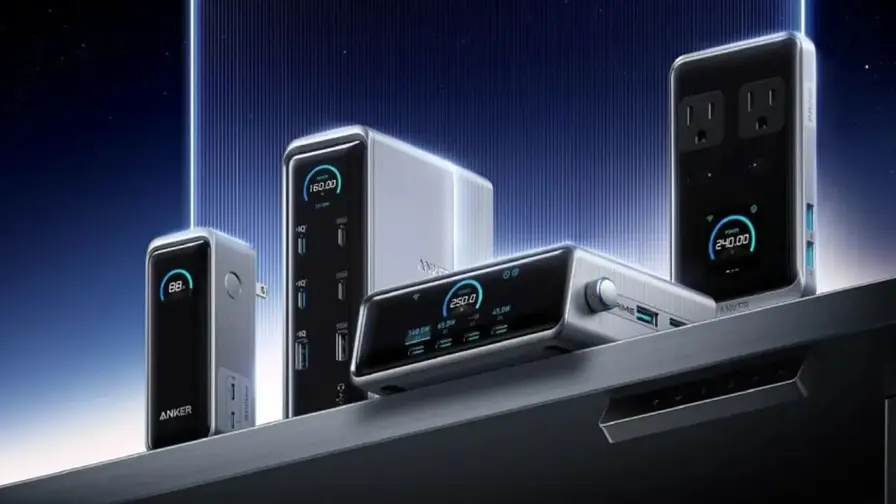
Anker also displayed a 10-port hub designed to expand laptop connectivity for both productivity and gaming setups.
The most visually distinctive versions shown at the booth were special VALORANT-themed editions, featuring customized exterior styling and matching interface elements.
Rather than treating docking products purely as office accessories, this collaboration indicates that Anker is also targeting gaming desks and enthusiast setups with selected accessories.

A 100W universal charger for international travel
Frequent travellers were another clear target.
Anker showed us a universal charger that combines the functions of a high-power USB charger and international travel adapter in one device.
The current Anker Universal Charger (4-in-1, 100W, Smart Display) supports built-in US, UK and EU plug configurations and is designed for use across more than 200 countries and regions. It can charge four devices simultaneously and deliver up to 100W from a single USB-C port.
Its display can show information including local voltage and power output, making it more informative than the basic passive adapters many travellers carry.

A compact six-port station for family travel
The final product demonstrated to us was a portable multi-port charging station aimed at families or groups travelling with several devices.
With six charging connections in a relatively compact body, the idea is simple: instead of carrying separate adapters for phones, tablets, watches and laptops, one station can become the charging point for an entire hotel room or travel setup.
It is a less dramatic product than MindBase or a 25W magnetic power bank, but also the kind of accessory that illustrates Anker's continuing focus on practical charging problems.
Anker's IFA strategy is becoming much broader
Taken together, the products at Anker's IFA 2026 showcase tell two different but increasingly connected stories.
On one side is MindBase, arguably the company's most ambitious attempt yet to move deeper into the smart home. Instead of simply selling cameras, eufy is building a local intelligence layer designed to understand information from many devices and respond to events across the entire property.
On the other is Anker's more familiar charging business, but even there the direction is changing. Active cooling, smart displays, battery-care modes and multi-device travel systems are turning previously simple accessories into increasingly intelligent products.
The common thread is integration. Whether it is a security camera feeding information to a local AI hub or a charger adjusting power based on the connected device, Anker increasingly wants its hardware to do more than perform one isolated task.
IFA 2026 offered one of the clearest demonstrations yet of that wider ambition.

“Some times I write about breakthrough startups, digital ecosystems, and how innovation is changing the way we build businesses.”

Discussion
Leave a Comment
Comments (5)
MagGo 2 Pro hitting 25W wireless? neat. SnapCool and Care Mode make chargers smarter, still curious about price and real world temps 🤔
Feels a bit overhyped. Local AI and no subscription is nice on paper, but locking you into one ecosystem plus support longevity worries me...
That 4-in-1 100W charger actually sounds handy for travel. Fewer plugs in the bag is a win. Hope it's compact and not heavy tho
mmWave radar for perimeter? sounds cool, but won't that cause loads of false alarms in busy areas? anyone tried it outside yet?
Wow a local AI hub with 26-TOPS and up to 48TB storage? If true that's massive. Privacy seems better, but what's the power draw and price tho