
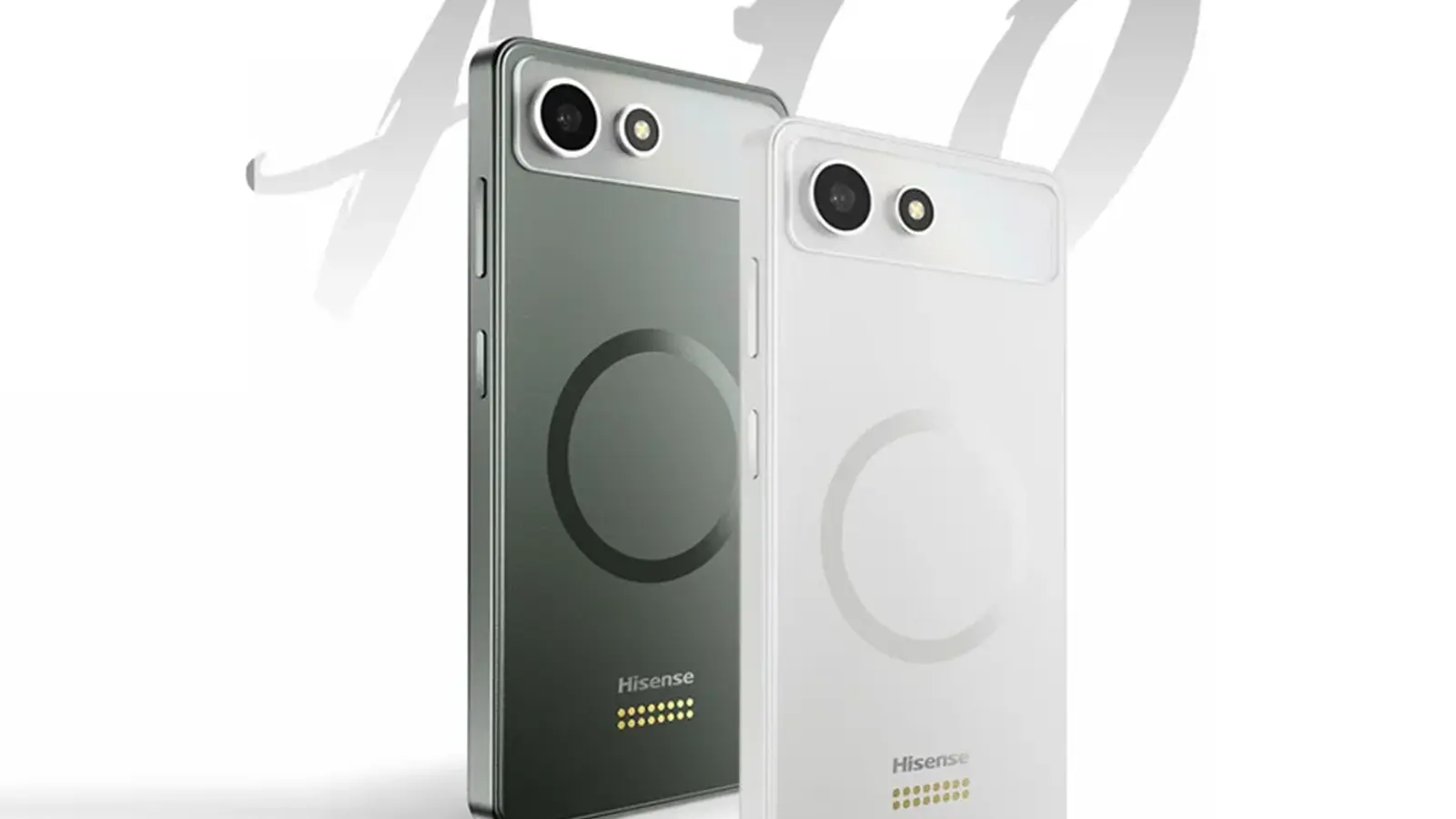
The first thing you notice is how calm it feels. Hold the Hisense A10 and it reads more like a paperback than a pocket computer. No backlight glare. No flicker. Just paper-like contrast and a screen built for long stretches of reading and study.
One phone, two faces
Hisense has split the difference between focused reading and everyday smartphone use by making the color panel optional. Both A10 Pro and A10 Ultra center on a 6.13-inch Carta 1300 e-ink display at 1648 by 824 pixels and a crisp 300 PPI. That monochrome panel supports 256 grayscale levels and 36 levels of dual-color front light, so it behaves like a modern e-reader when you want low eye strain and long battery life.
But then there is the trick: a 4.96-inch magnetic LCD color screen that snaps on to the back. Stick it on and the phone behaves like a normal device — comics, charts, short clips, social apps. Peel it off and you’re back to a focused, distraction-light reading instrument. The A10 Ultra ships with that color module in the box. The Pro has the magnetic contacts built in, but you buy the accessory separately.

If you need color occasionally and clarity most of the time, this is designed with you in mind.
Specs that matter for readers and doers
Under the hood the A10 family runs on Qualcomm’s QCM6690 octa-core chip built on a 4nm process, with 5G support and firmware tuned for e-ink workloads. The phone scales performance down when you’re stationary and reading, saving power, then ramps up responsiveness when an app demands it. Android 16 comes preinstalled and Hisense promises ongoing updates and security patches. The device allows normal Android app installation, so you aren’t locked into a tiny app ecosystem.
- Display: 6.13-inch E Ink Carta 1300, 1648 x 824, 300 PPI
- Optional color module: 4.96-inch magnetic LCD
- Processor: Qualcomm QCM6690, 4nm, 5G
- Battery: 4,000 mAh with 18W wired and 15W wireless charging; Ultra supports magnetic wireless charging
- Cameras: 48MP rear, 8MP front
- Other: NFC, infrared remote, Wi-Fi 6, call recording, app cloning

The e-ink panel is paired with an E Ink T2000 TCON chip that handles refresh work independently. The result: fewer ghosting artifacts and less load on the main processor during page turns and annotations. If you annotate PDFs or spend hours with e-books, that difference shows up in everyday use.
The phones weigh about 190 grams. They come in Moon White and Bamboo Green finishes.
Where the pricing lands in euros
Hisense has positioned the A10 Pro as the budget-minded model with upgrade paths. European-equivalent pricing starts at €383 for the 8GB + 128GB A10 Pro, €411 for 8GB + 256GB, and €479 for 12GB + 512GB. The A10 Ultra begins at €439 (8GB + 128GB), climbs to €466 for the 8GB + 256GB tier, and reaches €534 for the top 12GB + 512GB SKU. The Ultra’s box includes the magnetic color module; the Pro requires a separate purchase to add that piece.

Those figures put the A10 series in the same conversation as dedicated e-ink phones and larger e-readers, but with native Android and full app compatibility. It is a different trade-off than a mainstream OLED handset. Do you want constant color and multimedia capability, or a neutral screen that lets you focus?
For readers, students, or anyone who treats a phone like a study tool, the A10 family is a thoughtful answer. It is not trying to be everything to everyone. It is trying to be the right tool when focus and long reading sessions are the point.


“I love exploring gadgets, apps, and trends that redefine how we connect, work, and play in a digital world.”

Discussion
Leave a Comment
Comments (2)
Cool concept but wait, they charge extra for the color module? so Pro looks cheaper upfront but may cost more later. Do the magnets hold tight, or is it a wobble-bomb on the back?
wow, a phone that feels like a paperback? sign me up. Quiet screen, long battery, color only when you need it… curious about performance with heavy apps tho, ghosting fixed?