
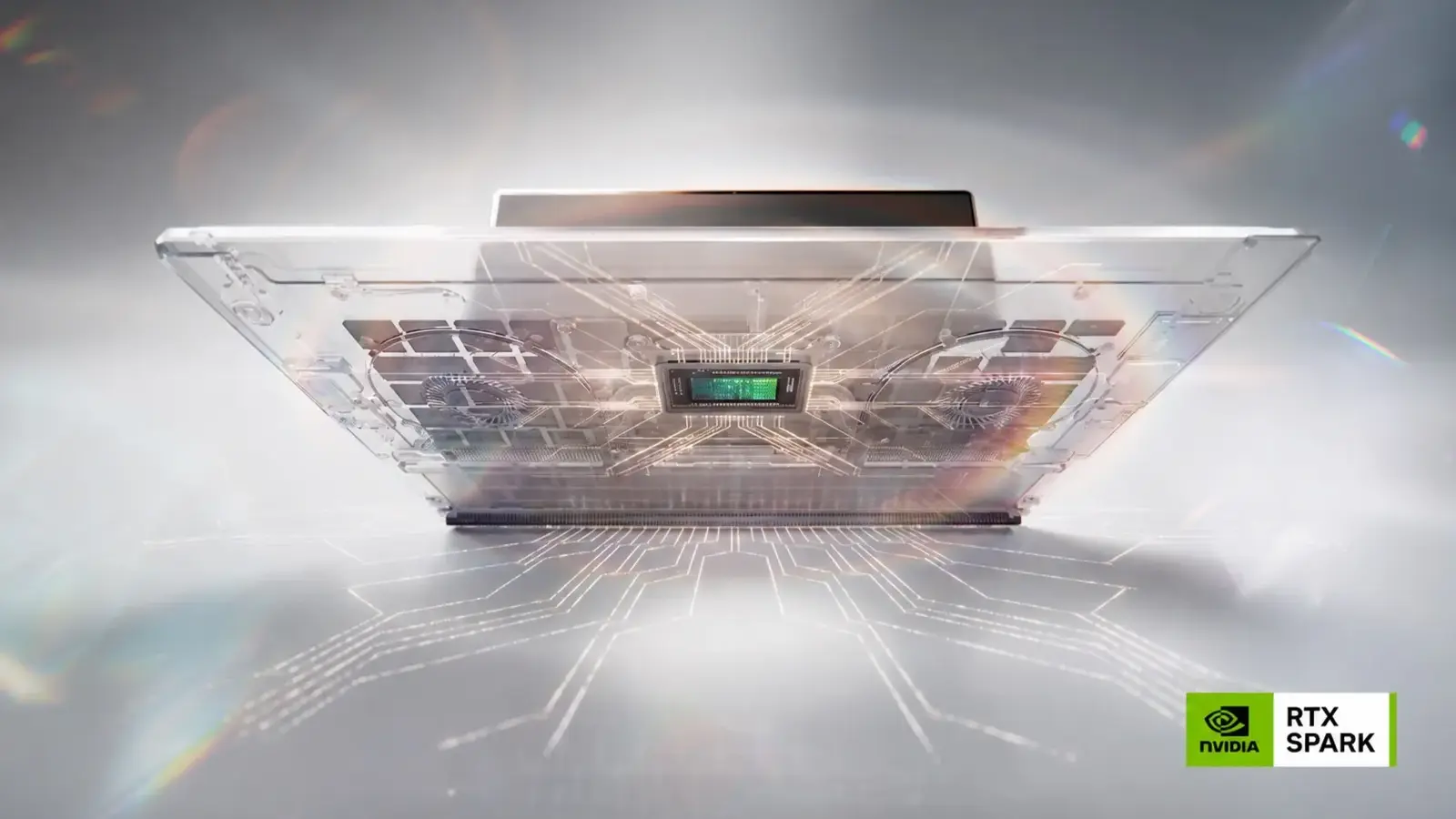
Picture this: you tell your laptop what you want, and it simply does it. No cloud trip. No waiting. Just instant local intelligence. That is the promise Nvidia and Microsoft are selling with RTX Spark, a superchip Nvidia unveiled alongside a reworked Windows strategy.
Under the hood: a chip built like a compact data center
RTX Spark is not a small upgrade. It blends a 3-nanometer process, a Blackwell GPU with 6,144 CUDA cores, and about 20 Grace-derived CPU cores into a single package. MediaTek had a hand in the chip’s development. The two domains—CPU and GPU—talk over a high-speed NVLink-C2C link. Memory is astonishing: up to 128 gigabytes of unified LPDDR5X, and a peak AI throughput around one petaflop. That lets machines run 120-billion-parameter language models offline and carry context windows measured in the hundreds of thousands to a million tokens.

Power scales with the workload. For light tasks it sips energy. Under heavy AI loads it can climb toward 80 watts. Nvidia plans lower-cost SKUs with 16 gigabytes of unified memory down the road. Because the design is ARM-based, legacy x86 Windows apps run through Microsoft’s Prism compatibility layer. Nvidia stresses that Spark is designed for Windows and won’t combine with a discrete GPU in a desktop chassis.
Local AI, wrapped in Windows safeguards
Running large models locally solves one thorny issue: privacy. But it also raises new challenges around access control and data leakage. Microsoft has extended Windows with native security layers, containerization, and finer-grained permission controls so on-device assistants can be sandboxed. Nvidia complements that with OpenShell, a tool that lets users decide what parts of their system an assistant can access and obfuscates personal data before any cloud handoff.
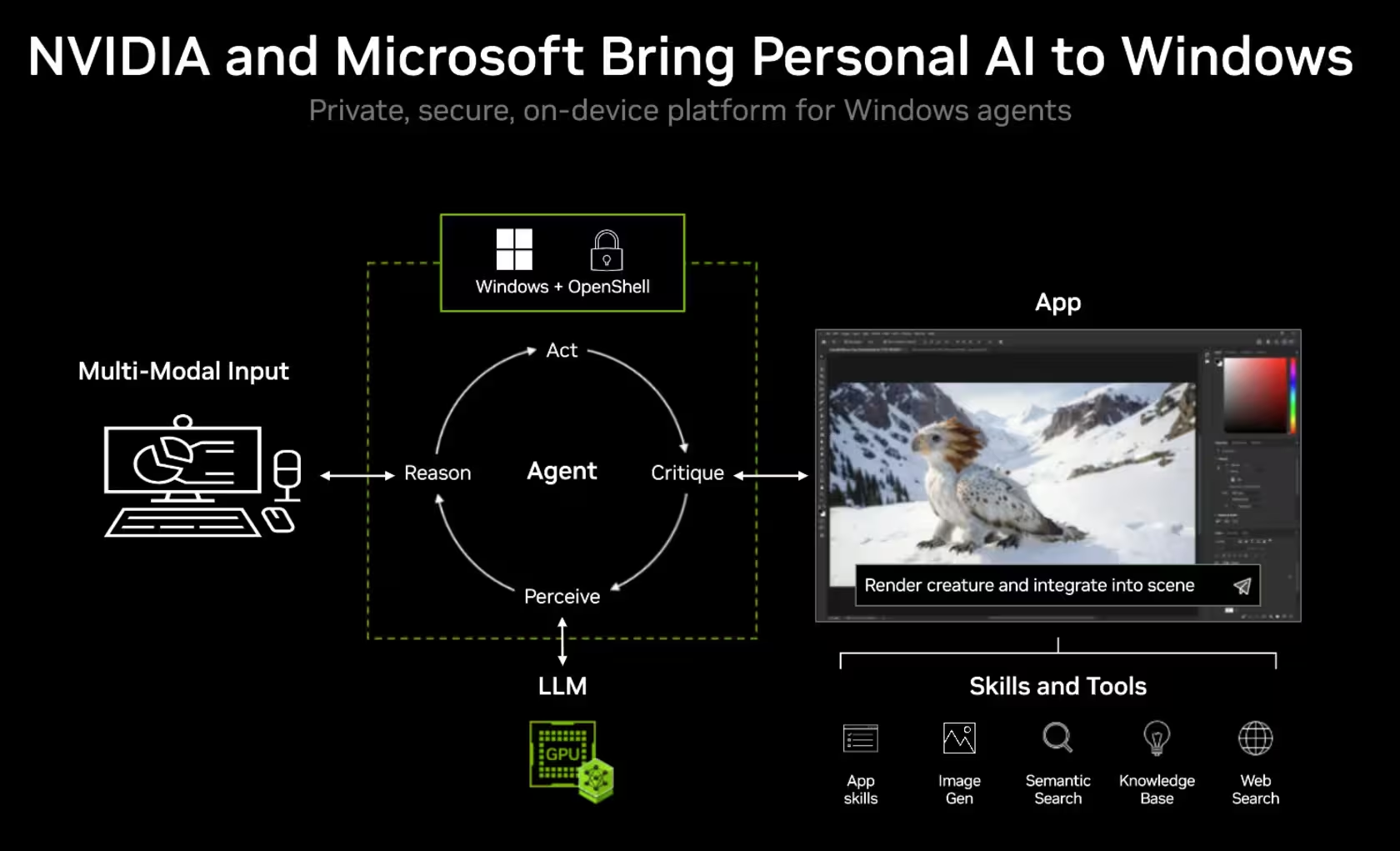
There’s a commercial logic here too: local inference avoids ongoing cloud token bills and latency. For pros who deal with sensitive media or proprietary code, that matters as much as raw speed.
Adobe jumped in early. The company rebuilt Premiere and Photoshop to take native advantage of Spark’s unified memory and Blackwell cores, claiming up to double the speed for AI-driven tools like Generative Fill and new generative timeline features in Premiere. Other apps—Blender, DaVinci Resolve, CapCut, ComfyUI and a raft of audio tools—have pledged native support or optimization paths.
.avif)
Gaming was an obvious test. Nvidia says Spark’s GPU performance sits in laptop territory comparable to an RTX 5070, enough to hit 1440p at north of 100 frames per second in many modern titles. That performance runs alongside workhorse AI duties, which is the point: a single, thin-and-light device that can be a creative workstation by day and a high-refresh-rate gaming rig by night.
There was also the anti-cheat hurdle. Historically, Windows on ARM stumbled with online multiplayer because anti-cheat systems didn’t support the architecture. Nvidia and Microsoft worked with vendors like Easy Anti-Cheat, BattlEye and Denuvo. Studios such as Riot and Krafton are now preparing native ARM releases of big titles, including League of Legends, Valorant and PUBG.
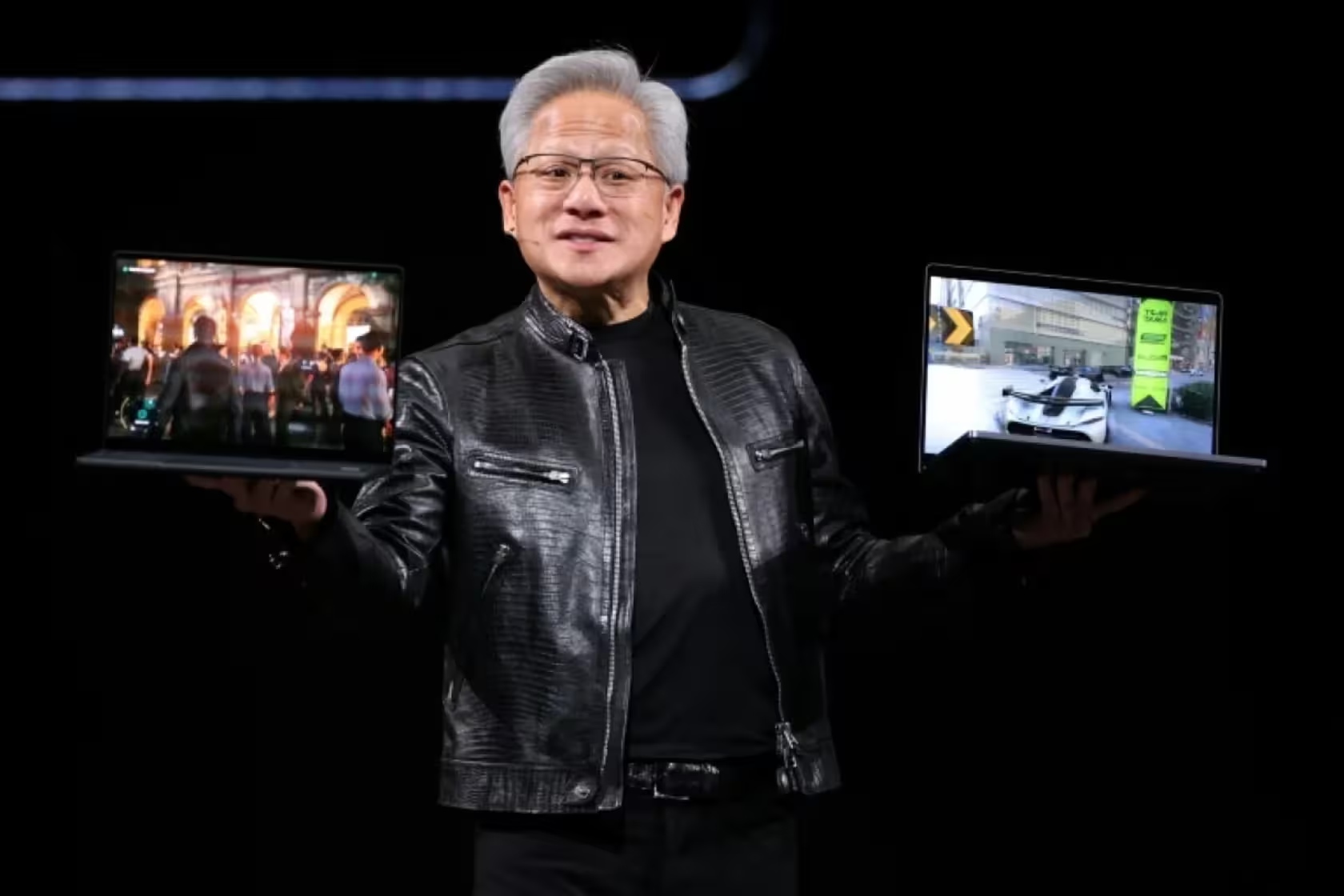
Hardware partners raced to design around the chip. Expect RTX Spark laptops this fall from Asus, Dell, HP, Lenovo, MSI and Microsoft, with Acer and Gigabyte following. Form factors will skew thin and light: 14 to 16-inch machines, roughly 14 millimeters thick, about 1.3 kilograms, machined aluminum shells, long battery life and Tandem OLED screens with G-SYNC. More than 30 laptop designs and about 10 mini PCs are reportedly in development. Nvidia also revealed a DGX Station for Windows, a desktop-class Blackwell system aimed at enterprise developers.
.avif)
So what changes? For creators, it’s speed plus privacy. For developers, it’s a new compute target that merges heavy AI and GPU tasks into one unified memory space. For gamers, it’s a chance to keep premium frame rates while the machine doubles as an AI workstation. And for the industry, it’s a fresh push to normalize Windows on ARM as a mainstream platform rather than a niche experiment.

Questions remain. Nvidia has not released exhaustive benchmark tables or pricing yet. The initial wave will tilt toward premium notebooks and compact desktops, with more affordable parts expected later. But take one clear lesson away: Nvidia wants the PC to stop being a passive tool that runs your apps and start being an active partner that understands and accelerates the work you ask it to do.

“I cover emerging technologies, digital innovation, and the intersection of tech and everyday life. My goal is to make complex trends accessible and inspiring.”

Discussion
Leave a Comment
Comments (2)
whoa a laptop that’s basically a tiny data center? if that’s real then i'm kinda hyped, but feels too good to be true, gotta see real tests
Is this even true? Running 120B models offline, 1 petaflop on a laptop sounds insane. But battery life, heat, and prices? Also compatibility shenanigans... show benchmarks pls