
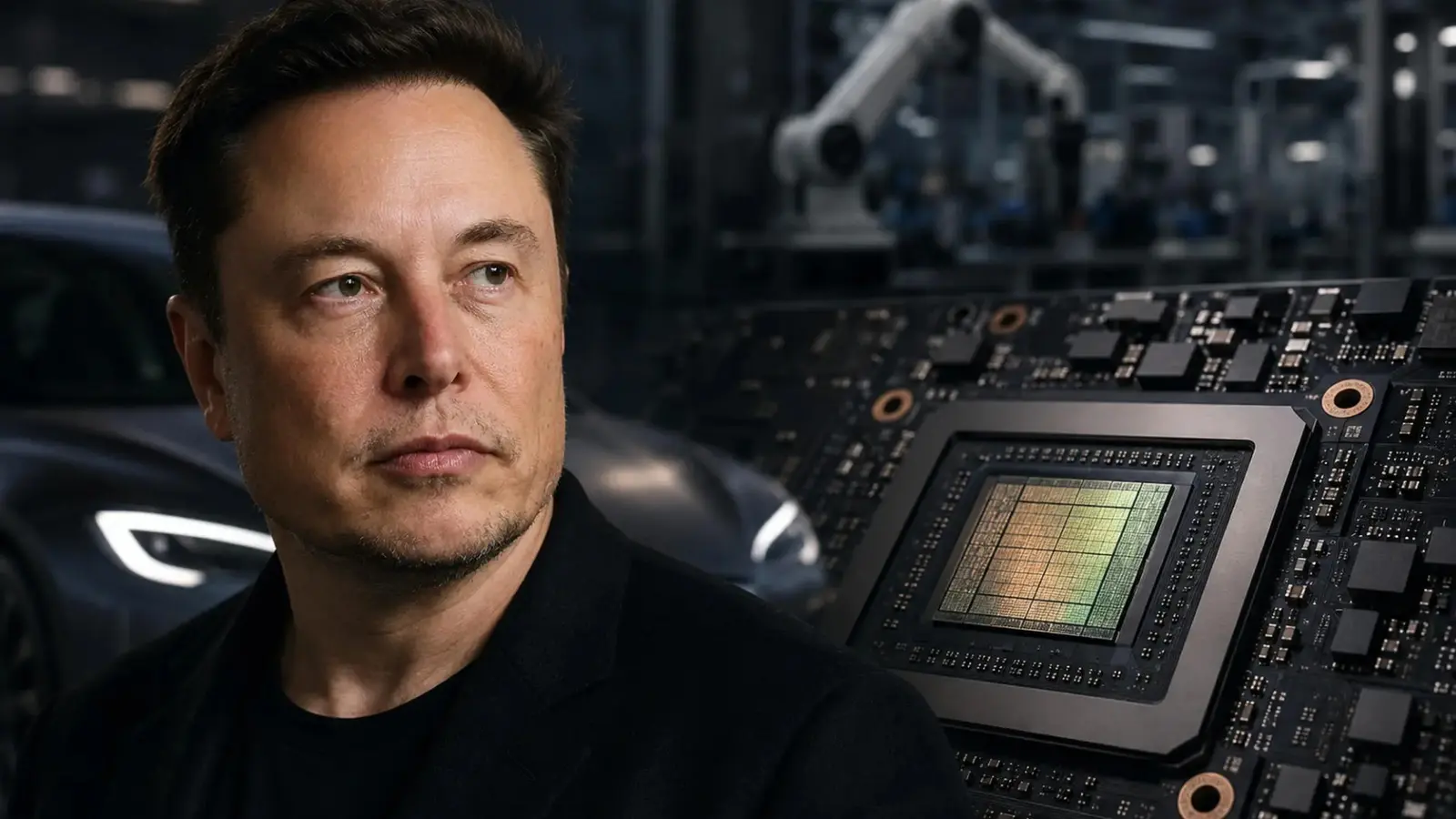
Imagine a single piece of silicon that can do the work of today’s top GPUs while costing a fraction of them. That’s the picture Elon Musk painted in a recent interview, and it’s the kind of claim that forces the industry to look up from its schematic notebooks.
Musk told podcaster Ron Baron that Tesla is developing a chip he believes will deliver two to three times the performance of current Nvidia products while requiring only around ten percent of the cost. He says the physical design is already fully formed in his mind and that development timelines for him run on the scale of one to two years, not the five-year horizon many chipmakers assume.
Why this rattles the AI and automotive worlds
Tesla has quietly spent years building custom silicon for its vehicles’ driving computers. The company uses in-house processors for fleet autonomy, while its sister venture, xAI, has become one of Nvidia’s largest GPU customers. So when Musk talks about a jump in compute efficiency, the implication is not just faster model training or inference; it’s a potential reshaping of economics across data centers and cars alike.
There are immediate angles to consider. Lower-cost, higher-performance chips could drive down the price of deploying large language models or vision stacks. They could enable more capable autonomy at the edge, inside the car, instead of relying on costly cloud inference. They could also change the bargaining power between hyperscalers and chip suppliers.

Musk also tied the development to safety claims. Tesla’s fleet, he says, has logged more than 16 billion kilometers and currently operates at roughly four times the safety performance of human drivers. According to him, the next-generation silicon could push that advantage toward ten times. Bold words. Big stakes. And few independent verifications so far.
Reality check: extraordinary hardware claims are common in tech press cycles. Engineers and investors hear bold targets all the time. What matters is measurable throughput, power efficiency, yield rates in a fab, and the software ecosystem that makes a chip useful. A dramatic improvement on paper must survive the grind of manufacturing tolerances, thermal limits, and real-world data-center economics.
There’s also the practical challenge of building chip fabrication capacity. Musk noted how slow the industry’s build cycles can be and suggested Tesla plans shorter timelines. But fabricating at scale is capital-intensive and fraught with logistical hurdles. Designing a revolutionary architecture is one thing; delivering chips to millions of vehicles or hundreds of data racks is another.
If Tesla truly ships a chip that outperforms existing accelerators at a fraction of the cost, the competitive landscape for AI hardware and autonomous vehicles will change overnight.
For now, take the claims as a strategic signal: Tesla wants to control more of its stack, reduce reliance on external vendors, and push the envelope on what edge hardware can do. Independent benchmarks will be the final arbiter. Until then, the industry will speculate, competitors will scramble, and the story will be watched closely by engineers and investors alike.

“I love exploring gadgets, apps, and trends that redefine how we connect, work, and play in a digital world.”

Discussion
Leave a Comment
Comments (2)
Feels overhyped but okay, if true this changes edge autonomy big time. Still, designing is one thing, scaling fabs and software is brutal, power and yields tho
If Tesla really builds a chip 2-3x Nvidia at 10% cost, wow. But where are the independent benchmarks? Fabrication, yields, power — all the hard bits. Vaporware until silicon shows up…