
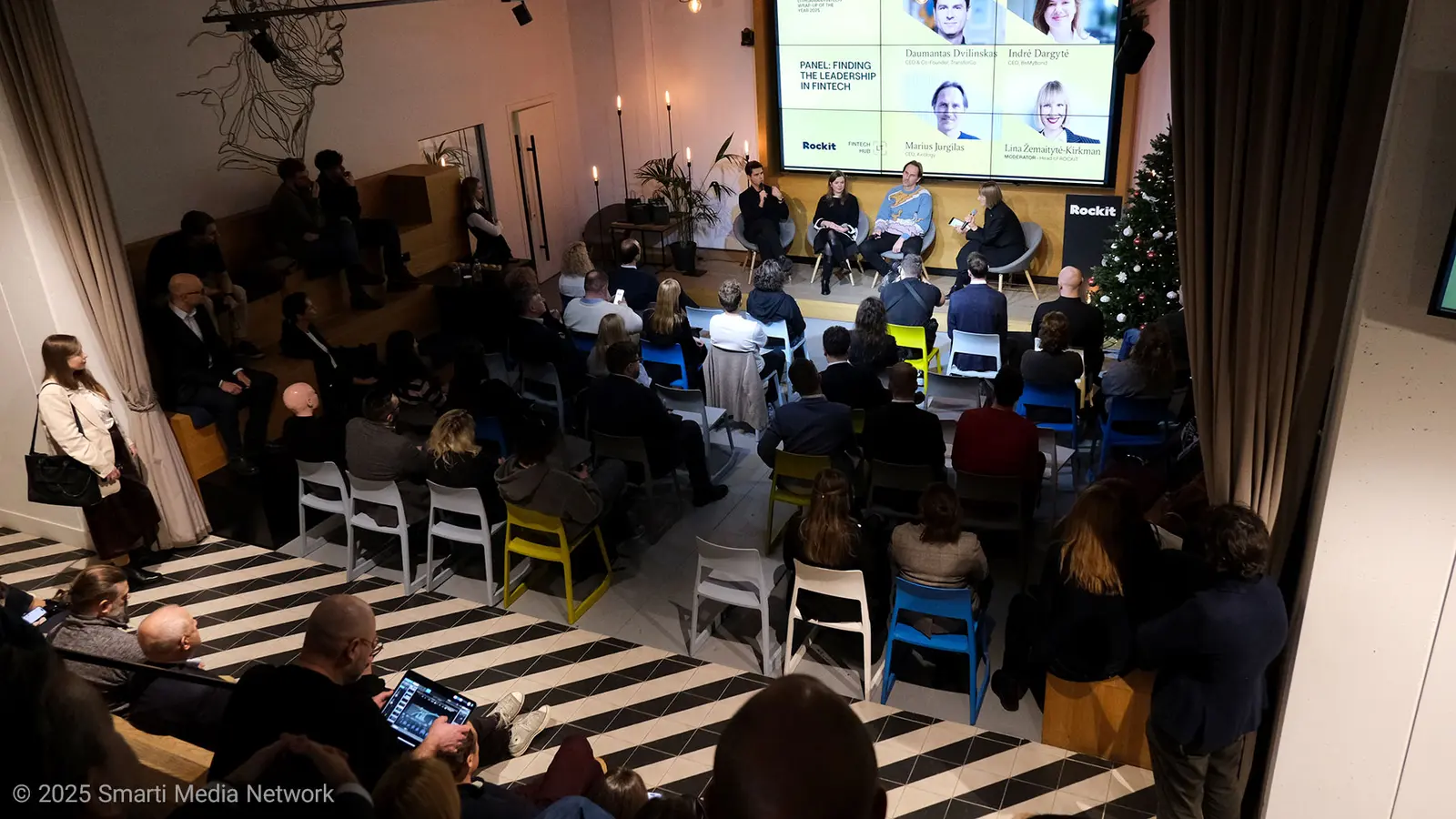
VILNIUS – If there was one overarching theme at yesterday’s massive gathering at ROCKIT, it was this: The party isn't over, but the rules have changed.
As the snow settled outside in Vilnius, the heat inside the venue was palpable. The event, titled Lithuanian Fintech Wrap-up of the year 2025, brought together the entire ecosystem—startups, regulators, banks, and investors—under one roof. But unlike previous years, where the mood was often defined by unbridled optimism and growth-at-all-costs, this year’s tone was different. It was sharper. It was more critical. It was mature.
From the Vice Minister of Finance calling the sector a "strategic national asset" to the Regulator admitting disappointment in the crypto sector, and founders debating whether to slow down licensing to filter out "crooks," the message was clear: Lithuania is no longer trying to prove it exists. It is trying to define what global leadership looks like.
Smarti was on the ground to cover every keynote, fireside chat, and panel discussion. Below is our comprehensive wrap-up of the event that defined the roadmap for 2026.
1. The Government’s Perspective: A New Roadmap for a "Strategic Asset"
The event opened with a keynote from Januš Kizenevič, Vice Minister of Finance. His presence alone signaled the weight of the occasion. The days of fintech being a niche experiment are gone; today, it is a pillar of the Lithuanian economy.
Kizenevič acknowledged the "courage" of the decisions made a decade ago but wasted little time on nostalgia. His core message was a warning against complacency:
“What was impressive a few years ago is not enough today. Definitely not enough. To stay competitive, we need to keep moving.”
He unveiled the government's updated strategic guidelines for 2023-2028, which have been refreshed to meet the realities of 2025. The focus has shifted from simple payments to deep-tech infrastructure.

Key Takeaways:
Web3 & Real-World Assets (RWA): The government committed to providing regulatory clarity for DAOs and smart contracts, aiming to make Vilnius a hub for the tokenization of real-world assets.
The AI Sandbox: A call to action for companies to test AI solutions within a safe regulatory environment to build national expertise.
Talent Shortage: A specific focus on solving the shortage of AML (Anti-Money Laundering) specialists, acknowledging that growth is currently bottled-necked by compliance talent.
The Vice Minister closed with a promise that the Ministry sees the community as a partner, not just a tax base, setting a collaborative tone for the rest of the afternoon.
Read the Full Report: Ministry of Finance Signals New Phase for Fintech
2. The Numbers: €3.6 Billion Value & The "Compliance Crunch"
Following the Ministry, Greta Ranonytė, Head of Fintech Hub LT, took the stage to deliver the "State of the Ecosystem" address. This wasn't just a speech; it was a data-heavy audit of the sector's health.
The numbers she presented were staggering. The fintech sector now contributes €3.6 billion annually to the Lithuanian economy. More impressively, while the EU financial workforce grew by an average of just 1% over the last decade, Lithuania’s grew by 40%.
However, Ranonytė balanced the hype with hard truths. She highlighted that while tax contributions hit a record €232 million in the first three quarters of 2025, a significant portion of that comes from crypto giants like Binance (DFINITY). With the full implementation of MiCA (Markets in Crypto-Assets) and the end of transitional periods, she predicted a potential dip in these figures for 2026.

Sector Highlights:
Specialized Banks: Assets grew by 50% year-on-year, exceeding €1.5 billion.
P2P Lending: Peer-to-peer platforms have officially overtaken traditional non-bank lenders in consumer credit portfolio size.
The Warning: Ranonytė warned founders that 2026 will be a grueling year for regulatory work. Her advice? "Hug your compliance officers—they are going to have a very intense year."
Read the Full Report: Fintech Hub LT Market Analysis 2025
3. The Regulator: "We Are Still Hungry"
In perhaps the most anticipated session of the day, Marius Skuodis, Board Member at the Bank of Lithuania, sat down for a fireside chat with Chris Crespo. The conversation was refreshing for its lack of bureaucratic language. Skuodis spoke not just as a regulator, but as an ecosystem architect frustrated by missed opportunities and energized by new ones.
The "Invisible Threat" Skuodis provided definitive proof of fintech's impact on the average citizen. He cited the entry of Revolut into the mortgage market as the primary driver for lowering interest rates in Lithuania, debunking the myth that high rates were due to "geopolitical risk."
.avif)
The Crypto Disappointment He was equally candid about the crypto sector. Despite Lithuania positioning itself as a hub, Skuodis revealed that only about 50 Virtual Asset Service Providers (VASPs) applied for MiCA licenses, with 40% of them rushing in at the last minute. "We expected much more," he admitted, signaling that the transition from unregulated space to MiCA compliance has been harder than anticipated for many players.
The New KPI Most importantly, Skuodis declared the end of the "license factory" era. The Bank of Lithuania is no longer measuring success by the number of new licenses issued.
"Our KPI is not the number of licenses. It is about the maturity of the system."
He warned that the sector might be becoming "too tired," with profits concentrated in a few giants while smaller players struggle. This signaled a potential wave of consolidation or culling of "zombie" companies in 2026.
Read the Full Interview: Fireside Chat with the Bank of Lithuania
4. Sustainability: Profit, Not Charity
The narrative shifted from regulation to innovation in the "Fintech for Good" panel. Moderated by Felicia Jackson, this session dismantled the old binary that you either make money or you save the planet.
Aušrinė Armonaitė (InRento) and Laimonas Noreika (InSoil) presented business models where sustainability is the engine of profit, not a cost center.
InRento’s Real Estate Revolution: Armonaitė shared data showing that renovating existing buildings (conversions) reduces carbon footprints by up to 50% compared to new construction. But more importantly for investors, these projects are generating returns of ~12%, outperforming traditional buy-to-let investments (9%). By democratizing access with a €500 entry ticket, InRento is allowing the average person to profit from urban regeneration.
.avif)
InSoil’s "Measurable or Fake" Doctrine: Noreika introduced the concept of "Transition Finance" for agriculture. His company provides 0% financing to farmers to switch to regenerative practices. He argued that farmers don't buy "sustainability"—they buy lower costs and efficiency.
"I am personally tired of the word sustainability... It is either measurable or it is fake."
The consensus? Fintech has moved beyond the disruption phase and is now in the "integration" phase, acting as the financial plumbing that enables physical industries (farming, construction) to decarbonize profitably.
Read the Full Report: Fintech for Good - Financing a Sustainable Future
5. The Leadership Debate: "Stop Apologizing"
The event concluded with a panel that can only be described as a "reality check." Moderated by ROCKIT’s Lina Žemaitytė-Kirkman, the session brought together Daumantas Dvilinskas (TransferGo), Indrė Dargytė (BeMyBond), and Marius Jurgilas (Axiology).
The discussion was raw. It touched on the "shame" of scandals and the frustration of being a "high-risk" jurisdiction.
The "Crooks" vs. The "Dinosaurs" Dvilinskas argued passionately that the ecosystem needs to "get rid of the crooks." He suggested that the regulator should actually slow down licensing to ensure only quality players enter, protecting the reputation of the 99% of good actors. Jurgilas countered that the goal should be to "get rid of the dinosaurs"—the legacy incumbents slowing down progress.
.avif)
The "Tick" Analogy In a memorable moment, Jurgilas described Lithuania’s spirit animal as a "Tick"—a creature that is adaptable, resilient, and able to "suck opportunity" out of any situation, regardless of the political or economic climate.
The Final Verdict The panel agreed that looking over the shoulder at Latvia or Estonia is a waste of time. Lithuania’s competition is now Ireland, the UK, and the US. With a mature regulator, a massive talent pool, and unicorns like TransferGo leading the way, the time for "imposter syndrome" is over. As Marius Jurgilas put it in his closing remarks: "Stop apologizing and just look forward."
Read the Full Report: Finding the Leadership in Fintech
Watch: The Atmosphere at ROCKIT
To give you a glimpse of the energy, the debates, and the community that makes this ecosystem unique, our team put together a short highlight reel from the event.
Conclusion: The Road to 2026
The Lithuanian Fintech Wrap-up of the year 2025 was more than just a conference; it was a graduation ceremony. The ecosystem has graduated from the "Wild West" days of easy licenses and explosive, unchecked growth.
It is now entering a deeper, more complex phase involving AI governance, Real-World Asset tokenization, and the hard work of global leadership. The challenges are real, from the "compliance crunch" to the talent shortage but as the speakers at ROCKIT demonstrated, so is the ambition.
Smarti will continue to follow these stories as they develop. Stay tuned.

“Some times I write about breakthrough startups, digital ecosystems, and how innovation is changing the way we build businesses.”

Discussion
Leave a Comment