
Apple's M6 chip, now shipping in the latest Mac mini and MacBook Pro models, is a 2 nanometer-generation processor that pushes single-core performance and energy efficiency forward while Apple intentionally limits its memory bandwidth and maximum unified RAM. The result is a technically ambitious chip that is also engineered to preserve product segmentation across the Mac lineup.
2 nanometer process and transistor architecture
The M6 uses a 2 nanometer process node as a generational label rather than a literal transistor size. Macworld's technical examination estimates the M6 silicon die area at about 142 square millimeters, versus an estimated 157 square millimeters for the M5 and 119 square millimeters for the M1. To achieve higher frequency and lower leakage at this scale, Apple and TSMC moved from FinFET transistors to GAAFET, where the control gate wraps the channel on four sides instead of three. That change reduces microscopic leakage, improves voltage stability, and helps the processor sustain high clock speeds with lower power draw.
- Process: TSMC 2 nanometer generation
- Transistor architecture: GAAFET (gate-all-around)
- Silicon die area: ~142 mm2 (Macworld)
- Maximum unified memory: 32 GB
- Memory bus: 128-bit (same as M1 era)
Three-tier CPU design, cache layout and memory configuration
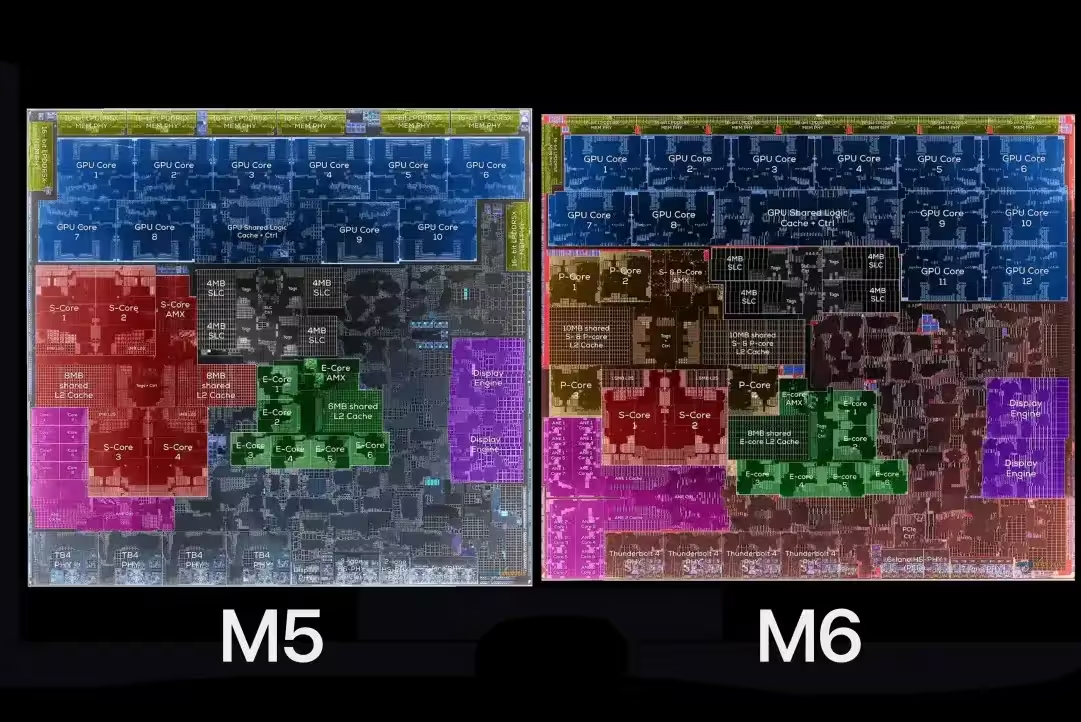
Apple redesigned the M6 CPU into a three-tier arrangement of cores. The configuration comprises two ultra-high-performance "super" cores, four mid-level performance cores, and six efficiency cores, for a total of 12 CPU cores. The super cores can reach up to 4.78 GHz, the performance cores up to about 4.5 GHz, and the efficiency cores operate around 2.94 GHz. Apple removed two super cores from the previous generation to add four performance cores, a trade-off that raises multi-core throughput without sacrificing single-core peak speed.

Cache and memory layout were adjusted to support the wider active core set. System-level cache (SLC) remains at 16 MB shared across the chip. Shared L2 cache for the super and performance clusters increased from 16 MB to 20 MB to better feed six active mid-to-high cores instead of four. The super cores retain their dedicated 1.5 MB private cache. The six efficiency cores are grouped with their own cluster cache and an on-die matrix accelerator (AMX) to handle light math and small AI tasks without waking the large cores.

Apple offers different memory configurations and speeds across capacity tiers. In 16 GB configurations, memory bandwidth is about 153 GB/s, identical to the M5 in comparable configurations. With faster memory in 24 GB and 32 GB configurations, peak bandwidth can reach up to 170 GB/s. The underlying memory interface remains a 128-bit bus that Apple has left unchanged since the M1 generation.
Benchmarks, GPU, neural engine and upgrade guidance
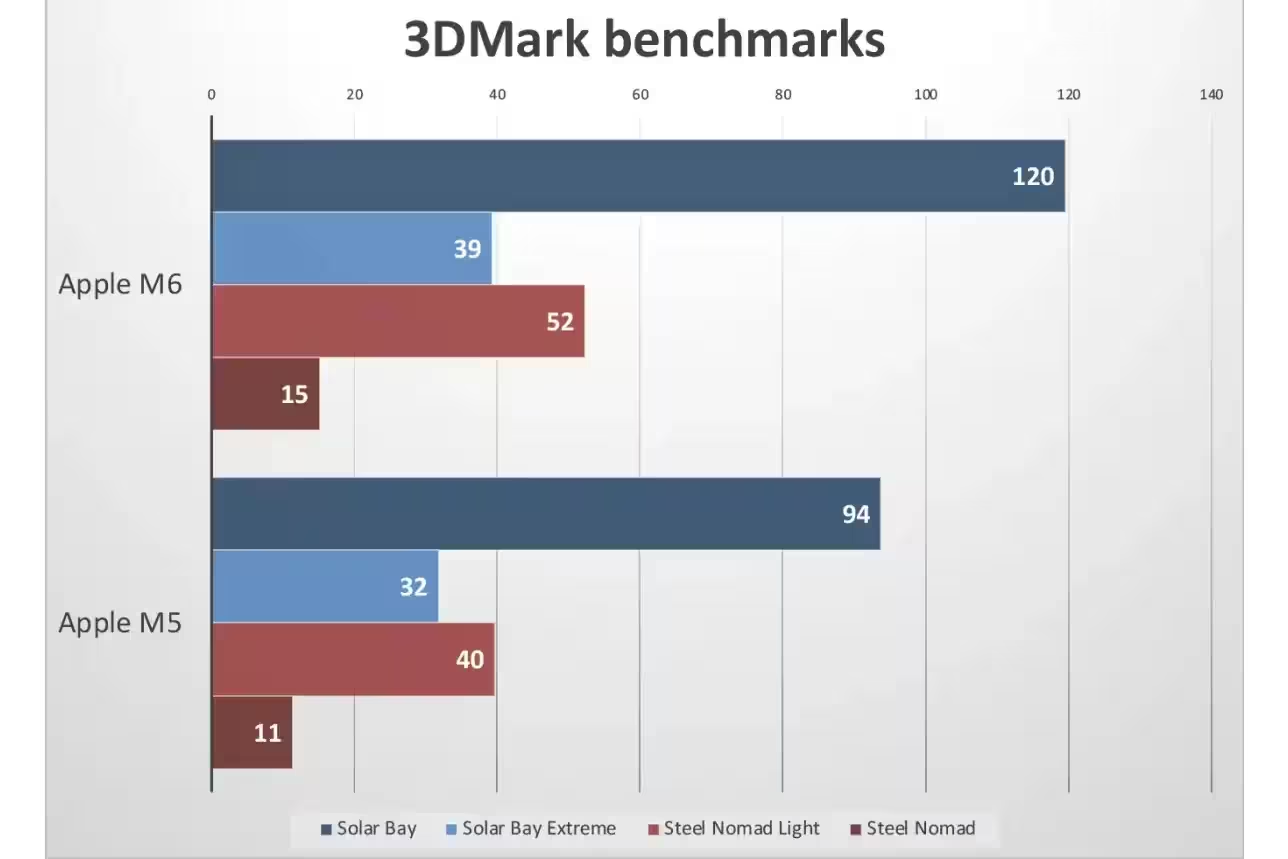
Independent benchmarks show meaningful gains for the M6 but also reveal limits. Notebookcheck's Geekbench 6.7 results for an M6-equipped Mac mini report single-core 4698 and multi-core 21302, versus 4326 and 18054 for M5, and 3655 and 15128 for M4. Those figures correspond roughly to an 8.6 percent single-core improvement over M5 and an 18 percent multi-core advantage. Notebookcheck's Cinebench 2024 results list the M6 at 221 single-core and 1468 multi-core, versus 200 and 1172 for the M5, or about 10.5 percent and 25.3 percent gains respectively. Notebookcheck also measured single-core efficiency at about 15.2 Cinebench points per watt for the M6 versus 13.1 for the M5.
Graphics and AI were both upgraded. The integrated GPU rises from 10 cores to 12 cores; Apple and independent testing indicate roughly a 30 percent graphics improvement over M5 and near 80 percent versus M4 in compute-limited workloads. In simulated gaming benchmarks at an 18 watt GPU power point, the M6 GPU delivers performance comparable to an Intel Arc B390 integrated part and is reported to exceed Qualcomm Adreno-class results in those tests.
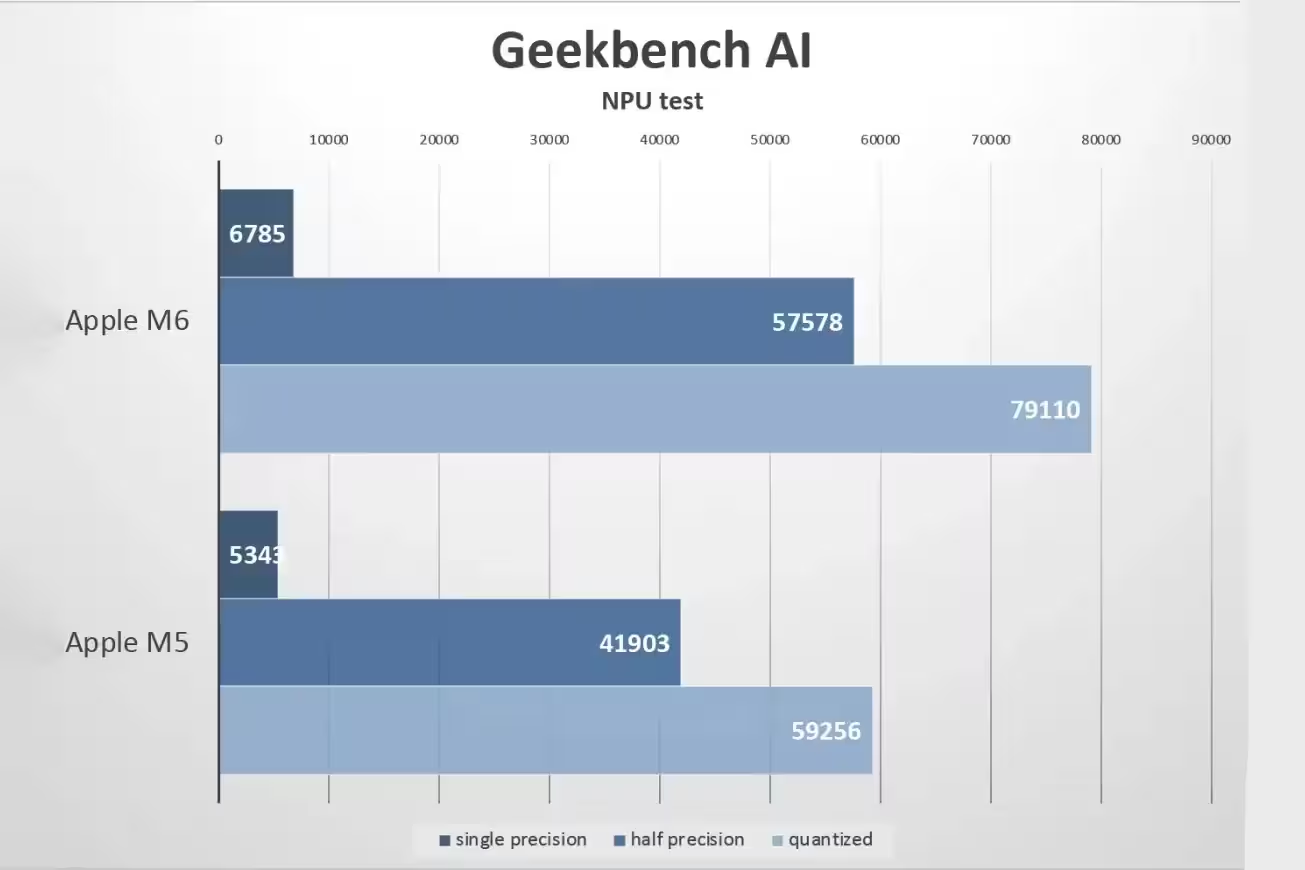
Apple doubled the neural engine differently than simply increasing a single block. The M6 contains two 16-core neural units, each with its own cache, orchestrated by a central controller, whereas M5 used a single 16-core engine. Apple states that on-device AI tasks in the 14-inch MacBook Pro can run up to 25 percent faster than on M5 and that the dual neural engine can be up to 1.9 times faster than M5 in certain workloads. In practical inference tests on quantized models, the M6 configuration showed about 35 percent faster results than M5 and roughly 20 percent faster than the M5 Pro in the cited comparisons.
Despite these gains, M6 is not universally dominant. Some multi-core Geekbench 6.7 runs show that Qualcomm Snapdragon X2 Elite Extreme can outperform M6 in certain scenarios. More significantly, the 128-bit memory bus and the 32 GB unified memory ceiling limit sustained throughput for concurrent CPU, GPU and neural workloads. When processor cores, the 12-core GPU and the dual neural engine demand simultaneous access to a shared memory channel, the limited bandwidth can become a bottleneck for large AI models, complex video timelines and other data-hungry tasks. The M6 therefore appears designed for strong local performance on typical workflows while leaving the highest-bandwidth, highest-memory-capacity workloads to Apple's Pro and Max silicon variants.

For users considering an upgrade: moving from M1 or M2-era Macs to an M6 system yields a clear generational jump in single-threaded responsiveness, graphics and thermal efficiency. Owners of M4 or M5 systems will see meaningful architectural advances in M6, but real-world improvement depends on whether their workloads are bandwidth-bound. Apple has deliberately kept the memory interface narrow to differentiate product tiers and steer professionals toward more expensive chips with wider memory buses.

“I cover emerging technologies, digital innovation, and the intersection of tech and everyday life. My goal is to make complex trends accessible and inspiring.”

Discussion
Leave a Comment
Comments (1)
Whoa, GAAFET at 2nm sounds wild. But capping unified RAM and sticking with a 128-bit bus feels like deliberate product gating. Love the perf gains tho curious about big-model limits...