

Google introduced Gemini 4 Carbon, a high-end AI model focused on coding, long-running agent tasks, and cybersecurity. Google called Carbon its most powerful model, but it is not yet publicly available; early access is limited to a small group of security specialists.
Long-running agent workflows and software development
Carbon is designed to sustain multi-day agent missions, maintain progress through complex projects, and produce usable software outputs. Google reports internal examples in which the model continued working for several days, navigated dead ends, and hunted the root causes of subtle bugs in large codebases and low-level systems. The model is intended to break problems into smaller steps, evaluate the result of each action, choose alternate approaches on failure, and deliver fixes that respect project constraints.
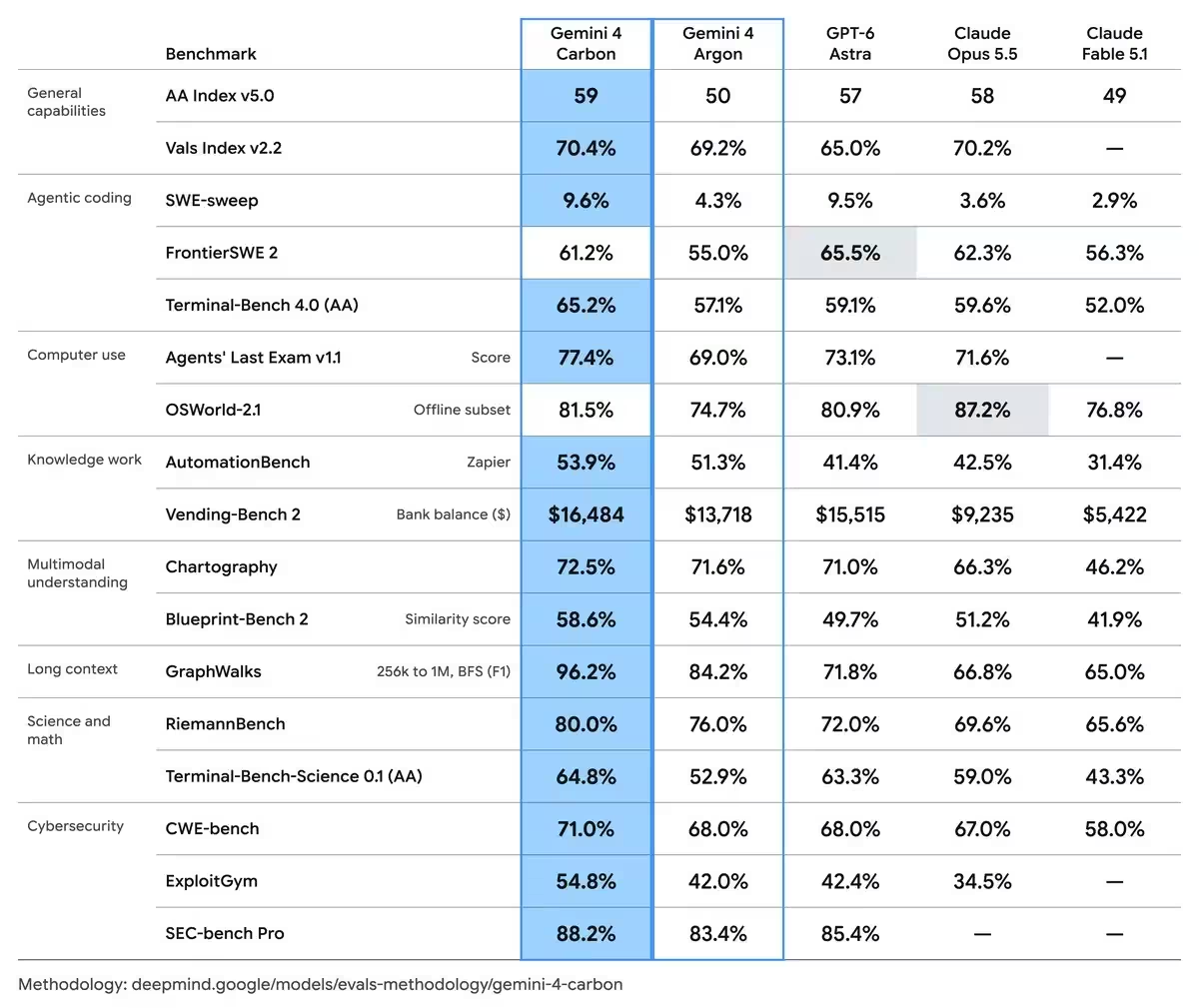
Google said Carbon shows improvements across scientific reasoning, multimodal understanding, full web development, and usable output generation. In the Artificial Analysis Intelligence index version 5.0, Gemini 4 Carbon scored 59 and ranked first. In WebDev Arena, Carbon jumped 89 points to a score of 1769 and placed fourth; Google notes this metric measures output quality by direct-response comparison and does not guarantee identical performance across all real-world projects.
Three-stage cybersecurity workflow and benchmark results
Google positions Carbon around a three-step cybersecurity cycle: find a real vulnerability in a large codebase, assess exploitability, and produce a remediation that addresses the root cause.
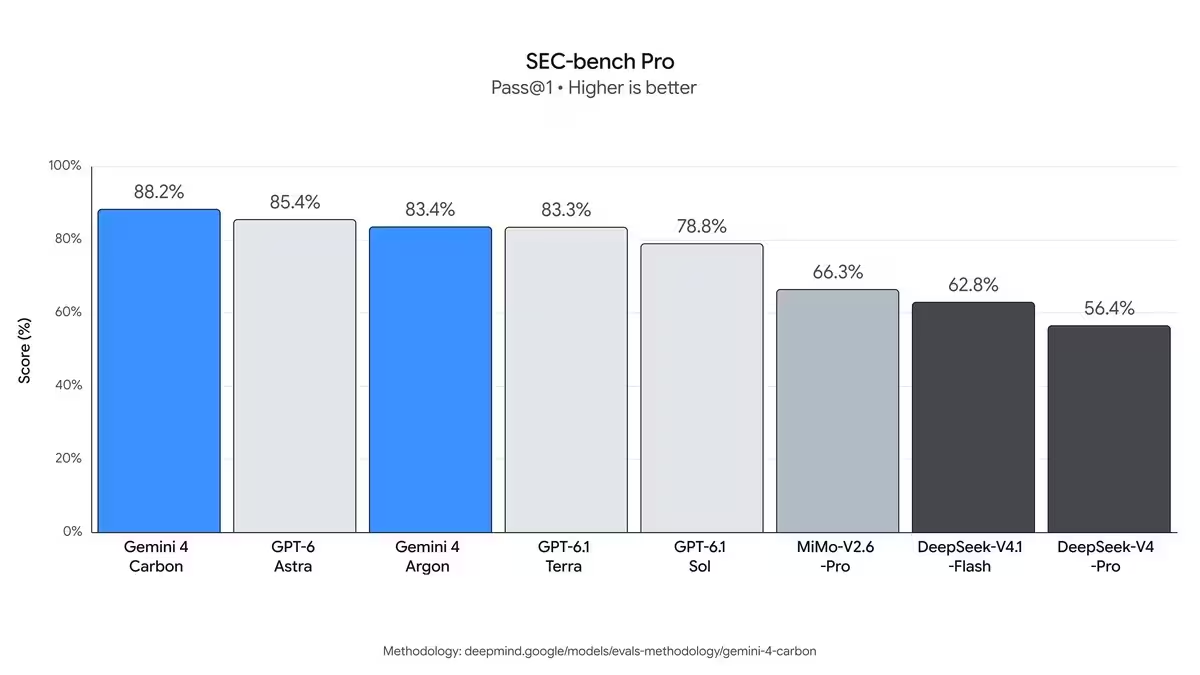
- Discovery: Carbon scored 88.2 percent on SEC-bench Pro, automatically identifying complex hidden defects in real software.
- Exploit validation: Carbon scored 54.8 percent on ExploitGym, which evaluates whether a model can judge exploitability.
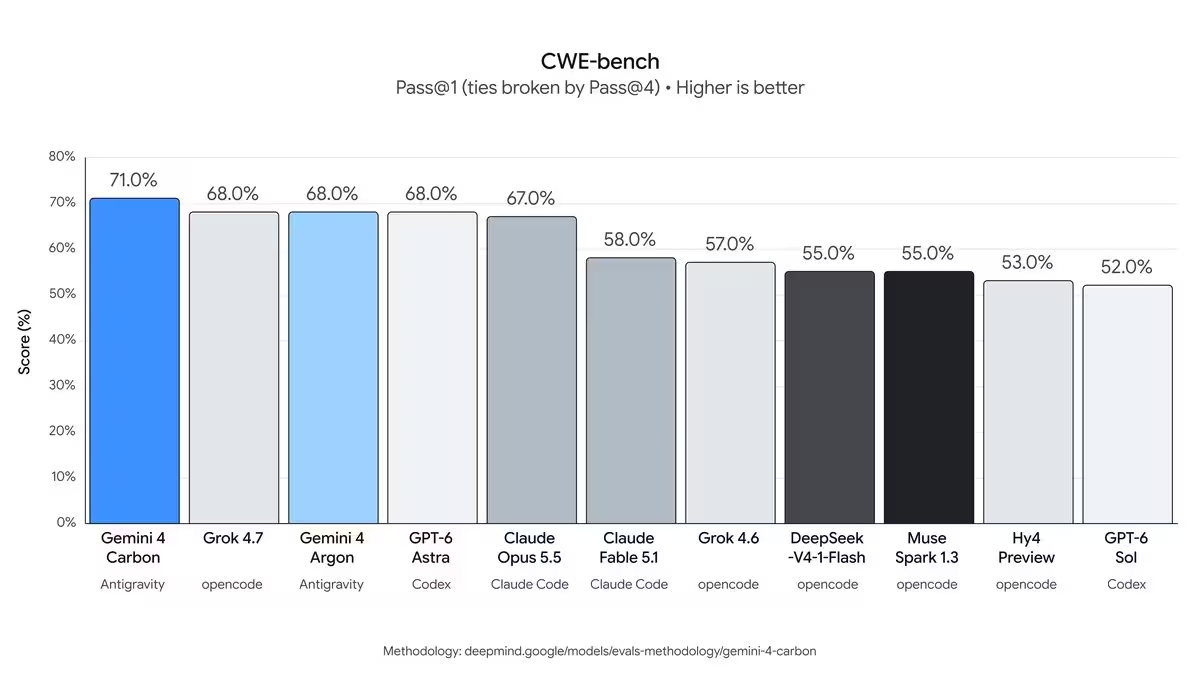
- Root-cause remediation: Carbon scored 71 percent on CWE-bench from Collinear, converting valid findings into executable patches.
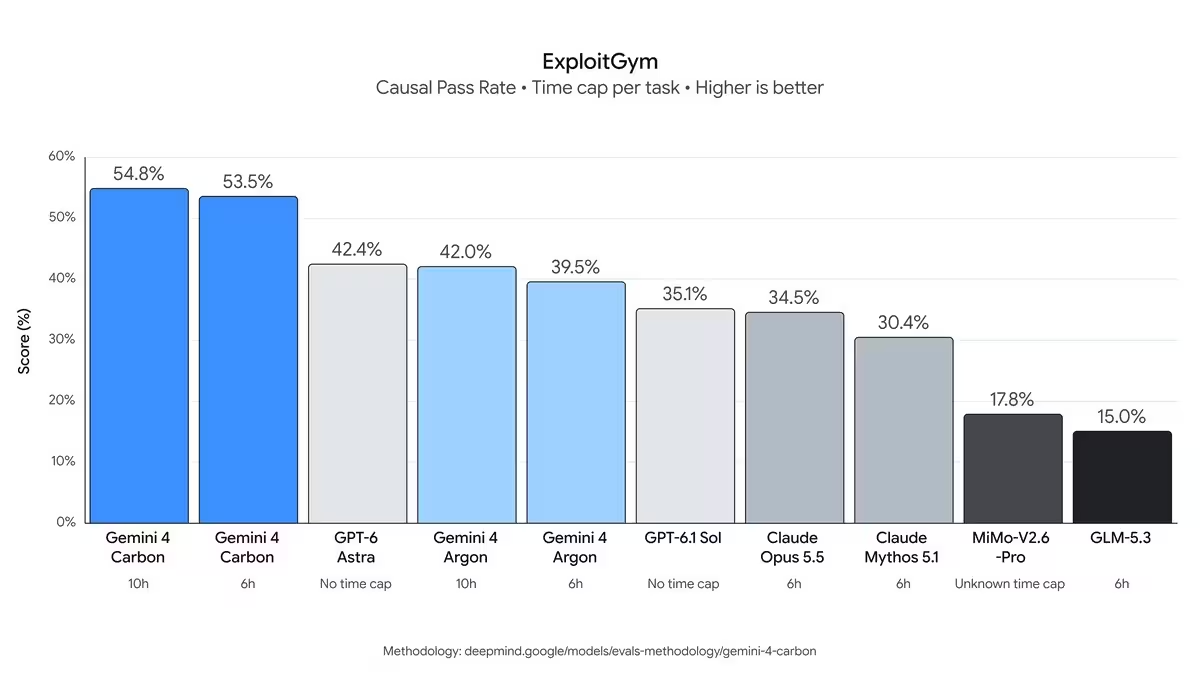
Those external tests were run without safety layers so the raw capabilities of the model could be measured; Google cautions that production deployments will include restrictions and abuse-detection systems. In internal evaluations, Carbon's success rate for producing secure code was reported as more than double Argon. The Chrome team reported Carbon produced higher-quality fixes at a rate more than 10 times that of a large unnamed model from another lab; Google did not disclose the competitor or full test methodology. Security platform Wiz also observed Carbon's advantage in web-intrusion metrics used in its Scan for Good program.
Safety architecture, prompt-injection resistance, and staged rollout
Google applied the same multilayer defensive architecture used for Argon, combining model training controls, real-time abuse protections, prompt-injection resistance, and chain-of-reasoning monitoring. Training objectives aimed to prevent the model from finding shortcuts that score well without solving the underlying problem.
In internal safety benchmarks, Carbon achieved a zero percent successful-cheat rate and a 0.4 percent cheat-attempt rate on Terminal-Bench 4.0 while overall accuracy increased. Live internal coding environments reported roughly an 80 percent reduction in severe behavioral-mismatch alerts. Tests also showed claims without evidence fell to about half the rate seen in Argon. Carbon can retrieve relevant sources before acting and flag inconsistencies in the data it finds. Google reported reductions of 26 percent in out-of-scope behavior and 29 percent in insufficient-service responses.
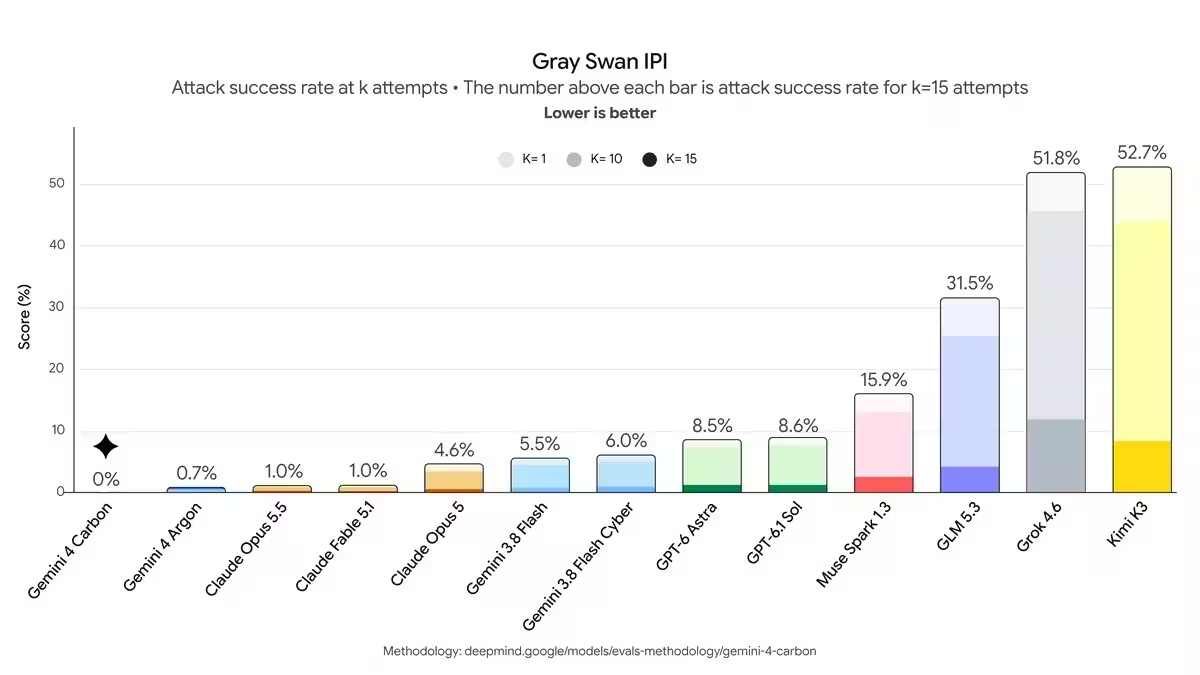
Carbon recorded a zero percent success rate against Indirect Prompt Injection attacks in the Gray Swan benchmark, compared with Argon at 0.7 percent on the same test. Google is conducting a staged rollout, participating in the U.S. voluntary government testing process. An initial group of cybersecurity defenders will have access, followed by expansion to trusted partners through the Fairwind Program. Tester feedback will be used to refine safeguards; Google gave no timetable for general availability.
Pricing and billing details
Google said Carbon will match Argon for introductory pricing. During the initial period processing each one million input tokens costs $2 and generating each one million output tokens costs $10. Stored input tokens in cache are billed at a 95 percent discount relative to the input price. After the introductory period, input token costs rise to $4 per one million and output token costs to $20 per one million. Google noted the final cost of long-running agent projects depends on more than the per-token rate, including the number of steps, tool invocations, context volume, and cache usage.


“I cover emerging technologies, digital innovation, and the intersection of tech and everyday life. My goal is to make complex trends accessible and inspiring.”

Discussion
Leave a Comment
Comments (1)
Wow, if Carbon really hunts root causes across days that's wild. Limited access tho? suspicious. Pricing seems steep, curious how it handles messy legacy code...