
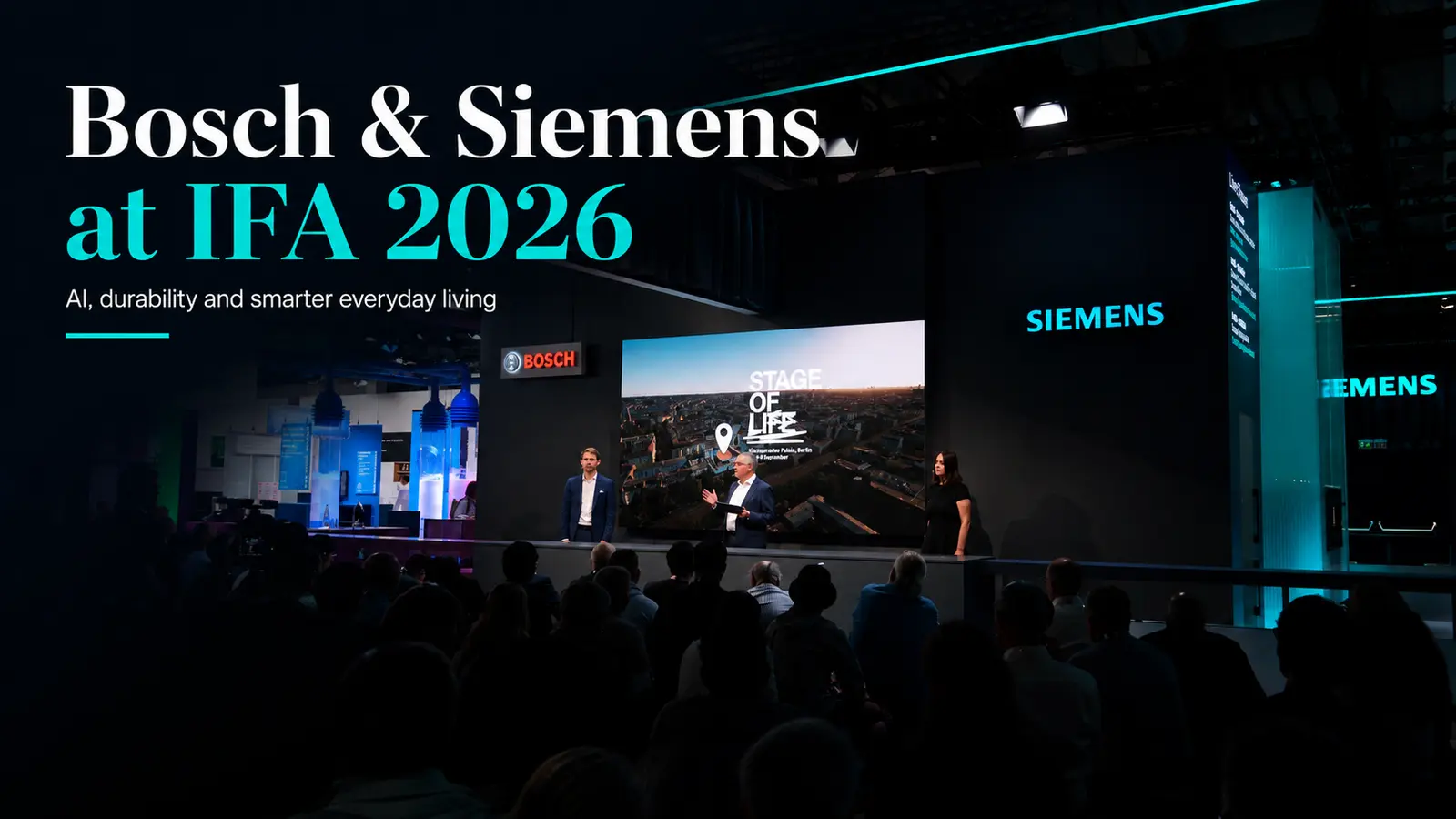
At BSH’s first joint Bosch and Siemens press conference at IFA in Berlin, artificial intelligence was everywhere, but the bigger message was more grounded: technology only matters when it makes everyday life easier.
BERLIN, Artificial intelligence may be one of the loudest themes running through IFA 2026, but Bosch and Siemens used their joint press conference in Berlin to make a noticeably different argument.
The future of the connected home, they suggested, is not about putting AI into an appliance simply because it can be done. It is about making products easier to use, more reliable, more personal and, ideally, useful for considerably longer.
That idea connected an unusually broad range of announcements at BSH’s first joint Bosch and Siemens IFA press conference, held on September 2 in Hall 1.1 at Messe Berlin. BSH board member and Chief Sales & Service Officer Rudolf Klötscher opened the presentation before handing the stage to Christoph Luis for Bosch and Ulrike Pesta for Siemens.
Their presentations revealed two distinct interpretations of the same broader strategy. Bosch concentrated heavily on durability, reliability and practical everyday assistance. Siemens leaned more visibly into artificial intelligence, personalization and premium design.
What joined the two was the idea that an appliance has to prove its value long after the excitement of buying it has disappeared.

BSH wants the relationship to continue after the checkout
Klötscher framed the morning around something less tangible than a new oven or washing machine: trust.
For BSH, he argued, the customer experience does not end when an appliance leaves the store. Connected ecosystems, software and customer service increasingly shape how people experience a product during years of ownership.
That puts greater pressure on manufacturers to think about what happens when something goes wrong, not only what happens during the product demonstration.
Klötscher emphasized the role of customer service in that relationship, describing situations ranging from assistance inside an app to speaking directly with an expert when an appliance fails. In an increasingly digital environment, he said, the human element of service remains particularly important.
It was an important introduction to what followed, because neither Bosch nor Siemens presented connectivity as an end in itself. The repeated argument throughout the conference was that invisible technology may ultimately be more valuable than technology that constantly demands attention.
Bosch: from the cellar to the roof
Christoph Luis approached that idea from the perspective of Bosch’s presence throughout the home.
The company's proposition extends beyond traditional kitchen and laundry appliances into heating, ventilation, air conditioning and smart-home products. One new example announced at IFA is the ability to connect Bosch Smart Home radiator thermostats with Bosch heat pumps, allowing demand-based heating and automatic hydraulic balancing.
But Luis spent at least as much time talking about longevity as connectivity.

Bosch says its washing machines and dryers are engineered and tested around a service-life target of up to 20 years under appropriate conditions, an idea the company packages under its "Tested to last 20 years" message. The point is less about making an appliance exciting than about making it dependable enough to disappear into everyday life.
Bosch is also trying to make that durability more visible in the second-hand market.
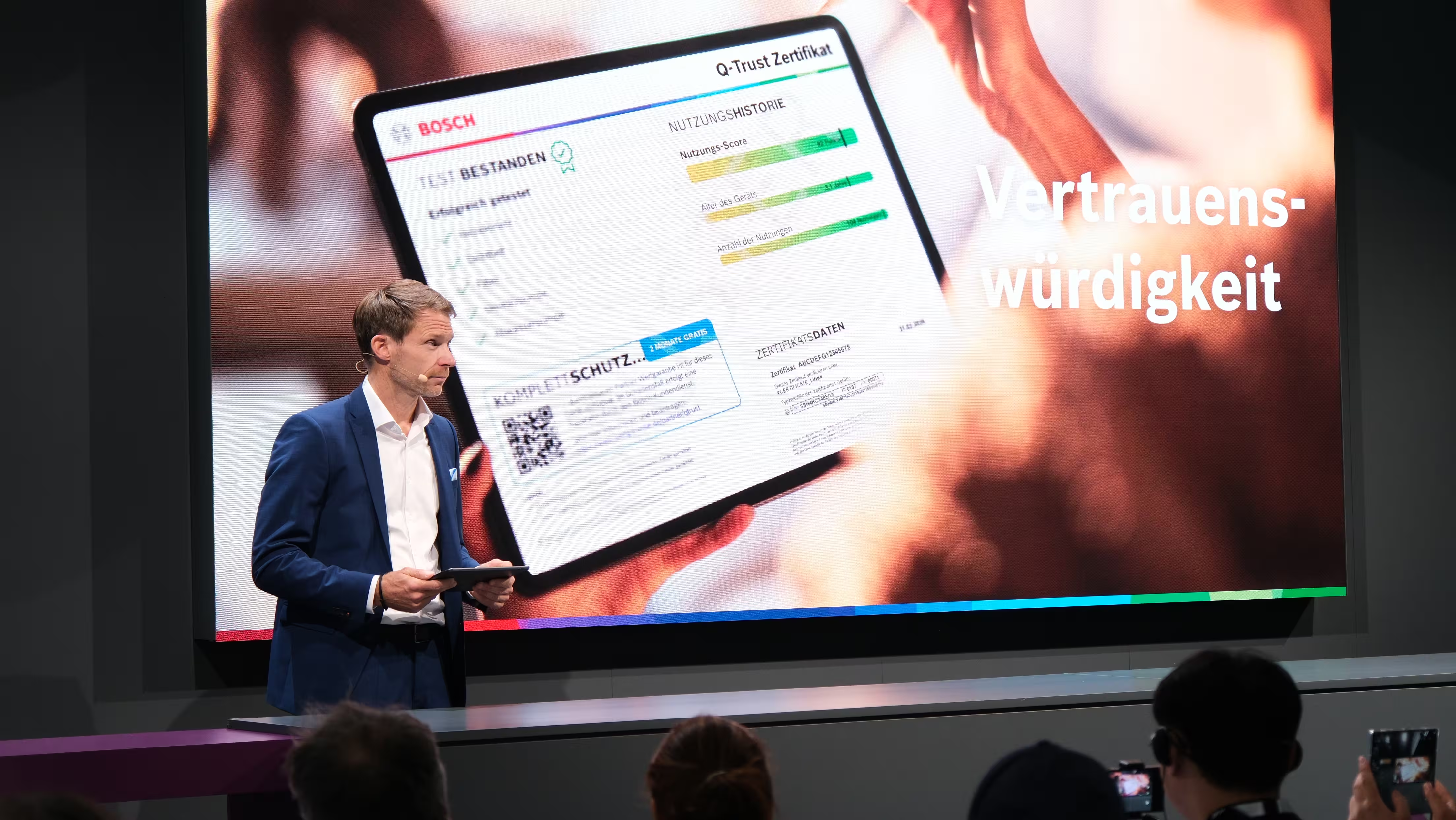
Its new Q-Trust system creates a digital assessment for compatible Bosch dishwashers. Owners can run a self-test through Home Connect, with appliance data used to generate a certificate intended to give potential buyers more information about the machine’s condition and history. Bosch describes Q-Trust as the first digital quality check of its kind.
It is an interesting expansion of the connected-appliance concept. Instead of connectivity being useful only while the original owner is using the machine, Bosch is trying to make appliance data part of the product’s residual value.
AI enters the Bosch kitchen, but does not take control
Artificial intelligence inevitably appeared in the Bosch presentation too.
Bosch Cook AI combines AI, appliance sensors and the Home Connect ecosystem to help users through more complicated cooking processes. The system can provide guidance, coordinate timing between appliances and adjust the cooking workflow while leaving final control with the person preparing the meal.

That distinction was repeated throughout the conference: AI as an assistant rather than an autonomous replacement for the user.
BSH has already demonstrated a wider push in this direction. Earlier this year it presented Bosch Cook AI as a system capable of using AI alongside appliance technology and sensors to dynamically assist cooking and coordinate multiple devices.
But some of Bosch’s most tangible IFA announcements were considerably simpler.
Air fryers become a full Bosch product family
Bosch entered the air-fryer category relatively recently, but it is now expanding aggressively.
The new Series 2 targets smaller kitchens with a compact footprint and a four-liter cooking chamber. At the opposite end sits the Series 6 Double Stack, which uses two vertically stacked six-liter drawers for a total capacity of 12 liters.
Bosch says that capacity makes it one of the largest double-stack air fryers on the market, with enough room for up to two kilograms of French fries.
The 12-liter capacity and two-drawer configuration are also confirmed in Bosch’s official product information for the Series 6 Double Stack.
The broader range reflects a theme Luis returned to repeatedly: households do not all need the same solution. A small apartment may prioritize countertop space, while a family may care more about preparing two dishes simultaneously or cooking much larger quantities.

More storage without a bigger appliance
Bosch applied the same thinking to refrigeration.
Its new freestanding refrigerators and freezers increase usable internal space while retaining conventional external dimensions. A configurable Flex Door system allows door bins to be moved depending on the size and type of food being stored.
Bosch's newly announced single-door range includes 402-liter refrigerators and 334-liter freezers, while the Flex Door design lets users relocate trays and storage elements according to their needs.
It is not a spectacular piece of technology in the conventional sense, but it fits the broader theme of the press conference remarkably well: redesigning familiar appliances around small everyday frustrations.
Sustainability comes to Bosch ovens
The Bosch Green Collection is also expanding.
At IFA, Bosch said ovens are now joining the range. According to the presentation, the materials used in their production have a 20 percent lower carbon footprint compared with standard models, while the Dark Inox handle uses 85 percent recycled material. Bosch said the product carbon footprint has been independently certified by TÜV.
The Green Collection itself is not new. Bosch has already used lower-carbon steel, recycled materials and bio-based raw materials in other product categories as part of an effort to reduce material-related emissions.

Bosch makes a move into semi-automatic espresso
Another notable expansion is coffee.
The Home Coffee Series 4 is Bosch’s first semi-automatic portafilter espresso machine, moving the company into a category aimed at people who want more involvement in preparing coffee rather than simply pressing a button on a fully automatic machine.

The machine combines an integrated burr grinder with 30 grind settings, five dosing presets and adjustable brewing temperature. Its stainless-steel portafilter uses the professional-standard 58 mm diameter, while an anti-static system is designed to reduce the familiar mess of ground coffee around the grinder.
It is a slightly different interpretation of convenience. Rather than automating the ritual away, Bosch is trying to make a more manual coffee process accessible without removing the control that enthusiasts want.

OneFlow tackles vacuuming and mopping together
Cleaning provided one of the more practical demonstrations of the morning.
The new Bosch OneFlow Wet-and-Dry Vacuum Cleaner vacuums and mops hard floors in the same pass and can cover more than 150 square meters on one battery charge. Once cleaning is finished, the docking station can wash the roller with hot water and dry it using hot air.
Bosch's official specification adds some useful detail: the roller is cleaned with water heated to as much as 70°C and dried with air reaching up to 75°C. The product is launching in Series 4 and Series 6 versions.
Bosch also showed its Eyes Plus smart-home service, which uses person recognition with indoor and outdoor cameras to distinguish familiar people from strangers and prioritize notifications the system considers relevant.
Taken together, the Bosch presentation was less about a single headline product than an accumulation of small attempts to remove friction from daily routines.
Then Siemens took the same basic principle in a distinctly more premium and AI-heavy direction.
Siemens sees AI becoming part of the appliance itself
Ulrike Pesta opened the Siemens presentation with a statistic that helps explain the company’s strategy.
Citing NielsenIQ research, she said 57 percent of European consumers regard convenience as the primary factor when purchasing smart home appliances, with AI-supported personalization becoming increasingly important.
For Siemens, that means intelligence should move deeper into the product rather than exist as a collection of separate smart features.
One example is an AI-powered talking oven introduced in China earlier this year. Instead of relying on rigid voice commands or an external smart speaker, the oven understands conversational speech directly and can guide users through the cooking process.


BSH had previously confirmed the launch in China of its first oven with fully integrated AI-supported voice control, part of a wider strategy to use conversational interfaces in home appliances.
Siemens also described an intelligent refrigeration system capable of quickly defrosting frozen food in a dedicated compartment. According to the company, frozen meat can be brought within around ten minutes to a state where it can be sliced, while sensors and algorithms manage the process to preserve texture.
These examples set up the centerpiece of the Siemens kitchen presentation.
An oven that learns the family recipes
The iQ700 oven already uses a camera and artificial intelligence to identify food and automatically select suitable cooking settings.
At IFA 2026, Siemens said the system can recognize more than 100 dishes. The bigger change this year, however, is personalization.
Users can now teach the oven their own recipes. That might be a particular lasagna, a family apple pie or a Sunday roast. Once programmed, the oven can recognize that dish in the future and automatically recall the appropriate preparation settings.
Previous versions of the iQ700 platform already used an integrated camera and AI for automatic dish recognition, with Siemens progressively expanding the number of recognizable foods over successive generations.
What changes with the new personalized recipe function is the direction of learning. The appliance is no longer limited to recognizing dishes defined by Siemens; it can begin adapting to the meals that matter to an individual household.

Siemens continues betting on matte design
Intelligence is only half of Siemens’ premium strategy.
The other half is design, and the company is expanding its Matt Edition range after what it says was a strong response to the original lineup.
The collection uses velvety matte surfaces rather than the more conventional stainless steel and glossy glass found across much of the appliance industry. Siemens is now extending that design language to additional categories, including its steam drawer.
Siemens says its appliance design has accumulated more than 500 international awards over the decades, underscoring how deliberately the company is trying to position aesthetics alongside intelligence rather than treating design as decoration added at the end of development.
Alexa Plus turns the coffee machine into a conversational device
The EQ900 plus coffee machine provided another glimpse at where Siemens believes natural-language interfaces are going.
The machine is being integrated with Amazon’s Alexa Plus service in Germany, allowing interactions based on modern large language models rather than a limited collection of predefined voice commands.
The intention is to make conversation with the appliance more natural. In Pesta’s description, the coffee machine should begin to feel less like a device awaiting instructions and more like a familiar assistant that understands routines and preferences.

More importantly, Siemens said it plans to extend this kind of capability through software updates to existing compatible products where possible, rather than limiting every new software feature to a new hardware generation.
That may eventually matter more than the novelty of speaking conversationally to a coffee machine.
A connected appliance that gains genuinely useful capabilities after purchase has a fundamentally different lifecycle from one whose feature set is frozen when it leaves the factory.
Heat pumps move inside the washer-dryer
The new Siemens iQ700 washer-dryer was one of the strongest examples of that focus on practical engineering.
It combines an 11 kg washing capacity with up to 6 kg of drying capacity while keeping standard appliance dimensions. More significantly, it uses heat-pump technology for the drying process.
Siemens says the machine achieves Energy Efficiency Class A for the combined wash-and-dry cycle, while washing alone performs 20 percent better than the threshold required for Class A.
The specification has been confirmed in Siemens' official IFA release for the new WL64B2A40 iQ700 heat-pump washer-dryer.
Several automated systems are built around it.
i-Dos calculates detergent quantities according to factors including the load and level of soiling. gentleDry uses lower drying temperatures, which Siemens says can be up to 40 percent lower than conventional washer-dryers. intelligentClean automatically removes lint and cleans the relevant internal system after cycles.
These are not the kind of features that necessarily produce dramatic demonstrations on a trade-show stage. They are, however, exactly the sort of features users may notice hundreds of times over the life of an appliance.


The premium laundry room gets an Iconic Edition
Siemens also presented its Iconic Edition for laundry appliances, combining a high-gloss, glass-like black exterior with a flush interface and full-color touch display.
The washing machine includes smartFinish, which Siemens says can reduce wrinkles and creases by up to 50 percent, while the dryer can use information from the preceding wash cycle to adjust drying. A varioSpeed option can reduce drying time by up to 38 percent.
Again, Siemens is treating the laundry room as part of the wider living environment rather than a purely functional corner of the home.
More refrigerator on the same floor space
The final stop in Pesta’s presentation returned to a very simple problem: people want more refrigerator space without necessarily having a larger kitchen.
The new Siemens freestanding refrigerator offers more than 402 liters of capacity, around 15 percent more than predecessor models while retaining the same exterior footprint, according to the company.
Its hyperFresh 0°C system uses controlled humidity and temperatures just above freezing in dedicated compartments to extend freshness, while movable door bins allow the interior arrangement to change depending on the weekly grocery load.
It is another example of the broader pattern that emerged throughout the morning.
Not every innovation at IFA needs to look futuristic.
Sometimes innovation is simply finding another 15 percent of useful space inside something that still fits where the old one did.

Two brands, two personalities, one direction
Putting Bosch and Siemens on the same stage made the differences between the brands unusually clear.
Bosch spoke the language of trust, durability and reliability. The brand’s strongest argument was that technology should remove work from everyday life while remaining dependable enough to fade into the background.
Siemens used a different vocabulary: intelligence, personalization, precision and design. Its appliances increasingly try to understand what the user is doing, anticipate the next step and adapt accordingly.
But beneath the different positioning, the two presentations converged on the same idea.
AI is moving into home appliances quickly, but neither brand wants AI itself to be the product.
The useful part is what happens afterwards: an oven that understands what is being cooked, a washer-dryer that manages detergent and lint on its own, heating that responds more precisely to demand, a vacuum that washes its own roller, or a coffee machine that can understand a normal conversation.
That may ultimately be the more important story from BSH at IFA 2026.
The smart home is becoming more intelligent, but the industry is increasingly discovering that the best technology may be the technology people have to think about the least.

“Some times I write about breakthrough startups, digital ecosystems, and how innovation is changing the way we build businesses.”

Discussion
Leave a Comment
Comments (6)
Makes sense tbh. Invisible tech that just works, now that's the future of the home.
Matte finishes and convo coffee machines feel premium but kinda indulgent. Practical wins (more fridge space) matter way more to me.
I've tested smart sensors in HVAC; demand-based heating can save energy, but only with decent installation. BSH stressing service is right, otherwise AI features flop. Hope diagnostics are solid.
AI ovens that learn recipes?? is privacy considered though, cameras in ovens sounds... weird
Makes sense: long-term value beats flashy specs. But will software updates keep value up? Risk of abandonware is real.
Wow Bosch leaning into 20-year durability? Finally, appliances built to last not to be replaced yearly. Curious about real-world repairs, tho…