
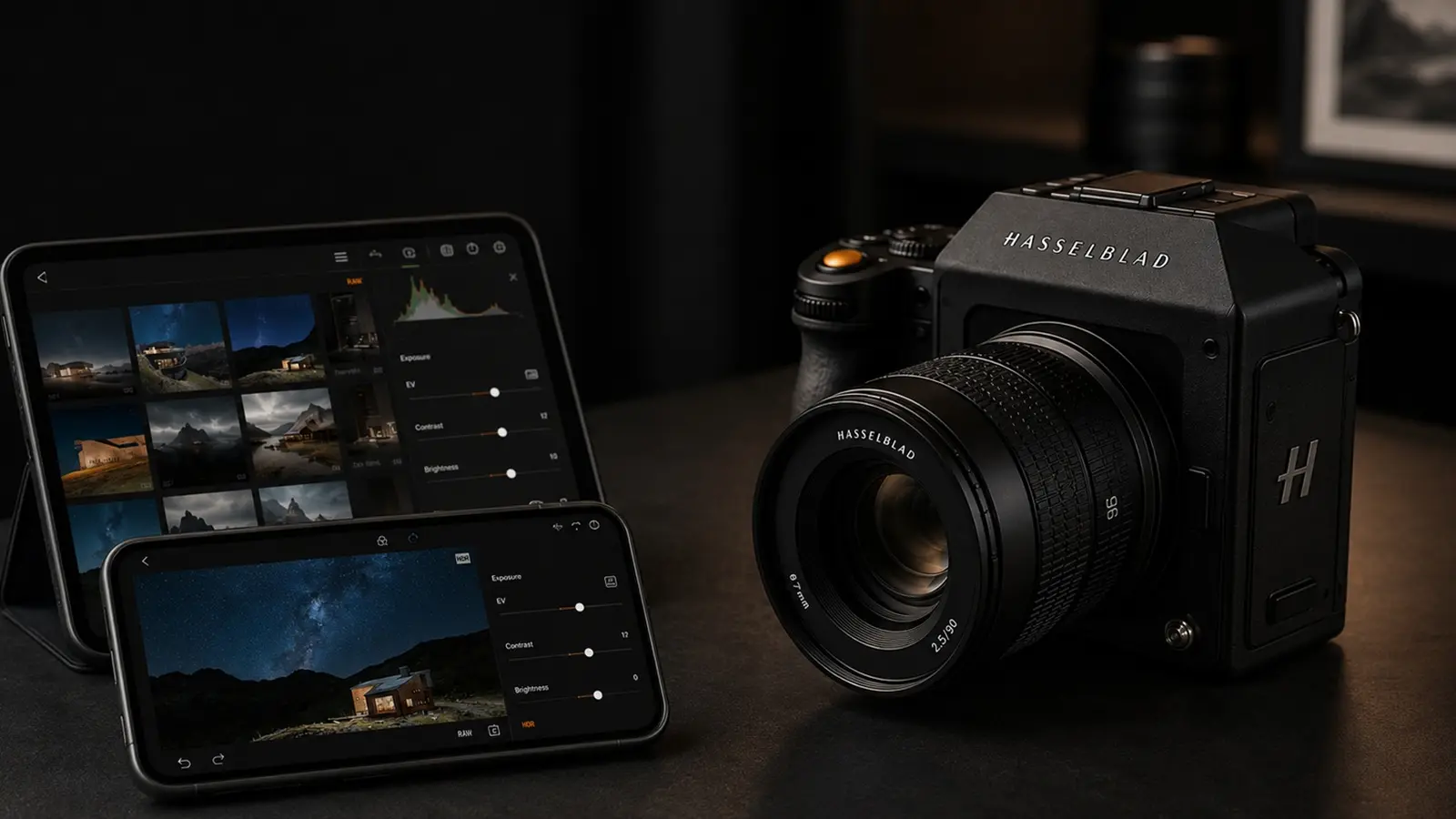
There’s a quiet moment in the camera-app world worth noting: Hasselblad’s Phocus Mobile has finally arrived on Android. Long the preserve of iPhone users, the app now speaks Android, and it’s not just a port. It’s the full Hasselblad experience, tuned for flagship phones that can handle its demands.
Owners of the X2D II, X2D 100C, and the 907X with CFV 100C can now review, edit, organize, and export photos directly from an Android device. That matters because this isn’t a basic preview tool. Hasselblad has transplanted its Natural Color Solution to mobile, along with advanced RAW processing that leans on AI to reduce noise while keeping tonal subtleties intact.
Why Android users should care
Colors hold. Details survive. Highlights and shadows remain convincing. On Android handsets that support HDR, images from the X2D II 100C show richer highlight information and shadow nuance that matches what you saw through the viewfinder. In short: previews stop feeling like approximations and start feeling like the final picture.

Low light used to mean compromise. Now, AI-powered RAW noise reduction steps in and cleans up high-ISO shots without wiping away texture. Expect a wait of about 15 to 20 seconds for a 100MP RAW file to be processed. Two modes give you practical control: Purity Mode chases out noise, while Detail Mode tolerates some luminance noise to preserve the finest edges and grain-like character.
Phocus Mobile for Android is more than noise control. It ships with a robust editing toolkit: exposure sliders, curve adjustments, white balance, monochrome tuning, lens correction, and noise reduction. There’s sharpening, cropping, rotation, and keystone correction too. Apply a look to one file, then roll it out to a batch. That kind of workflow thinking is welcome when you’re shooting tethered or finishing a session on the move.
Connectivity keeps pace with modern gear. Import images over Wi-Fi or via USB-C. Export in multiple formats: JPG, TIFF, HEIF, 3FR, and RAW. That range covers quick social-ready jpegs, high-quality tiffs for retouching, and camera-native files for archival work.
If you’ve been waiting for feature parity between mobile platforms, this is a meaningful step. Hasselblad hasn’t just put Phocus on more phones; it’s preserved the brand’s color science and handed Android shooters the tools to treat mobile devices as part of a professional workflow. The result feels less like a compromise and more like an extension of the camera bag.
.webp "Oppo Find X9 Ultra Hits 3C With a 100W Charger")

“I love exploring gadgets, apps, and trends that redefine how we connect, work, and play in a digital world.”

Discussion
Leave a Comment
Comments
No comments yet. Be the first.