
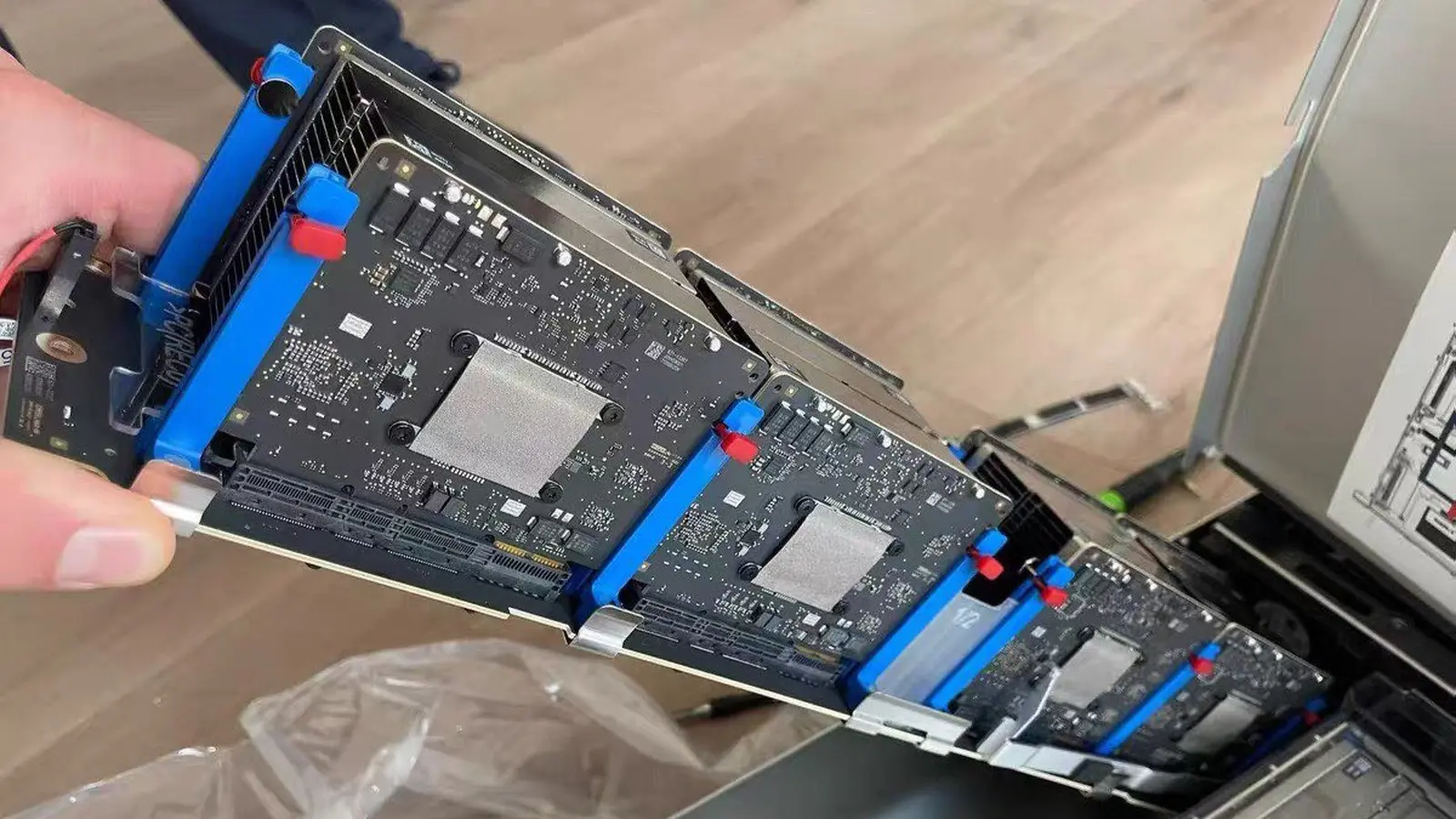
Imagine a server rack that looks more like a high-end PC chessboard than a traditional data-center behemoth. Quiet. Dense. Carefully engineered for swaps and service. That image is exactly what the leaked photos from X user @hsuchingpo deliver: a rack-mount enclosure stuffed with hot-swappable compute cards, and at least one of those cards hiding an Apple M5 chip beneath thermal paste.
A modular server built like a gadget
The pictures show rows of PCIe-style cards with blue ejector latches, each designed to be pulled and replaced in the field. A service diagram taped inside the chassis lists 14 numbered board positions, each paired with a unique Apple part number. One board carries a sticker marked 631-13397. Up close, you can see a single M5 package, voltage-regulation circuitry along the edge, and a gold finger connector that mates to the backplane.
Two carrier bars are visible, each holding eight boards and joined by a central heat-pipe manifold. That layout points to a deliberate choice: pack many efficient chips into a single enclosure, make them easy to service, and manage heat with shared plumbing rather than brute-force fans and huge heatsinks. Could the chassis hold more modules than we see? Possibly. Or the internal diagram may reflect a modular logic that doesn't map perfectly to a symmetrical layout.
 |  |
Why use the M5 here instead of conventional server CPUs? Power efficiency. The M5 won't out-muscle a workstation M3 Ultra in raw multi-core benchmarks, but when dozens of efficient units are stacked together, thermal overhead drops and overall throughput rises for certain workloads. Apple appears to be extending its device-first privacy model into the cloud by using the same device-class silicon that runs iPhones and Macs for server-side AI tasks.
That shift matters. Device-class chips bring consistent performance per watt and tightly controlled architectures, which are attractive when you want predictable, secure enclaves for private compute. Apple’s approach would let it scale AI workloads while keeping the hardware and software stack tightly integrated.
Of course, these could be engineering prototypes rather than final production units. Still, this is one of the clearest public glimpses yet at how Apple might build a privacy-focused, M5-powered cloud infrastructure.
This leak strongly suggests Apple is betting on its M5 silicon to deliver dense, serviceable, privacy-minded compute for cloud AI.


“I cover emerging technologies, digital innovation, and the intersection of tech and everyday life. My goal is to make complex trends accessible and inspiring.”

Discussion
Leave a Comment
Comments
No comments yet. Be the first.