
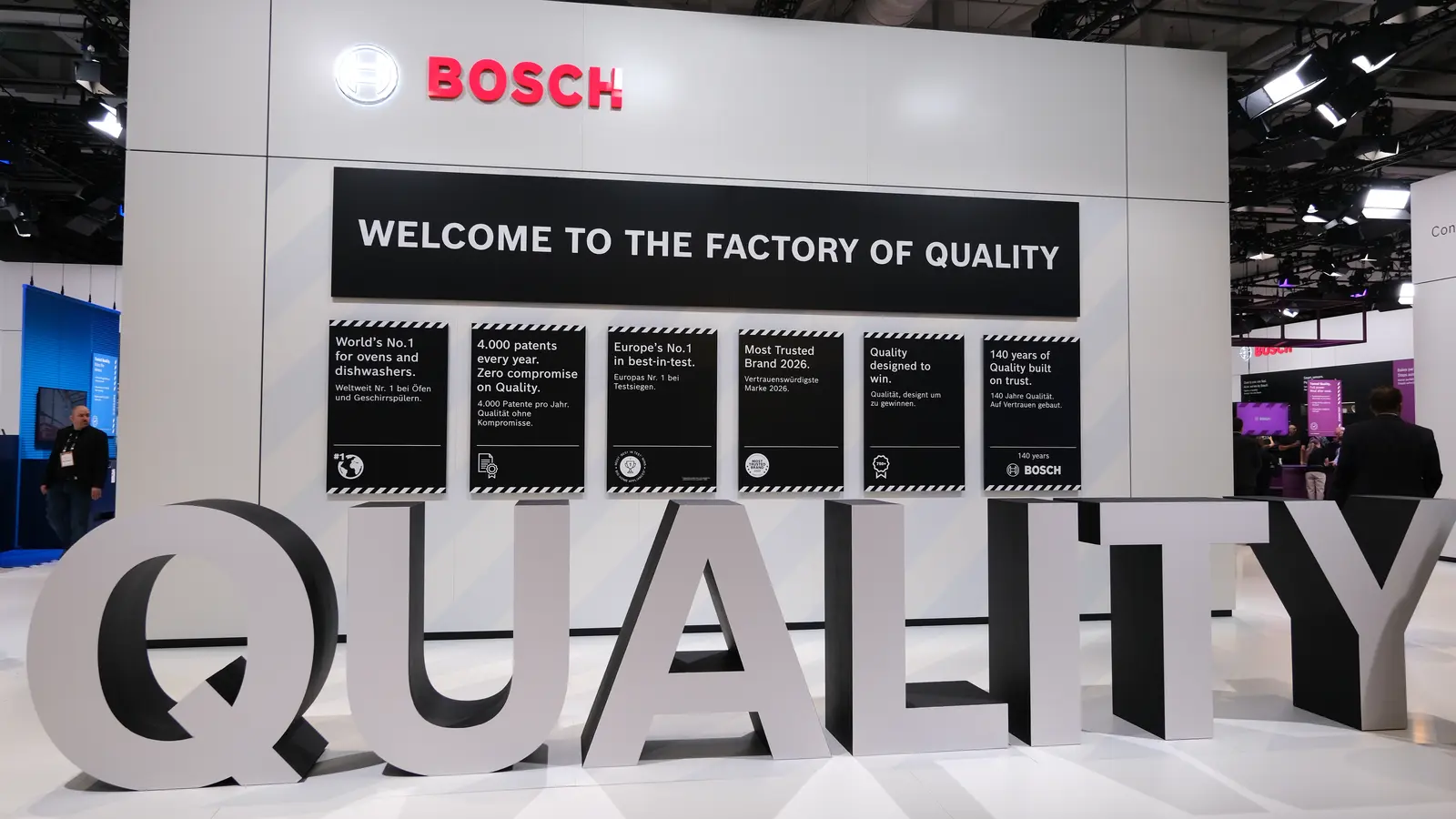
During a private tour of the Bosch and Siemens exhibition at IFA 2026, Maria Beltran from Global Corporate Communications and Global Brand PR Manager walked us through some of BSH’s most important new products, from energy-efficient laundry systems and floor cleaners to AI-powered ovens, modular refrigeration and a new generation of coffee appliances.
BERLIN: The biggest home-appliance innovations are not always the ones that immediately look futuristic.
Sometimes the more meaningful changes happen inside the machine: a condenser that cleans itself, a washing and drying cycle that runs at lower temperatures, a refrigerator door that can be reorganized around what you actually buy, or an oven that recognizes the dish placed inside it and suggests how to cook it.
That became increasingly clear during our private tour of the Bosch and Siemens exhibition area at IFA 2026 with Maria Beltran, Global Corporate Communications, Global Brand PR.
Rather than focusing on a single headline product, the tour moved through a wide range of appliances and showed how Bosch and Siemens are approaching familiar household tasks from different angles: energy efficiency, automation, sustainability, repair-free maintenance, flexibility and, increasingly, artificial intelligence.

Bosch brings heat-pump technology to the washer-dryer
The tour began with one of Bosch’s more significant laundry developments: its first washer-dryer using heat-pump technology.
Combining washing and drying in a single appliance has obvious advantages for homes where space is limited, but drying efficiency has traditionally been one of the compromises of the format.
Bosch is trying to change that.
According to Beltran, the heat-pump system allows the washer-dryer to achieve Energy Efficiency Class A for the combined washing and drying operation while also using drying temperatures that can be up to 40 percent lower.
Lower drying temperatures matter for more than electricity consumption. They also mean fabrics are exposed to less heat during the drying process, giving Bosch another way to position efficiency and garment care as parts of the same design.
But the heat pump is only part of the story.

A condenser designed to keep its efficiency over time
Bosch also demonstrated its self-cleaning condenser technology.
The problem is straightforward: as a dryer operates, lint gradually accumulates around the condenser. Even if the appliance is highly efficient when new, that buildup can reduce performance over time.
Bosch’s solution is to automatically wash the condenser with water, preventing lint from remaining on its surface.
The aim is not simply to achieve a high energy rating when the appliance leaves the factory, but to maintain that efficiency throughout its working life. Beltran described the self-cleaning condenser as a patented Bosch technology used across many of the company’s dryers.
It is a good example of the type of engineering that is easy to overlook during a quick product demonstration but may become considerably more important after years of ownership.
Zeolite continues to solve one of the dishwasher’s most annoying problems
Not everything on the tour was new for 2026.
Beltran also stopped to explain Bosch’s use of Zeolite in dishwashers, a technology the company has used for some time but still considers an important differentiator.
Zeolite is a mineral capable of absorbing moisture and releasing heat.
Inside the dishwasher, moisture produced during the cleaning process is absorbed by the mineral and converted into heat, which is then used to help dry the dishes.
The advantage becomes particularly noticeable with plastic containers and other items that often come out of conventional dishwashers still covered in small water droplets.
With the Zeolite system, Bosch aims to deliver a more complete drying result even on those more difficult surfaces.
It is not one of the new launches at IFA, but its inclusion in the tour helped underline how much of Bosch’s appliance strategy is built around technologies that work quietly in the background.

Bosch enters a new coffee category
Coffee represented a genuine expansion for the Bosch portfolio.
The company already sells fully automatic coffee machines, but its new semi-automatic espresso machine marks Bosch’s first move into the portafilter category.
This is a very different type of coffee experience.
Instead of asking the machine to do everything automatically, the user becomes more involved in the preparation process, closer to the workflow of a traditional barista setup.
The machine includes an integrated grinder. Beans can be ground according to the desired amount, placed into the portafilter, tamped and then brewed as coffee or espresso. The system also supports milk and hot-water preparation.
Bosch showed visually similar variants with small design differences, including different trim finishes and lighting details.
The important change, however, is not cosmetic.
For Bosch, this is an entirely new product category, aimed at users who want more direct control over the ritual of preparing espresso without moving to a completely professional setup.

OneFloor vacuums and mops in a single pass
The floor-care demonstration was one of the most practical stops on the tour.
Bosch’s OneFloor system combines vacuuming and wet mopping in a single cordless appliance.
The device uses separate tanks for clean and dirty water, so the water being used on the floor remains isolated from the dirt, debris and liquid already collected during cleaning.
During the demonstration, a deliberately messy mixture of debris and food was placed on the floor.
Instead of requiring an initial pass with a cloth or vacuum followed by a second pass with a mop, the OneFloor collected the debris and washed the surface in one movement.
The Series 6 version also uses bidirectional movement assistance. Although the appliance needs sufficient weight at floor level to clean effectively, powered assistance helps it move forwards and backwards, reducing the amount of effort felt by the user.
The machine can also lie almost completely flat, allowing it to reach underneath sofas and other furniture. An integrated LED helps reveal dirt in those darker areas.
But arguably the most interesting part happens after the floor is clean.

The floor cleaner also cleans itself
Cleaning a wet-and-dry floor washer can sometimes be nearly as unpleasant as cleaning the floor itself.
Bosch has tried to remove much of that maintenance.
Once the OneFloor is returned to its service station, the user can activate a self-cleaning cycle with a foot control.
The system then cleans the appliance using water heated to 70°C before drying it with hot air.
The idea is to leave the roller clean, dry and ready for the next use while reducing the possibility of unpleasant odors developing on a damp brush.
Bosch showed two versions during the tour.
The white Series 4 requires the cleaning solution to be mixed directly into the fresh-water tank, while the black Series 6 adds a separate detergent reservoir capable of automatically dispensing cleaning solution onto the roller.
The Series 6 also includes bidirectional movement assistance, while the Series 4 provides assistance in the forward direction.
For households with children or pets, this may be one of the easiest products in the exhibition to understand: fewer tools, fewer cleaning steps and less work after the cleaning itself.
Bosch expands the Green Collection beyond refrigerators
The next part of the tour shifted from product use to how appliances are manufactured.
Bosch’s Green Collection is built around the idea that efficiency should not begin only when an appliance is plugged into the wall.
Energy and water consumption during years of use remain important, but Bosch is also trying to reduce environmental impact earlier in the lifecycle by using materials with a lower carbon footprint during manufacturing.
Refrigerators were among the first products in the collection.
According to Beltran, the materials used for those models can achieve a 50 percent reduction in carbon footprint, helped by the amount of steel, plastics and packaging involved in producing a refrigerator.
The major addition for 2026 is the oven.
Bosch says the Green Collection oven achieves a 20 percent reduction in the carbon footprint associated with its materials. Its handle also uses aluminum with an 85 percent reduced carbon footprint.
The underlying idea is important.
Once an appliance becomes highly efficient during use, additional environmental improvements increasingly need to come from elsewhere in its lifecycle.
Manufacturing and materials are the next obvious target.

Flexible refrigerators rethink the door
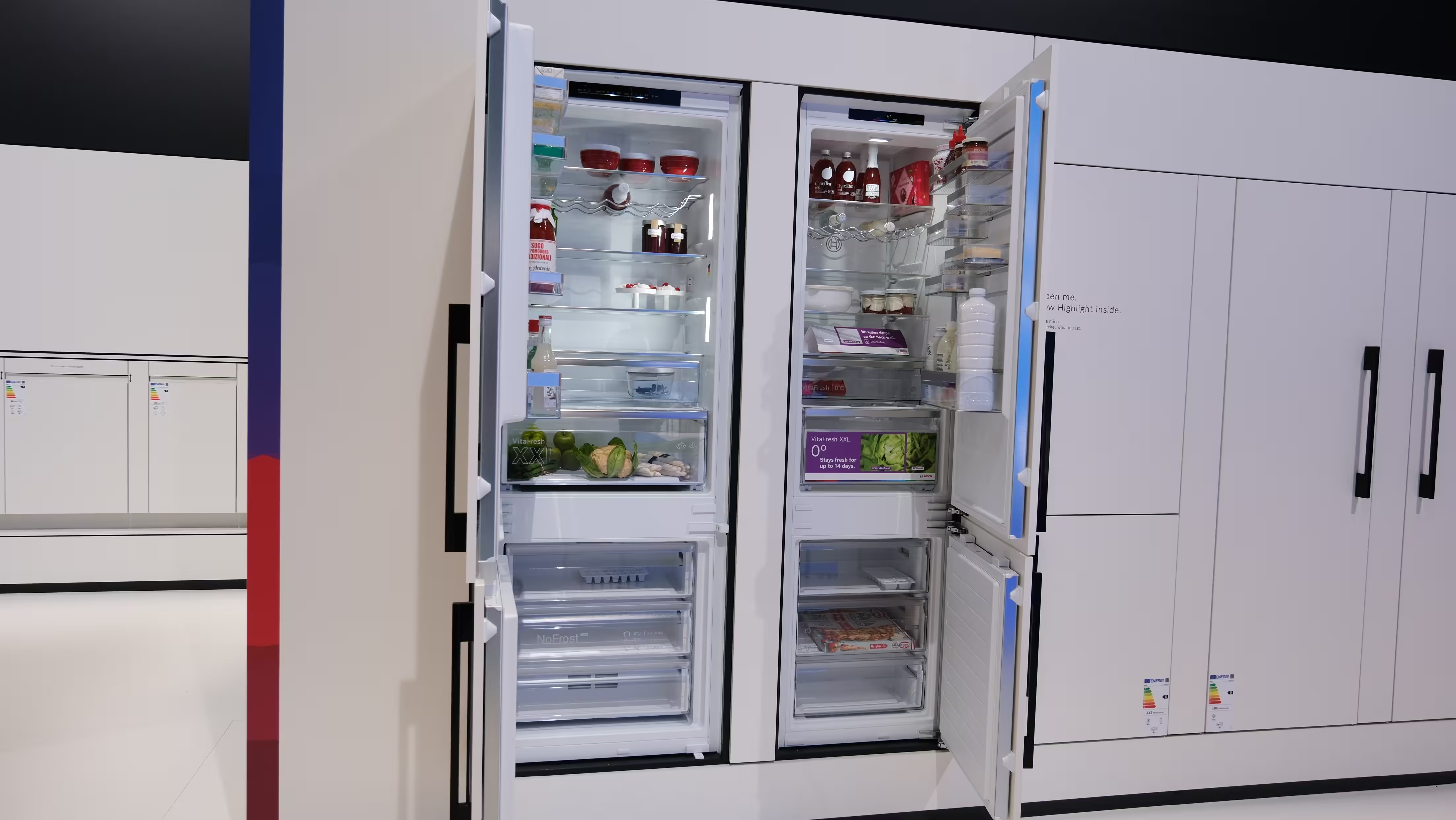
Bosch also introduced new refrigerators and freezers built around greater flexibility inside familiar dimensions.
One of the most noticeable changes is the Flex Door concept.
Instead of treating door shelves as fixed storage positions, users can move them according to what they need to store.
A particularly tall bottle, for example, no longer has to dictate how the rest of the door is organized. Shelves can simply be repositioned to create the required space.
Bosch is also extending frost-management technology.
NoFrost is already familiar from freezers, where it eliminates the need for manual defrosting. The new refrigerator concept brings that approach into the refrigerator compartment as well under the name Total NoFrost.
For larger kitchens, Bosch is also showing what it calls a European side-by-side arrangement.
Instead of one traditional American-style side-by-side appliance, a full-height single-door refrigerator and a matching freezer can be installed next to one another to create a similar visual effect with two separate units.

VitaFresh separates vegetables from meat and fish
Food preservation remains another important part of Bosch’s refrigeration strategy.
The refrigerators shown during the tour use the VitaFresh system, which separates foods according to the storage environment they require.
Fruit and vegetables are stored in a compartment with higher humidity.
Meat and fish, which do not benefit from the same humidity level, receive a separate storage environment.
Beltran said the system is designed to keep suitable food fresh for as long as 14 days.
Even the door hardware has been engineered around increasingly heavy kitchen installations.
Bosch uses hinges designed to support considerable loads, accommodating both heavy furniture fronts and heavily stocked refrigerator doors.
Again, this is not technology designed to draw attention to itself.
It is engineering intended to disappear once the appliance is installed.

Bosch now has an air fryer for almost every kind of kitchen
Air fryers may not be the most technologically sophisticated products at IFA, but they have become an important category in the kitchen.
Bosch has responded by building a surprisingly broad range.
At the largest end is a 12-liter model using two vertically stacked drawers.
Another design uses a 10-liter FlexDrawer that can operate as one large cooking area or be divided into two independent five-liter zones.
That flexibility becomes more useful with Bosch’s Sync & Match function.
If two foods require different cooking times, the appliance can coordinate the two zones so that both dishes finish at the same moment.
The user does not have to calculate when to start the second dish manually.
Bosch also showed more conventional dual-drawer models and a smaller unit of around four liters.
The range makes the strategy fairly obvious: rather than assuming one air-fryer format works for everyone, Bosch is treating capacity and drawer configuration as choices based on household size and cooking habits.
Siemens takes over with a stronger focus on design and intelligence
The second half of the tour moved into the Siemens portfolio.
While many of the underlying themes remain similar, Siemens presents them differently.
The emphasis becomes more visibly premium: cleaner surfaces, more integrated displays, stronger design identity and artificial intelligence that tries to remove decisions from everyday tasks.
Iconic Edition makes the washer and dryer look like one system
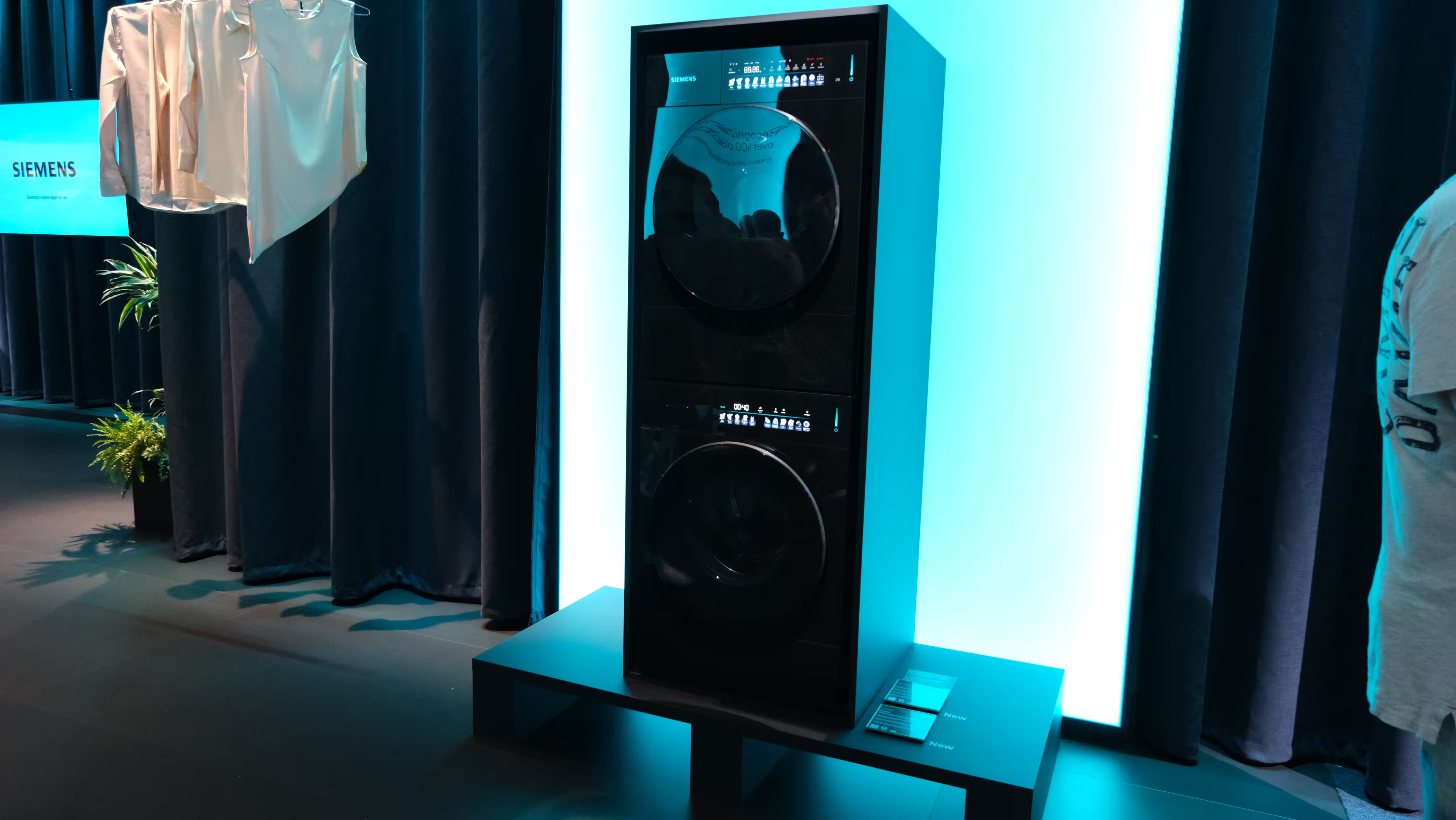
The Siemens Iconic Edition begins with a simple visual idea.

The washing machine and dryer remain two separate appliances, but their design has been coordinated so closely that they appear almost like a single system when installed together.
The fronts are deliberately clean and minimal.
The washing machine includes Siemens’ i-Dos automatic detergent dosing system. Liquid detergent can be stored inside the machine and used across roughly 10 to 20 washing cycles, depending on consumption, rather than being manually measured for every load.
A full-color display provides access to programs for different fabrics and use cases.
The washer and dryer can also communicate through Home Connect.
Using intelligentDry, information about the condition of the laundry coming out of the washing machine can be used to adapt the subsequent drying process.
The practical benefit is automation.
Instead of asking the user to estimate how much drying a particular load requires, the appliances increasingly exchange that information themselves.
The Siemens iQ700 oven recognizes what you put inside it
Artificial intelligence becomes much more visible in the kitchen.
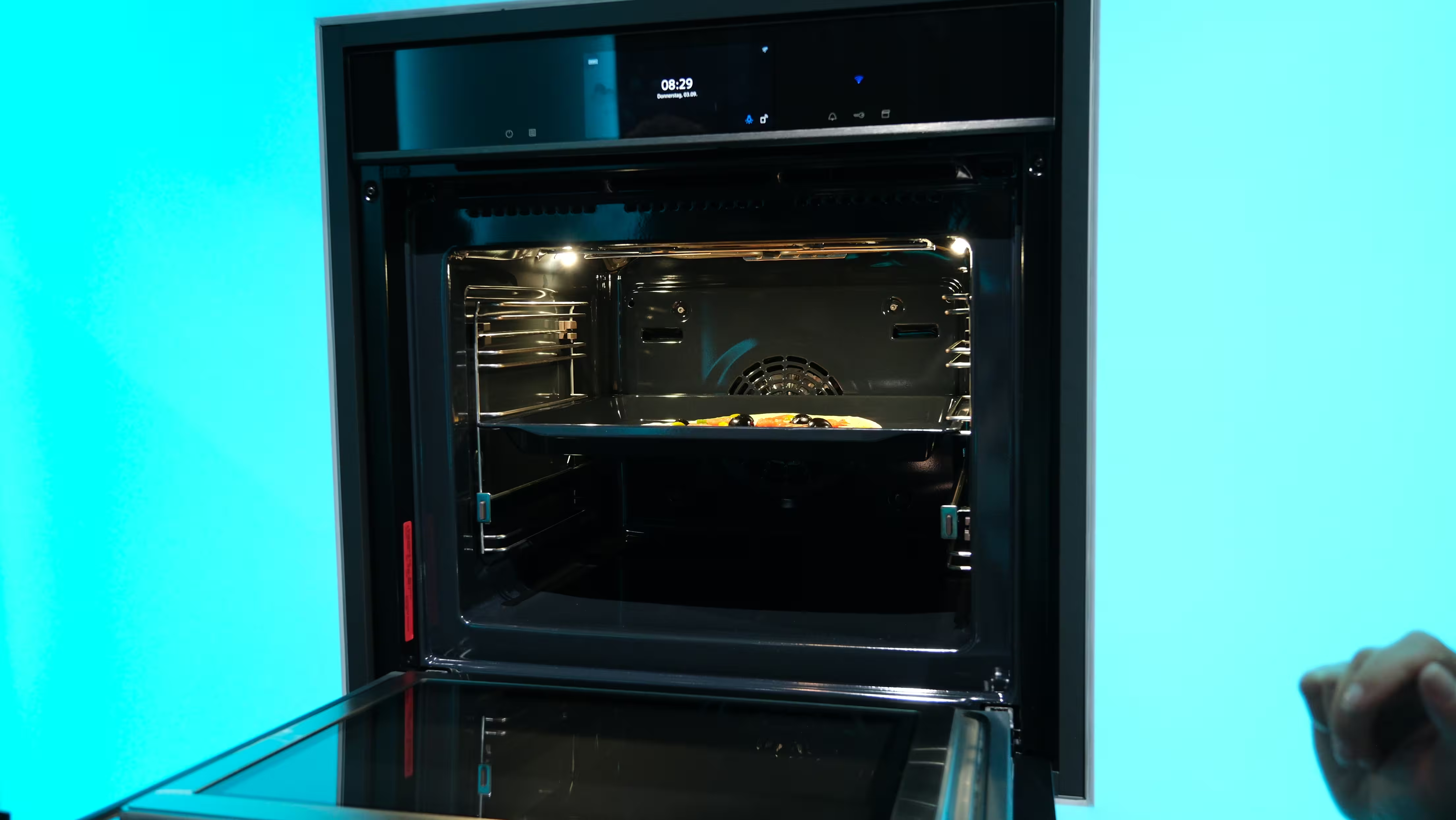
The Siemens iQ700 oven includes a camera positioned inside the upper corner of the cavity.
When food is placed inside, the camera captures an image and the system uses AI-based recognition to identify the dish.
Put in a pizza, for example, and the oven compares what it sees with the visual information available to its recognition system. Once it determines the likely dish, it recommends an appropriate preparation mode.
The user can accept the suggestion and allow the oven to handle the rest of the cooking process.
The system can recognize more than 100 dishes.
The important new addition is personalization.
Users can now save their own dishes to the oven, meaning the recognition system is no longer restricted only to recipes and food types predefined by Siemens.
That turns image recognition from a generic cooking assistant into something that can gradually become more specific to an individual household.

Siemens expands its Matt Edition with a 14 cm steam drawer
The final stop on the tour returned to design.

Siemens has been developing its Matt Edition in response to the growing popularity of matte kitchen fronts.
Rather than having appliances visually interrupt that aesthetic with glossy black glass or stainless-steel surfaces, Siemens offers a coordinated matte range spanning ovens, coffee machines, compact ovens, cooktops and ventilation hoods.
The new addition for 2026 is particularly unusual.
Siemens has created a steam drawer only around 14 cm high.
It occupies roughly the vertical space of a conventional kitchen drawer but functions as a dedicated steamer.
A water tank is built into the unit, food is placed inside the drawer, and the appliance provides full steam-cooking functionality without requiring the space of another full-size oven.
For kitchens already combining several built-in appliances, that compact format could be especially useful.
It also fits neatly into Siemens’ wider design philosophy at IFA: adding functionality without allowing the technology to dominate the kitchen visually.

The smarter home is becoming less about spectacle
Walking through the Bosch and Siemens displays makes one trend particularly clear.
Some of the most interesting appliance development at IFA 2026 is no longer about adding another screen or another connected feature simply because it is possible.
The changes are becoming more practical.
A washer-dryer uses a heat pump to reduce energy consumption and drying temperatures.
A condenser cleans itself so efficiency does not gradually disappear under layers of lint.
A floor washer cleans its own roller after cleaning the floor.
A refrigerator adapts its internal layout to the food placed inside.
An air fryer coordinates two different cooking times.
A washing machine tells the dryer what condition the clothes are in.
And an oven looks at dinner and decides how it should be cooked.
Bosch and Siemens approach those ideas with different personalities.
Bosch repeatedly emphasizes practicality, efficiency and flexibility.
Siemens takes many of the same underlying technologies and wraps them in a stronger focus on design, personalization and intelligent automation.
But after seeing both sides of the exhibition, the direction is largely shared.
The home appliance is becoming better at handling the small decisions and maintenance tasks that used to belong to the person using it.
And at IFA 2026, that may be a more convincing definition of a smart home than simply connecting another appliance to Wi-Fi.

“I cover emerging technologies, digital innovation, and the intersection of tech and everyday life. My goal is to make complex trends accessible and inspiring.”

Discussion
Leave a Comment
Comments (6)
Makes sense tbh. AI ovens sound handy, but I just want stuff that lasts. durability over bells.
Nice features but probably pricey. Smart enough to do laundry, but will my bank like it? also, repair parts availability matters.
I've worked on similar self-cleaning condensers years ago, they cut service calls massively. If Bosch nails reliability, users win big. small detail: water use?
Nice to see lifecycle thinking, 50% lower carbon in fridges, 20% for ovens. Materials matter. hope they publish LCA data, otherwise it's just marketing fluff, but promising
Looks cool, but is the oven camera really ok privacy-wise? who stores those images, local or cloud? feels a bit invasive if not clear
Wow, the self-cleaning condenser and heat-pump washer? actual game changers! finally tech that cares for clothes, not just specs. curious about noise levels tho