
Picture this: you type a rough research note or a plain list of talking points and a few minutes later a clean, editable slide deck sits ready on your screen. No hunting for templates. No late-night layout tweaks. Just a presentable set of visuals that actually says what you meant.
OpenAI quietly acquired NextSlide, a startup focused on turning text, notes, documents and research into ready-to-edit visual presentations. The small team has joined OpenAI to fold those capabilities directly into ChatGPT. The deal closed earlier this year and is only now public; financial terms remain undisclosed.
The shortcut from idea to polished slides
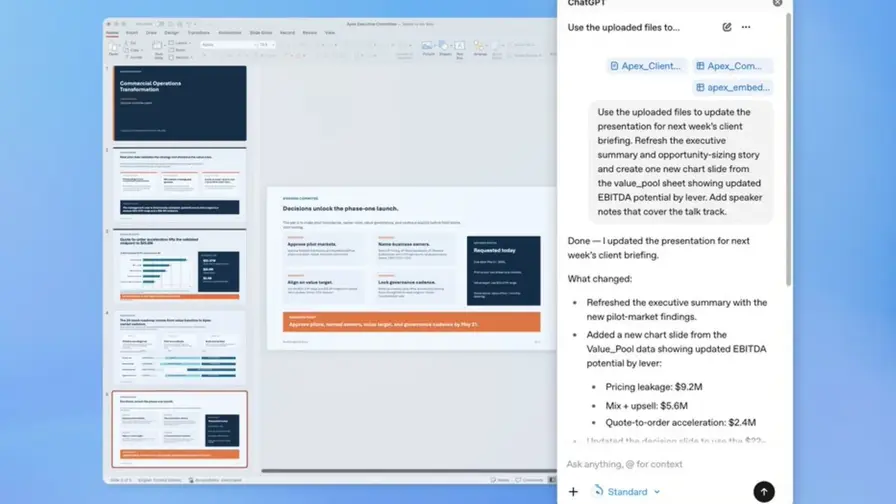
NextSlide started less than a year ago with a simple ambition: make presentation creation fast and accessible. Their engine can take raw input and output slides that are visually coherent and structurally sound, leaving users to tweak rather than build from scratch. That changes the math on one of the most tedious office tasks.

Ahmed Beshry, NextSlide's founder, framed the mission as more than speed. They wanted visual communication to be within reach for everyone, so ideas can land clearly and persuasively. Beshry is no stranger to startups; he previously co-founded Caper AI, a smart cart and checkout company acquired by Instacart in 2021.
Why would OpenAI make this move? Because slide decks are not a niche. Presentations are how ideas travel in business, academia and public policy. Integrating slide generation into ChatGPT turns a text-first assistant into a more complete workspace: brainstorm, analyze data, then export the visual narrative without switching apps.
Think of it as closing the production loop. You can ask ChatGPT to summarize findings, generate a storyboard, refine language, and now produce slides that match the tone and structure of your brief. For teams, that could mean fewer handoffs and faster iteration. For solo creators, it means production quality without a designer on call.
The broader play is clear. OpenAI continues to push ChatGPT beyond conversational answers toward tools that handle actual, repeatable work. Adding presentation-building is a logical extension of that trajectory. It also signals a focus on workflows, not just chat—on wrapping capabilities around tasks that people perform every day.
There are practical questions ahead. How deep will customization go? Will users retain full control over layout and branding? How will data privacy and collaborative editing be managed inside ChatGPT? Expect OpenAI and the former NextSlide team to iterate rapidly, testing the balance between automation and agency.
For now, the acquisition is a small but meaningful step toward more seamless creative tooling inside AI assistants. It slashes friction. It frees time. And it nudges the humble slide deck toward becoming another output ChatGPT can produce with purpose and polish.

“I love exploring gadgets, apps, and trends that redefine how we connect, work, and play in a digital world.”

Discussion
Leave a Comment
Comments
No comments yet. Be the first.