
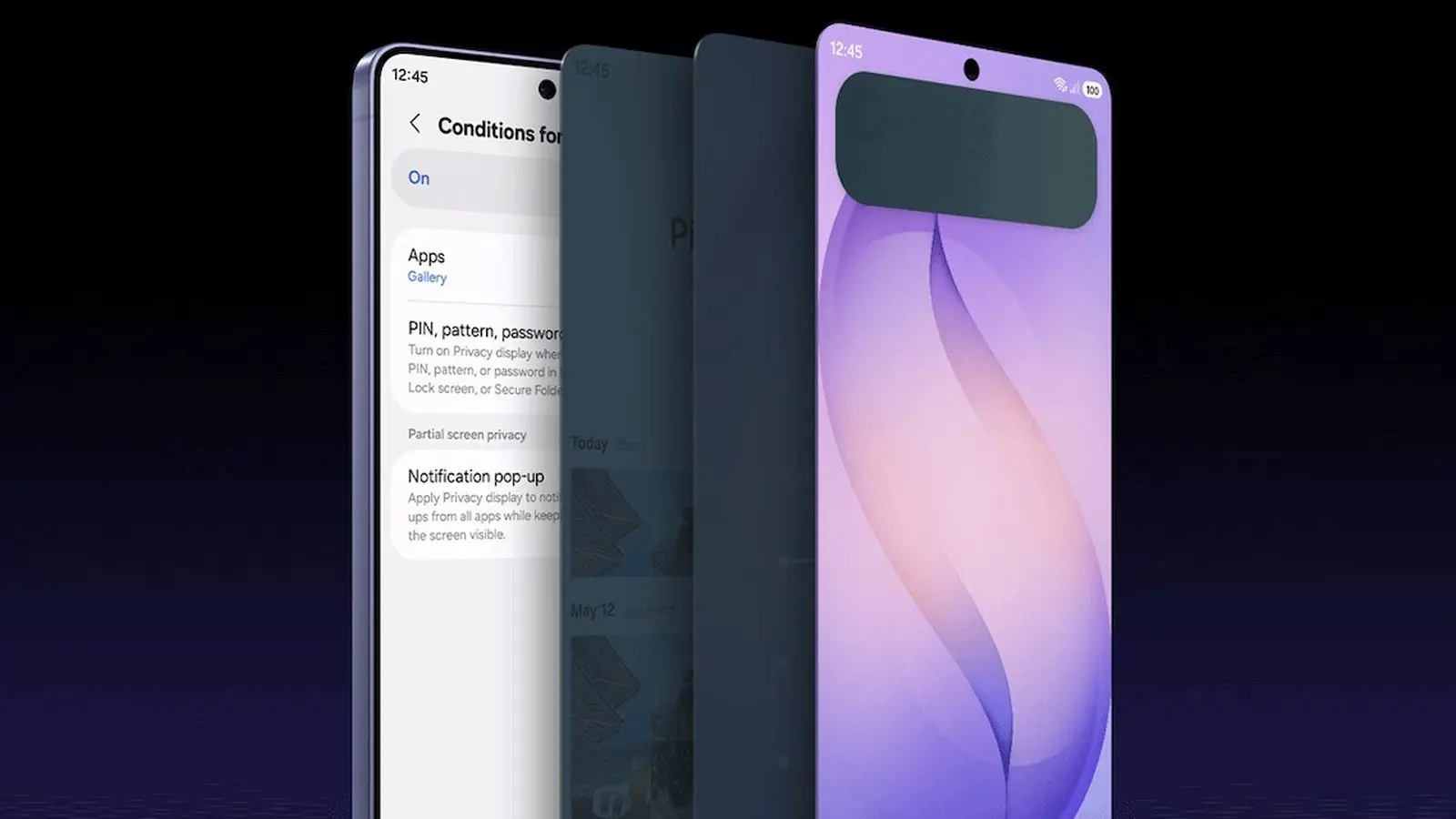
You glance at a message on the train. No one notices. That small, private moment is exactly what Samsung set out to protect when it introduced Privacy Display on the Galaxy S26 Ultra.
Privacy screens step out of the shadows
Now the feature is expanding fast. Sources at The Elec say all four Galaxy S27 models will ship with Privacy Display. Yes, every single one — Ultra, Pro, and the vanilla S27 too. That last bit matters. Historically the plain model missed headline features like faster charging and ultra-wideband, so giving it a privacy panel is a little unexpected.
There was a subplot, too. Samsung had reportedly eyed cheaper panels from BOE for the base S27, which would have helped margins. That plan didn’t hold. The phone will use Samsung Display panels instead, according to the same reporting. A supply shift like that tells you how seriously Samsung is treating the feature.
Numbers back the momentum. Market researcher SigmaIntel says about 1 million phones with Privacy Display shipped in 2025 — mostly specialized business devices. The Galaxy S26 Ultra pulled the capability into the consumer market, and SigmaIntel projects growth to roughly 21 million units in 2026 and 29 million in 2027. Rapid adoption, by any measure.

It’s not just Samsung warming to the idea. Leaks suggest Xiaomi, Honor, Oppo and vivo are all working on similar systems for their upcoming flagships. Competition will accelerate refinement. Expect features to migrate across price tiers and categories.
But the tech that makes these privacy screens possible is fiddly. Privacy Display is a hardware trick: the panel combines two pixel modes. One set of pixels narrows viewing angles so the screen looks dark from the side. The other set stays wide-angle and is masked off when privacy mode is active. That split creates headaches — drops in perceived resolution, dimmer output, and higher power draw. Foldable phones add another layer of difficulty because their layered displays complicate the optical engineering.
The end result? A more private phone experience, but not without trade-offs. Engineers still have work to do on brightness, efficiency, and image quality before privacy panels feel seamless everywhere.
Expect privacy displays to move from niche corporate tools to ordinary phone features over the next two years.

“I cover emerging technologies, digital innovation, and the intersection of tech and everyday life. My goal is to make complex trends accessible and inspiring.”

Discussion
Leave a Comment
Comments
No comments yet. Be the first.