
Imagine a landscape of glass and concrete where the next generation of AI will be fed: rows of cleanrooms, robots on silent tracks, and racks stacked with DRAM and NAND modules that future data centers will breathe through. That image is closer now, because SK Hynix has just greenlit two massive fabs that together total about €35.4 billion in investment.
Timing over sheer size
Big numbers are easy to notice. Harder to see is why the company is doubling down now. The plan breaks down into two projects: a DRAM plant slated to begin operations in June 2029 and a NAND facility expected to come online in December 2028. The money behind those projects translates roughly to €23 billion for the DRAM fab and €12.4 billion for the NAND fab.
Why invest when chips still sit on waiting lists? Because memory demand is not ebbing; it is compounding. Industry forecasts expect DRAM and NAND to grow rapidly through the decade, and SK Hynix is betting the mismatch between need and immediate supply will be the decisive battlefield.
Ask yourself: is building capacity the same as solving shortages? No. Factories take years to tune. But capacity buys leverage. It gives manufacturers the option to meet surges when customers suddenly need scale, and that kind of timing can trump raw output in contract negotiations.
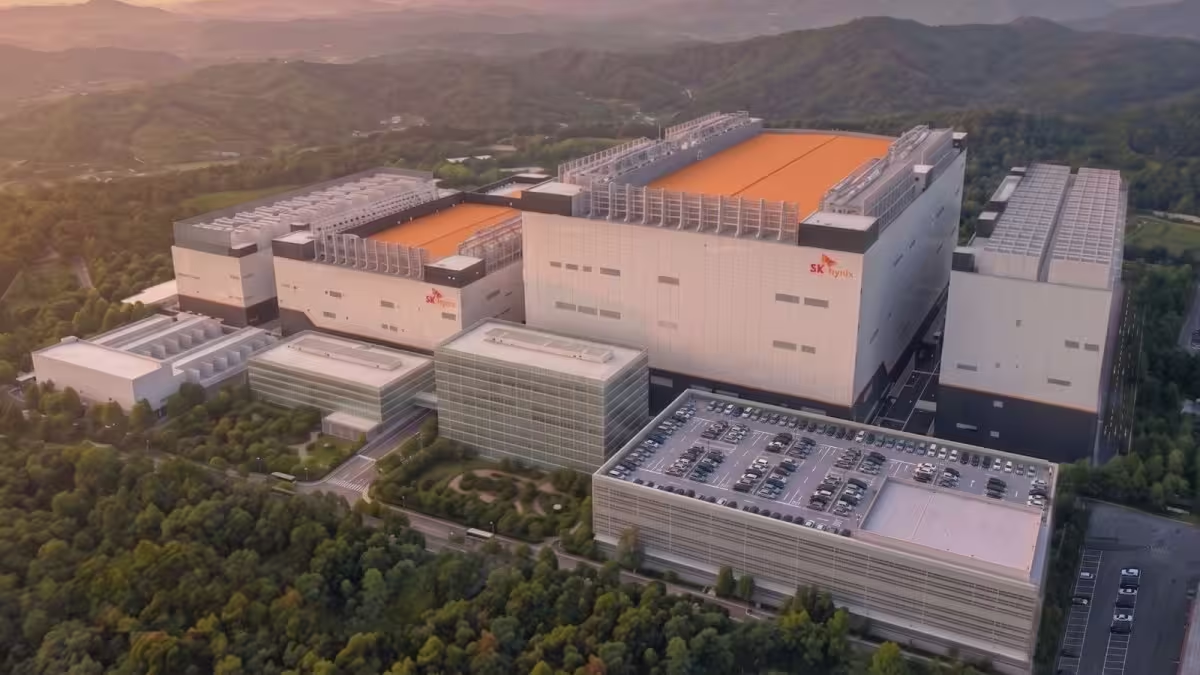
For SK Hynix, the move is strategic. The company frames these fabs as more than production lines. They are part of positioning as a partner to AI infrastructure providers, an effort to anchor reliability in a supply chain that companies say must be more predictable and resilient.
There is another angle. Memory chips are the throttle for many AI workloads. Training a large model eats DRAM like a furnace. Storage-hungry inference and massive datasets ask for denser NAND. Ownership of ample, modern memory capacity is a lever; it can influence pricing, partnership terms, and where hyperscalers route their hardware builds.
That does not mean relief is immediate for consumers. Smartphone launches and next-season electronics will still chase available inventory while these new fabs are completed and qualified. The industry will feel the impact, but gradually.
SK Hynix puts it plainly: the company decided to move now to match the market's growth tempo and to secure production capability proactively. In their words, they intend to become a key partner in AI infrastructure and help stabilize the global AI semiconductor supply chain.
SK Hynix is betting that precise supply timing, not just capacity, will be the ultimate competitive advantage in the AI era.

“I love exploring gadgets, apps, and trends that redefine how we connect, work, and play in a digital world.”

Discussion
Leave a Comment
Comments
No comments yet. Be the first.