
TCL used its IFA 2026 presentation in Berlin to connect smartphones, home appliances, security, AR glasses and big-screen entertainment under one increasingly familiar idea: AI should work quietly across the home rather than remain confined to a single device.
BERLIN: TCL’s presence at IFA 2026 was not built around one flagship product.
Instead, Sun Li, Executive Director at TCL, presented a much broader vision in which the smartphone, air conditioner, washing machine, security system, television and even a pair of glasses increasingly become parts of the same intelligent environment.
The products themselves covered very different categories, but the message connecting them was consistent: artificial intelligence should make everyday interactions simpler, more personalized and, ideally, less noticeable.

TCL’s presentation moved from the new P80 smartphone family into smart-home security and appliances before turning toward personal entertainment, augmented-reality glasses and the company’s growing partnerships with Google and Amazon.
What emerged was less a collection of individual launches than a picture of how TCL wants its hardware ecosystem to work together.
TCL P80 Ultra brings flagship features lower down the smartphone market
The smartphone section centered on the new TCL P80 series, led by the P80 Ultra.
TCL is positioning the P80 Ultra as the most capable model in the family, with a display reaching up to 3,200 nits of peak brightness, 100 percent DCI-P3 color coverage and a 120 Hz refresh rate.
The display is surrounded by a 1.38 mm ultra-narrow bezel, helping TCL maximize screen area while keeping the device visually compact.
One of the more notable additions is the camera system.

The P80 Ultra includes a 50-megapixel 3x periscope telephoto camera, a feature TCL described as unusually advanced for this segment.
Sun Li also emphasized the wider package, including imaging, battery performance, chipset capabilities, IP68 protection and integration with Google Gemini.
TCL is also using design to distinguish the Ultra model.
Alongside Sunlight Gold and Midnight Blue, the company introduced a third finish called Deep Burgundy, developed as part of its collaboration with CMF designers.
P80 Pro brings NXTPAPER to a lower price point
Below the Ultra sits the TCL P80 Pro.
TCL describes it as a more affordable route to many of the same everyday capabilities, including an AMOLED display combined with the company’s NXTPAPER technology.
The emphasis here is less on matching every flagship specification and more on retaining the display experience and core functionality while reducing the price.
The standard TCL P80, meanwhile, targets users who want a slim smartphone with a large screen but do not specifically need NXTPAPER technology.
TCL announced that the P80 family is already available to order.
The P80 Ultra starts at €549 with 256 GB of storage and €599 for 512 GB.
The P80 Pro starts at €429 for 256 GB and €499 for 512 GB.
The standard P80 begins at €349 for 128 GB and €379 for the 256 GB version.

TCL wants AI working before you even enter the house
From smartphones, Sun Li moved into TCL’s vision of the connected home.
The first example was security.
TCL showed a smart door lock that uses infrared sensing to read the unique vein pattern beneath a user’s skin, allowing the door to be unlocked with a palm gesture rather than a conventional key or fingerprint scan.
Support for Matter is intended to let the lock communicate with a wider ecosystem of compatible smart-home products.
TCL also described cameras that can interact more naturally with users.
Rather than simply displaying a live feed, the idea is that users will be able to ask questions about what the camera is seeing and request the feed directly on a television using voice commands.
A smart safe was another part of this security ecosystem, using fingerprint verification for faster access while maintaining additional authentication.
For TCL, this is one of the areas where AI becomes immediately practical: less about generating content and more about making access, monitoring and security easier.

FreshIn 3.0 Ultra adjusts the room while you sleep
Inside the home, TCL turned to climate control.
The TCL FreshIn 3.0 Ultra air conditioner introduces an AI-driven sleep system called AI Sleep Eye 2.0.
Using millimeter-wave radar, the system can monitor sleep-related activity and adjust room temperature in real time with the aim of maintaining comfort without requiring the user to wake up and make changes manually.
The unit also uses a dual fresh-air system capable of bringing in 60 cubic meters of fresh air per hour while simultaneously monitoring air quality.
Voice control is also built into the broader experience.
Energy consumption is another part of TCL’s climate strategy.
Sun Li introduced several new systems, including a 360-degree round cassette, a one-way cassette and a new solar series.
The solar series can automatically manage energy coming from solar generation and the electrical grid, switching between sources to balance comfort with lower power consumption.

AI moves into laundry with the TCL AI Silk tower
Laundry was another example TCL used to show how AI can remove routine decisions.
The TCL AI Silk laundry tower is designed to identify factors including fabric type, load size and the amount of dirt in a load before selecting an appropriate washing program.
Washing and drying are then connected into one continuous process rather than being treated as two separate decisions for the user.
The same philosophy extends across TCL’s refrigerator and washing-machine ranges.
Sun Li described AI working in the background to optimize temperatures, assess food freshness and automate everyday household routines.
That wording, “in the background,” may actually be one of the more important parts of TCL’s strategy.
The company is not presenting AI only as something users actively open or speak to. It increasingly wants intelligence embedded into appliances that make small decisions automatically.
TCL’s entertainment strategy is no longer tied to one screen
Home entertainment marked another major shift in the presentation.
TCL argued that entertainment inside the home is no longer defined by everyone sitting around a single television.
Sometimes people want the largest possible screen in the living room.
At other times, they want a completely personal display.
That is where RayNeo enters TCL’s ecosystem.

RayNeo Air 2 turns almost anywhere into a personal cinema
The first of two new products was the RayNeo Air 2.
TCL described it as a new generation of home-theater AR glasses capable of creating the impression of a large immersive screen directly in front of the wearer.
Instead of requiring a television or projector, the display effectively travels with the user.
The idea fits neatly into TCL’s larger display strategy.
At one end of its portfolio, the company continues pushing toward extremely large televisions.
At the other, it is trying to create a screen that effectively exists only for one person.
RayNeo X2 puts an AI assistant directly into your view
The second announcement, the RayNeo X2, takes a different approach.
Rather than primarily acting as a personal cinema, the X2 is built around AI.
TCL described the glasses as putting a smart assistant directly into the wearer’s field of view, allowing information and assistance to become part of normal visual interaction rather than requiring the user to take out a phone.
The two RayNeo products therefore represent two quite different ideas about wearable displays.
Air 2 is primarily about content.
X2 is about intelligence.
And both indicate that TCL sees the display moving beyond conventional televisions, monitors and phones.

Google Gemini is changing the role of the television
Despite the new form factors, the television remains central to TCL’s home strategy.
Sun Li said TCL has been among the leading Google TV manufacturers for the past five years and described the company as the first brand to bring Gemini to television.
The broader aim is to transform the TV from a passive display into a more personalized entertainment hub.
The biggest change with Gemini for Google TV is conversational interaction.
Traditional voice control normally requires relatively direct commands: open an application, search for a title or change a setting.
Gemini allows the interaction to become less rigid.
Users can ask follow-up questions and communicate in a more natural way rather than always knowing exactly what command or title they need.
The television can also become useful beyond entertainment.
Sun Li gave the example of planning a family holiday: a user could ask Gemini for itinerary suggestions and receive recommendations together with relevant video content directly on the television.
Gemini on Google TV expands into more markets
TCL also announced a broader international rollout for Gemini on Google TV.
According to Sun Li, the service is expanding into additional countries and languages, including European markets such as the UK, France, Italy and Spain, alongside Australia, Japan, India and Brazil.
The expansion will reach TCL’s broader Google TV lineup.
At the top of that range sits the TCL X11L, which Sun Li positioned as the flagship demonstration of the company’s combination of picture quality, AI and Google TV functionality.
The television is therefore becoming a central point where several parts of TCL’s strategy meet: premium hardware, large displays, conversational AI and the connected home.

TCL is also betting on Alexa Plus and Fire TV
Google is not TCL’s only AI platform partner.
The company is also working with Amazon across its Fire TV range, where Alexa Plus is now available in the UK, Germany, Austria, France, Italy and Spain.
The new Fire TV experience is designed to make discovery faster and less dependent on navigating menus.
Amazon has redesigned the interface to make it cleaner and more organized, while Alexa Plus adds more contextual conversation.
That means viewers no longer have to know the exact title they want.
They can describe a mood, genre, actor or preference and then refine the results through follow-up conversation.
Sun Li cited Amazon figures suggesting users are nearly twice as conversational with Alexa Plus on television compared with the original Alexa and select top recommendations more than 40 percent more often.
For streaming platforms struggling with the paradox of having enormous libraries while users still cannot decide what to watch, that type of conversational discovery could prove more useful than another redesign of the home screen.
The television becomes a smart-home control center
Alexa Plus also demonstrates another direction TCL expects televisions to take.
A viewer can ask to see a front-door camera without leaving the program currently on screen.
A Ring camera feed can appear directly on the television.
Alexa Plus can also summarize earlier activity, including whether someone rang the doorbell or a package was delivered.
That turns the television into more than a content device.
It becomes a large-screen interface for the rest of the home.
And that brings the presentation back to where TCL’s smart-home section began: the lock, camera, appliances and television increasingly operating as parts of the same system.

TCL wants technology to look as considered as it behaves
Sun Li also emphasized that intelligence alone is not enough.
TCL is working with companies and designers outside the traditional technology industry to shape the appearance and feel of its products.
Among the partnerships highlighted were Bang & Olufsen for audio, Roche Bobois around living spaces, Castelli Milano for Italian craftsmanship, Chris Lefteri Design for materials and WGSN for global trend insights.
The idea is that a smart home should not look like a collection of technology demonstrations.
The products need to fit naturally into the room.
That may sound obvious, but it is increasingly relevant as televisions become larger, appliances become more visible and connected devices spread through almost every part of the home.
Sport remains part of TCL’s big-screen identity
TCL closed the presentation by connecting its technology strategy with sport.
The company highlighted partnerships designed to associate its large displays with major live events and the communal experience of watching sport.
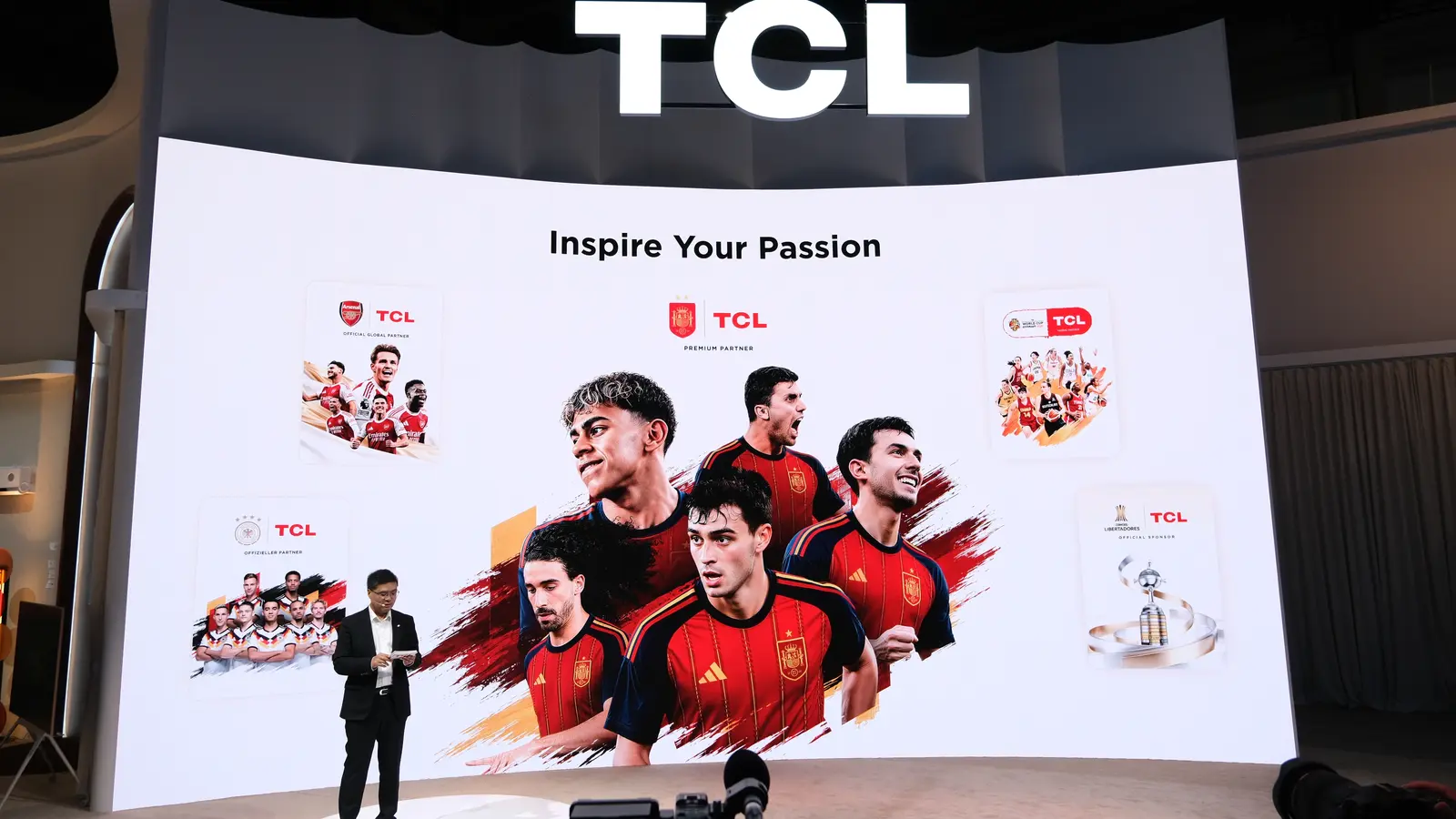
Sun Li referenced TCL’s relationship with the Spanish national football team as well as the company’s global partnership with FIBA and the 2026 FIBA Women’s Basketball World Cup taking place in Berlin.
A dedicated FIBA experience was also built into TCL’s IFA exhibition area, allowing visitors to move from looking at screens to physically stepping onto a basketball court.
It was a fitting final example of how TCL wants to present itself.
The company is not simply selling display panels.
It increasingly wants to associate those displays with the experiences happening on them.

TCL’s IFA vision is an ecosystem where AI fades into the background
Looking across everything Sun Li presented, TCL’s IFA 2026 strategy becomes relatively easy to identify.
The P80 Ultra brings features such as a periscope camera, NXTPAPER and Gemini into a more aggressively priced smartphone family.
FreshIn uses AI to adjust the sleeping environment.
The AI Silk laundry tower chooses how clothing should be washed.
Security products identify users and connect cameras to the television.
RayNeo moves screens from the wall to the face.
Gemini and Alexa Plus replace rigid TV commands with conversation.
And the television itself increasingly becomes a control surface for the rest of the home.
None of those products alone defines TCL’s direction.
Together, they do.
TCL is trying to build an ecosystem where intelligence follows the user from the phone in their hand to the lock at the door, the air in the bedroom, the appliances in the utility room and the screen in the living room.
The most ambitious part of that vision is not that every product contains AI.
It is that, if TCL succeeds, users may eventually stop thinking about where the AI is at all.
It will simply be part of how the home works.

“Some times I write about breakthrough startups, digital ecosystems, and how innovation is changing the way we build businesses.”

Discussion
Leave a Comment
Comments (6)
Pretty balanced take. TV as control hub is smart, RayNeo AR looks promising, curious about battery life and latency.
I've seen similar IoT rollouts at my job; integration is messy. If TCL pulls it off, big win, but supply chain + updates...
Feels kinda overhyped, AI in everything sounds like more bugs waiting. Nice designs tho, but will it age well?
Makes sense tbh. Converged home = huge convenience, hope they actually nail security and updates, or it's a mess.
Seems neat, but is the AI actually reliable overnight? Sleep radar sounds invasive, and what about false positives, alarms etc...
Wow, TCL wants your fridge and glasses to talk? Kinda cool but creepy. If it really fades into background, who controls prefs and privacy?