
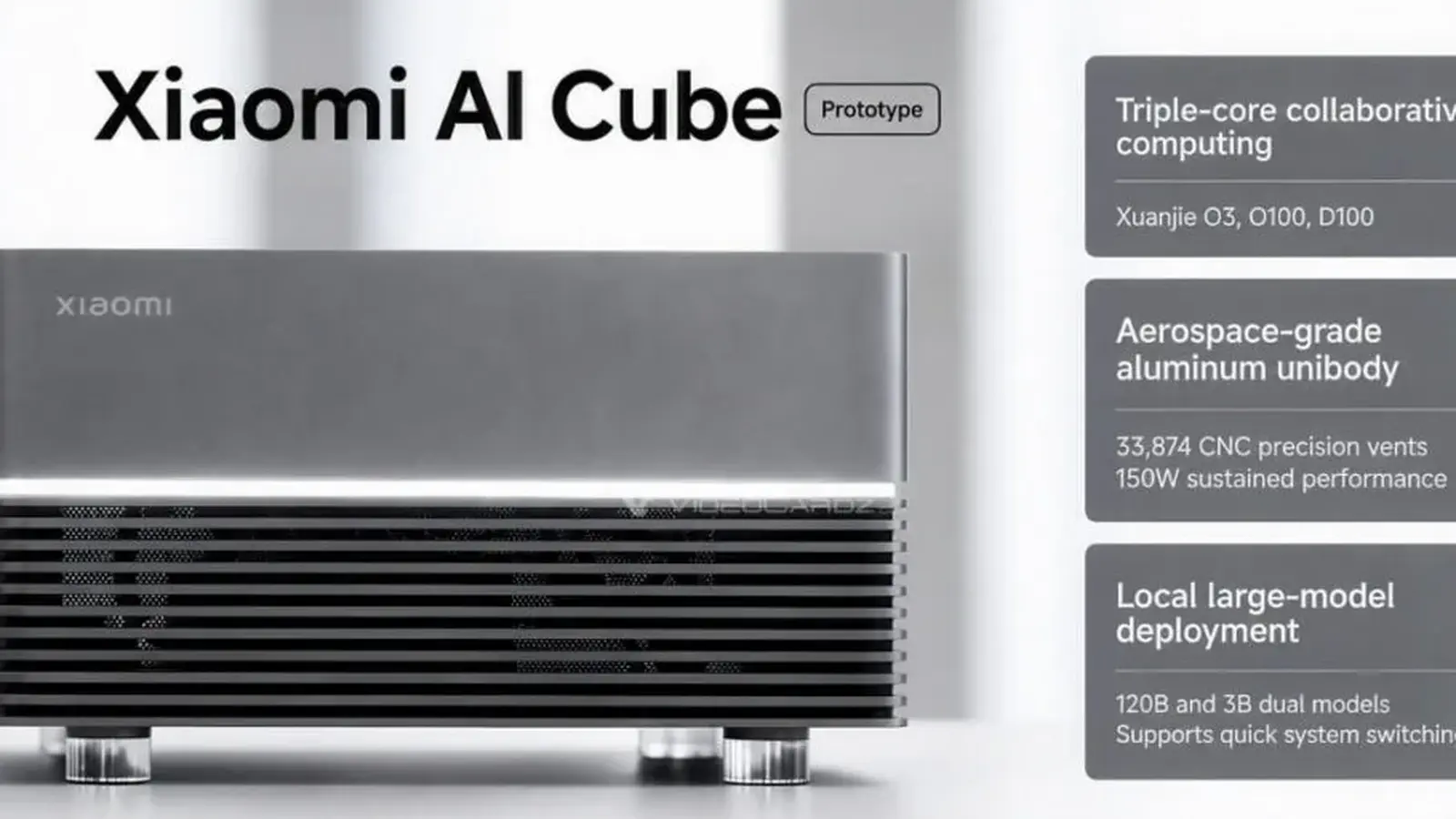
Imagine a palm‑sized desktop that tries to cram a datacenter into a shoebox. Xiaomi's prototype AI Cube feels like that kind of experiment: compact, precise, and unapologetically ambitious.
Small box, big ambition
At the heart of this mini PC sit three homegrown chips named XRING O3, XRING O100, and XRING D100. The O3 is the primary AI engine: a 10‑core CPU paired with a 16‑core G2‑Ultra NX GPU and a low‑power NPU rated around 200 TOPS. Short bursts of raw throughput. Long stretches of efficient inference.
The O100 plays the role of a high‑bandwidth accelerator. Built on a 6 nm process, it claims 28,672 effective data lanes and near‑memory compute bandwidth approaching 1.22 TB per second. That kind of local throughput matters when you want to run larger language models without constantly asking the cloud for help.

And then there is the D100, a 3 nm design geared toward driving and perception tasks. It brings 20 powerful compute cores, a 16‑core NPU, and support for up to 160 GB of memory. The trio is meant to share work: general orchestration, heavy lifting, and I/O‑sensitive acceleration.
Physically, the AI Cube is dressed in aerospace‑grade aluminum machined with 33,874 CNC cuts. Xiaomi says the chassis can safely handle sustained power delivery up to 150 watts. That tells you this is not a passive demo; it is built to run demanding models for extended periods.
What’s the use case? Local inference. Xiaomi frames the Cube as a box that can host LLMs from roughly 3 billion to 120 billion parameters offline, on premise. Think privacy‑focused assistants, on‑device coding helpers, or edge AI tools that cannot tolerate latency or cloud dependency. A physical switch lets users toggle between high‑performance and low‑power modes depending on the task.
There is some context worth keeping in mind. Other niche products, like the Tiiny AI Pocket Lab, have already shown it is possible to run 120B models in a compact form factor. Xiaomi’s twist is that it uses proprietary chip architecture and silicon, rather than repacking third‑party accelerators.

For now, the AI Cube is a prototype. Xiaomi has not shared pricing or a release window, so whether this becomes a commercial product or remains a technology showcase is still an open question. One curious side note: early machine translations of promotional images reportedly swapped the XRING names for another label, which caused momentary confusion in coverage. The underlying hardware, however, appears intentionally native to Xiaomi.
Bottom line: the AI Cube signals Xiaomi’s ambition to own more of the stack—from silicon to services—and to push high‑performance AI closer to the user. Whether the market wants yet another edge appliance remains to be seen. But as a technical statement, it’s hard to ignore.


“I cover emerging technologies, digital innovation, and the intersection of tech and everyday life. My goal is to make complex trends accessible and inspiring.”

Discussion
Leave a Comment
Comments (2)
wow didnt expect Xiaomi to go full silicon, bold move! hope they actually ship it, or at least open the SDK, pls
If that performance is real, cool, but 150W sustained in a palm box? thermal sounds sketchy... who cools it, fans noisy? privacy angle is neat though, curious about price