
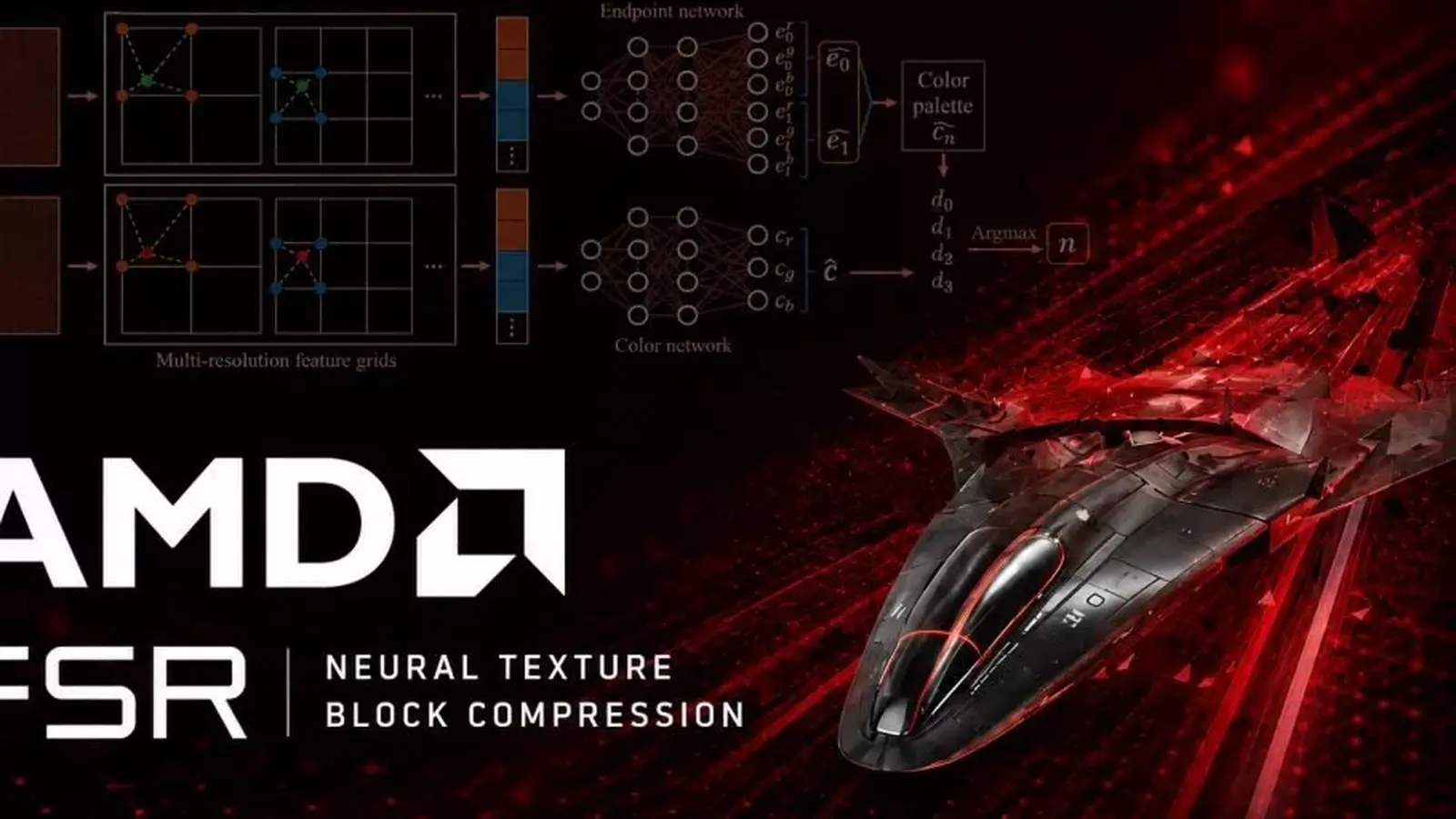
Think of a texture as a melody. Simple coordinates hum a tune. Now imagine reorchestrating that tune along a looping Lissajous curve so the melody contains far more harmonics. That, in essence, is what AMD’s Positional Encoding Projected Sampling, or PEPS, proposes.
A new twist on positional encoding
Traditional neural texture compression leans on implicit neural representations, or INR. You feed low-dimension texture coordinates into a multi-layer perceptron and the network learns to recreate image detail with tiny memory footprints. Positional encoding is the secret sauce: it lifts coordinates into a higher-dimensional sinusoidal space so the MLP can model fine detail.
PEPS reframes that lift. Instead of treating each sinusoidal embedding as an isolated vector, AMD’s approach maps those embeddings onto points along Lissajous curves, then samples the encoder or network at those projected points. The result is an expanded information manifold for the INR to work with. In practical terms, the model can represent richer texture content without changing the network backbone.

The catch is cost. More sampling means more computation and more memory traffic. AMD’s experiments on a 9070 XT GPU show the trade-off in clear numbers: producing a three-channel 1024 by 1024 texture took 4.32 milliseconds in their baseline. Grid-PEPS raised that to 5.47 milliseconds. An optimized variant called Grid-PinkPEPS trimmed the penalty down to 4.86 milliseconds, but it did not beat the baseline. Those extra cycles come from the additional projections and the heavier memory accesses PEPS requires.
That computational overhead is not a deal breaker. It is a design choice. If your priority is raw compression efficiency and reduced storage, PEPS offers a new lever. If your priority is latency-sensitive real-time rendering, you might prefer lighter-weight encoders—at least for now.
Another interesting angle: this trick is not limited to color textures. PEPS can apply to signed distance fields, or SDFs, which underpin a lot of modern geometry and volumetric rendering. SDFs typically demand high-resolution nets that gobble VRAM. A compact, expressive INR that preserves fidelity could materially reduce memory pressure in scenes that would otherwise require kilometers of texture and geometry buffers.

So will you see PEPS in your next Radeon driver? Not immediately. The research paper was presented at I3D and showcases promising technical ideas, but industry adoption lags research. Nvidia has already put some public tools and demos around neural texture workflows, yet no mainstream title ships with a full neural texture compression pipeline. AMD’s public materials remain experimental and unbranded; the company still uses generic terminology in its publications rather than a consumer-facing name.
There is a broader context to keep in mind. The industry is still trudging through what some call the RAMpocalypse. Mid-decade graphics cards with 8 gigabytes of memory are still common, so any technique that squeezes memory use without dramatic hardware requirements has practical appeal. PEPS sits squarely in that space: more expressive compression at the cost of compute, which may be a worthwhile trade for studios and engines that can amortize the CPU/GPU hit.
In the end, PEPS feels like an elegant experiment with practical implications. It nudges the envelope on how positional encoding can be used, borrowing a bit of geometry and a bit of signal processing to give INRs more room to breathe. Expect more papers, more optimizations, and slow, cautious transfers from lab demos into tooling and engines. For now, PEPS is an intriguing waypoint on the road to more efficient content pipelines, not a finished consumer feature.

“I cover emerging technologies, digital innovation, and the intersection of tech and everyday life. My goal is to make complex trends accessible and inspiring.”

Discussion
Leave a Comment
Comments (2)
Worked with INRs a bit, and yeah projecting into more harmonic space seems like a neat way to boost expressivity. Cost tradeoffs tho, GPU time matters.
Hmm, clever trick mapping encodings to Lissajous curves, but 4.86 vs 4.32 ms? Is that worth the memory savings in real engines, idk…