
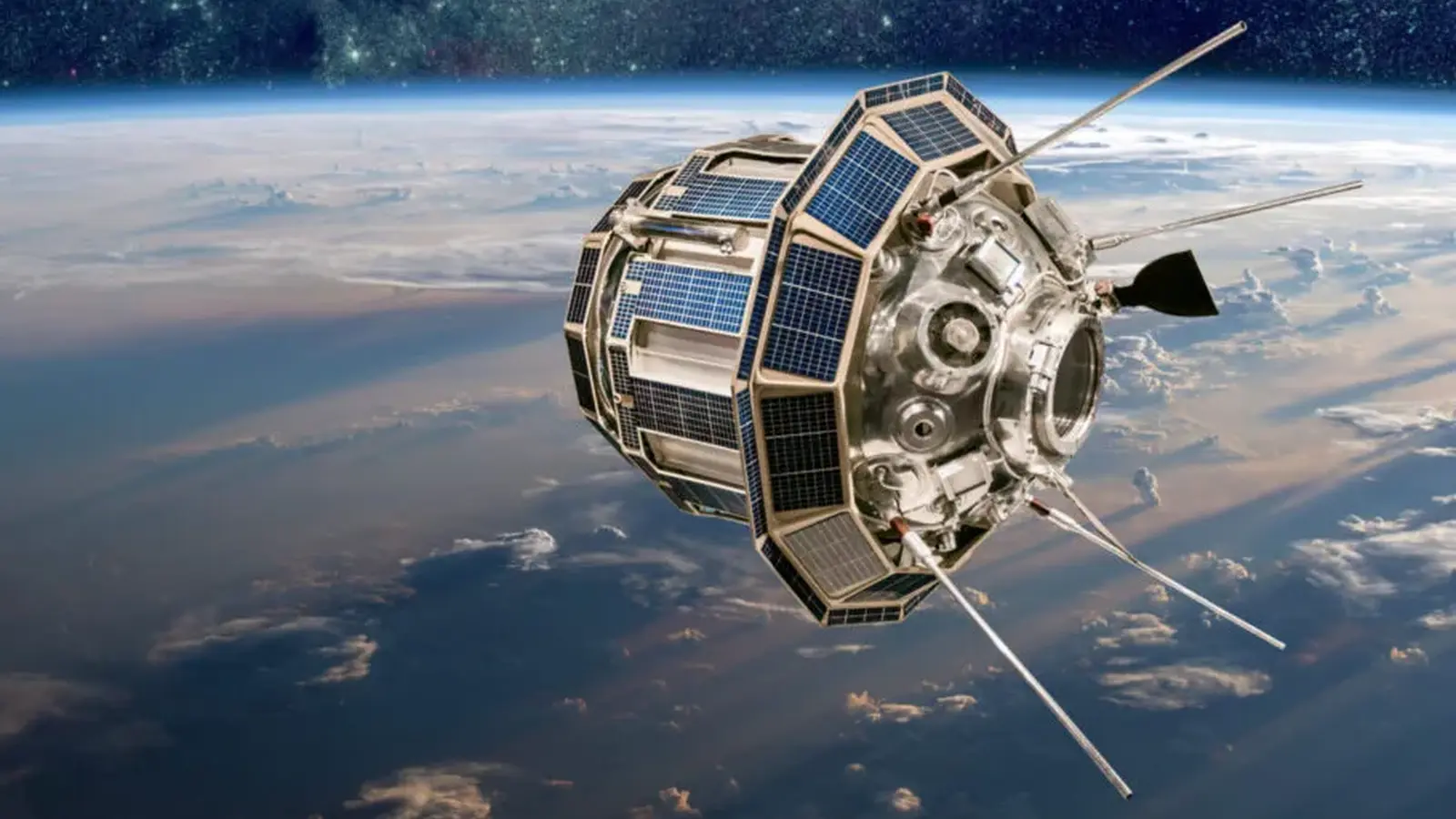
A small glass chip, mounted on titanium plates and rattled by rocket vibrations, quietly proved a big idea: quantum interference can be produced in low Earth orbit. The experiment did not yet turn satellites into quantum supercomputers, but it crossed a technical threshold that engineers long thought might be out of reach.
Mission hardware and the challenge of photons in space
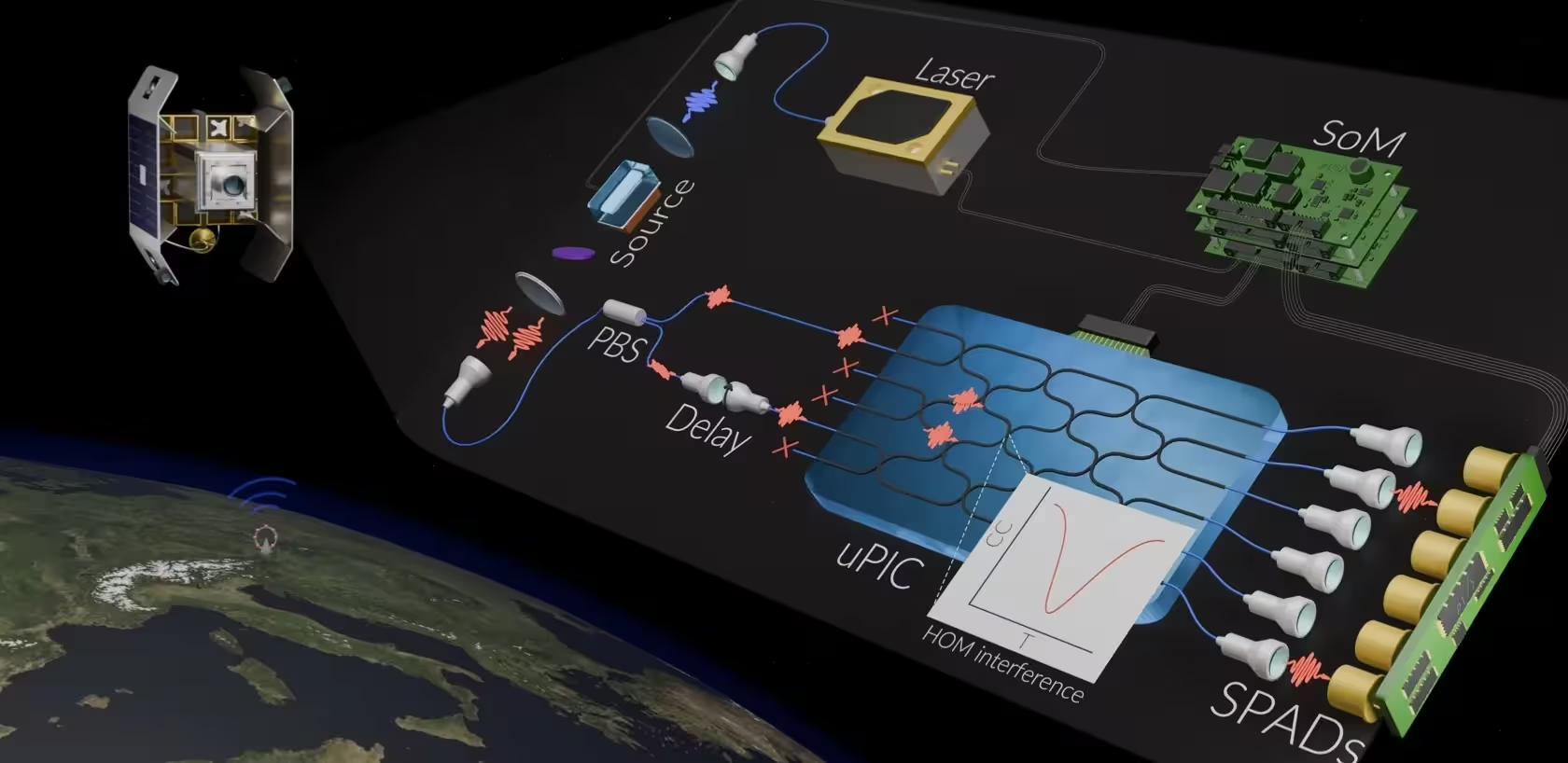
The system launched in summer 2025 on a Falcon 9 and rode to about 510 kilometers above Earth. At its heart sits a photonic quantum processor: a compact source that generates pairs of photons and injects them into a programmable network of waveguides etched into a glass chip. Photons carry quantum information in properties such as arrival time, polarization, and wavelength. For the processor to work, those particles must be as indistinguishable as possible. Tiny differences spoil the quantum interference that underpins photonic computation.
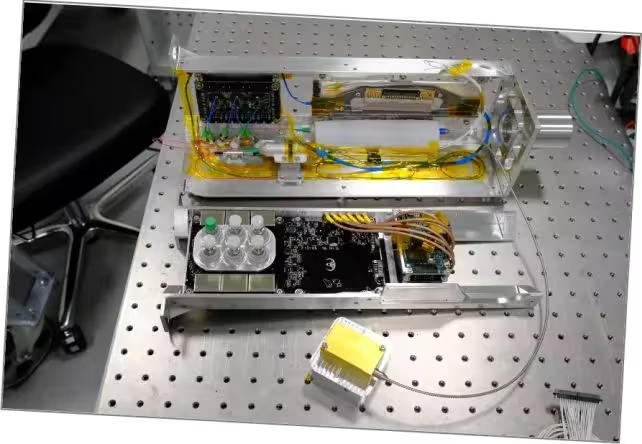
Putting delicate optics through a rocket launch required careful engineering. Sensitive components were fixed to reinforced titanium plates, and the fiber connections to the photonic chip were strengthened. Prototypes underwent vibration and shock tests that simulated launch stresses. In a resonant test mode, shock pulses reached roughly 1500 times Earth gravity, and the optical subsystems showed no major degradation afterwards.
Space introduces new, subtler problems once the rocket is behind you. The payload included six single-photon avalanche diodes, SPADs, to detect the photons emerging from the chip. Only three detectors remained functional after deployment. Sunlight proved another nemesis. The remaining detectors are so sensitive that direct or scattered sunlight created a strong, fluctuating background that masked the faint quantum signals. The satellite does, however, pass into Earth shadow about every 92 minutes. During that roughly 30-minute window each orbit, background noise drops and the team could attempt their most sensitive measurements.
What the team measured and why it matters
Despite detector faults and a laser module that used an adhesive not well suited to vacuum conditions, researchers observed a clear signature of quantum interference known as the Hong-Ou-Mandel effect. In plain terms: when two identical photons enter a beam splitter from opposite sides at the same moment, they do not emerge separately as classical particles would. Instead they interfere and tend to leave together, producing a dip in the rate of coincident detections.
On ground, the experimenters had identified an optimal operating temperature near 32.5 degrees Celsius for producing the strongest interference. In orbit, they saw the same behavior: when the local temperature approached that target, the rate of simultaneous photon detections fell sharply and the Hong-Ou-Mandel dip appeared. That result shows the essential quantum behavior survives the extreme environment of space, at least for short measurement windows.
It is important to be precise about what this does not mean. The satellite processor is not yet capable of performing practical quantum computations on real satellite imagery or telemetry. The team frames the flight as a technical validation, a step toward building more robust, space-ready quantum processors that might one day process data onboard and reduce the need to downlink vast volumes of raw information.
Implications and the road ahead
Satellites collect terabytes of raw data, but communication bandwidth and ground-station windows are limited. One potential advantage of reliable, flight-qualified quantum processors is local pre-processing or specialized quantum-enhanced tasks executed before sending compressed results to Earth. That could matter for Earth observation, climate monitoring, and missions with constrained communication links.
Yet significant engineering challenges remain. Detector resilience, stray-light filtering, radiation hardening, thermal control, and vacuum-compatible components must all improve. The experimenters used a commercial laser adapted for space, including a gold-coated alloy body selected for low thermal expansion. Still, internal adhesives incompatible with vacuum caused concern and underscore how even small materials choices can limit long-term reliability.
Expert Insight
"This flight demonstrates that photonic quantum effects are not confined to lab benches," said Dr. Elena Vargas, a quantum systems engineer not involved in the mission. "Seeing a Hong-Ou-Mandel dip in orbit is a milestone. The next steps are engineering resilience and extending operating windows so useful, routine tasks can be performed aboard spacecraft."
The full report is currently available as a preprint on arXiv and has not yet passed peer review. The research team describes the mission as an important feasibility test and a blueprint for future, hardened designs.
Conclusion
The experiment marks a pragmatic advance rather than a sudden revolution. It shows that key quantum phenomena can be generated and measured in low Earth orbit using a photonic processor, even under imperfect conditions. Engineers and mission planners will now take aim at the next set of problems: better detectors, contamination control, longer dark-window operations, and integrated payloads that can move from demonstration to useful, operational capabilities in future satellite constellations.

“The cosmos has always fascinated me. I write about space missions, astronomy, and the technologies pushing humanity beyond Earth.”

Discussion
Leave a Comment
Comments (1)
wow, didn't expect quantum interference to survive rocket vibes… but 30 min dark windows? if that holds up it's big, still lots to fix tho