
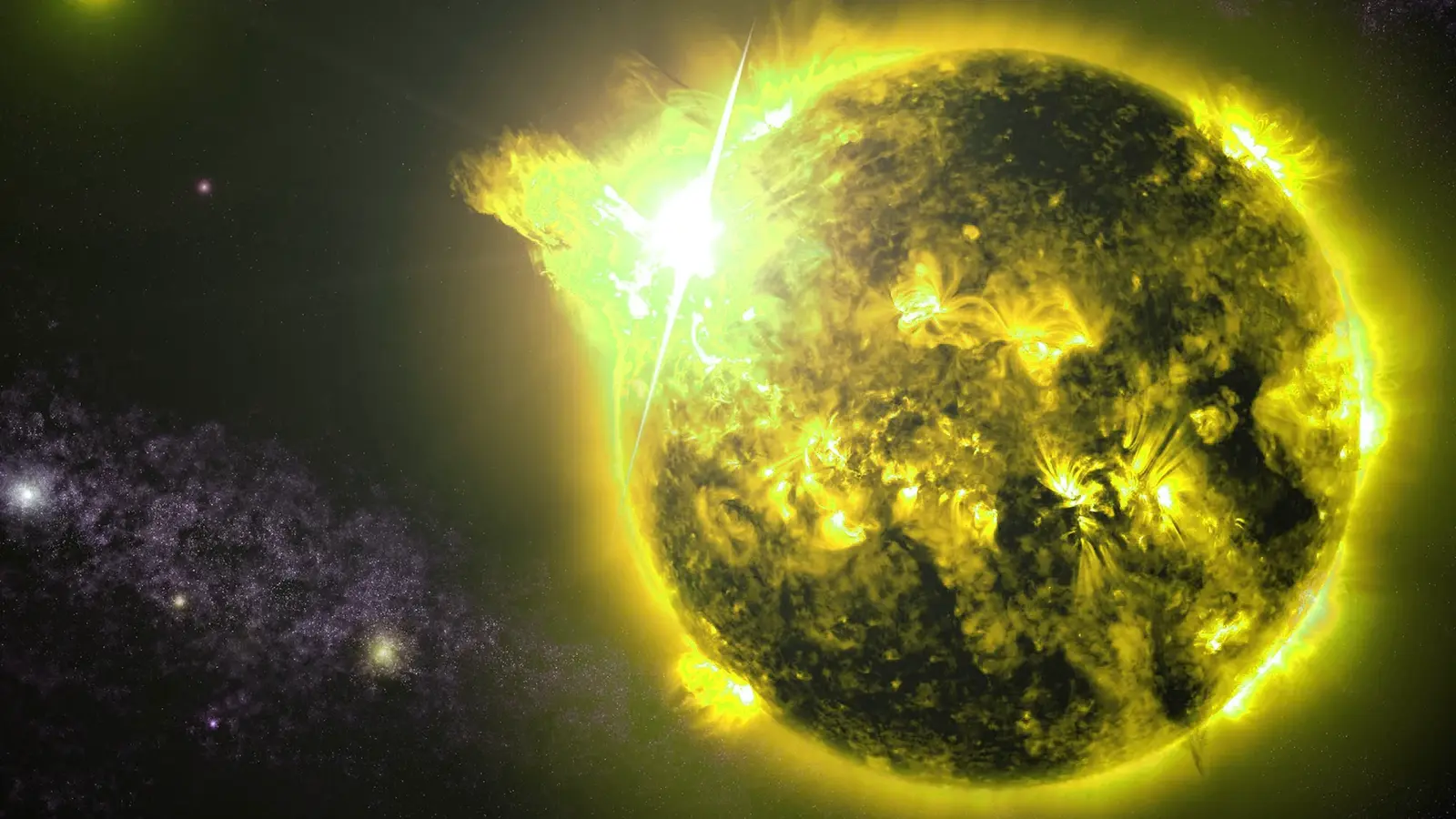
Imagine a blot on the Sun so large it could swallow dozens of Earths. Stare at it long enough and the scale becomes hard to hold in the mind: a single sunspot, a tempest of magnetic fields, with the raw potential to spark one of the most violent eruptions our star can mount.
A blot the size of continents
Researchers at the Max Planck Institute for Solar System Research have taken that mental image and given it a number. By examining the 300 most powerful solar flares recorded between 2010 and 2016, they mapped flare energy back to the size of the active regions—those tangled magnetic patches on the solar surface that often host dark sunspots. The result is a statistical relationship tying how much energy a flare releases to how large its parent active region was.
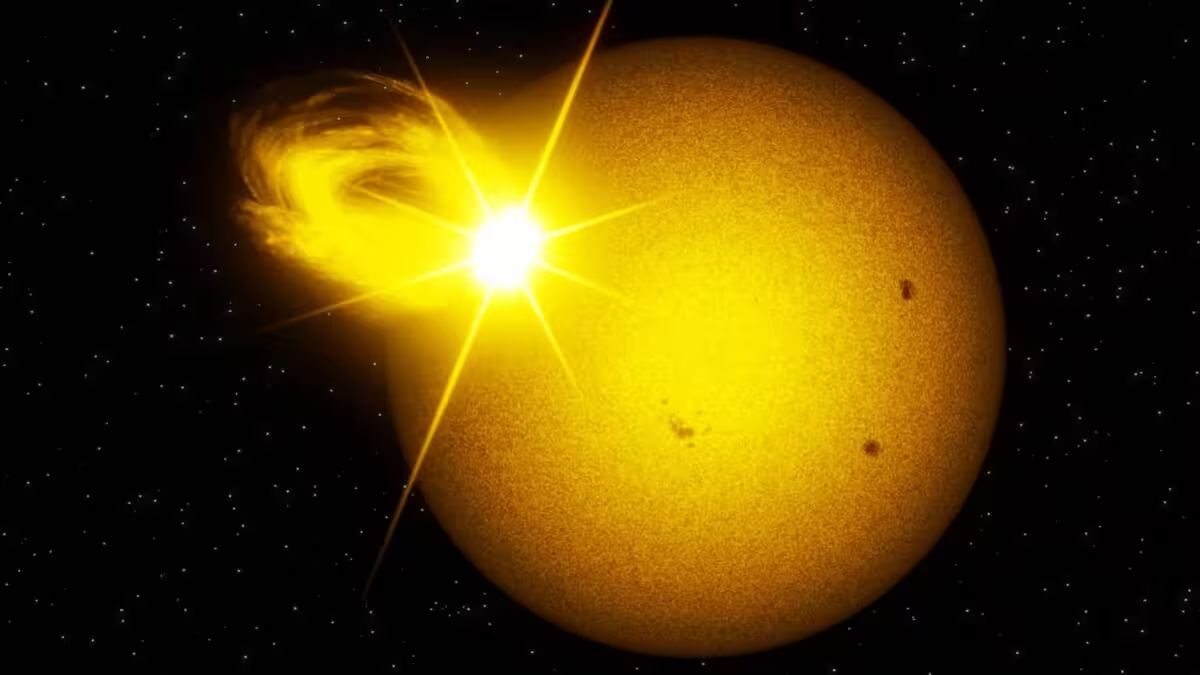
That mapping matters because historical records show our star has occasionally produced sunspots far larger than the ones we usually see today. The standout example is a sunspot from 1947 that covered roughly 0.6 percent of the visible solar disk. Put another way: its diameter would be about 40 times that of Earth. Using the new energy–size relationship, the team concluded a sunspot of that scale could, in principle, produce a flare near the lower boundary of what astronomers call a superflare.
Superflares are not everyday phenomena. On some Sun-like stars, astronomers see them roughly once a century. They can unleash hundreds to thousands of times more energy than the largest flares we have directly observed in the Solar System. If the Sun can generate similar events, the consequences for modern technology would be substantial even if direct effects on human health remain limited.
Reading the past in tree rings and sunspot catalogs
We do not have telescopes pointed at the Sun through deep time. Instead, researchers turn to proxies. Tree-ring records show spikes in certain isotopes that imply Earth was hit by extreme solar particle events in the distant past. Those spikes are fingerprints of radiation storms far stronger than anything in the historical telescope era. The new study proposes that at least some of these extreme solar particle events could have been triggered by superflares on the Sun.
"Our Sun has superflare potential," says Natalie Krivova, an astrophysicist at MPS and a lead author on the paper. She cautions that observing no superflares during recent satellite-era measurements does not rule them out across longer timescales. Rather, the empirical link between active-region size and released energy should hold if a truly extreme event ever arises.
There are caveats. A flare's raw energy is one thing; whether that energy translates into a particle storm that reaches Earth depends on magnetic geometry and how easily energetic particles can escape the Sun's magnetic cages. Subsequent modeling must therefore look beyond single-spot metrics and attempt to reconstruct how groups of sunspots interact, how field lines reconnect, and which magnetic configurations trap energy versus release it into space.

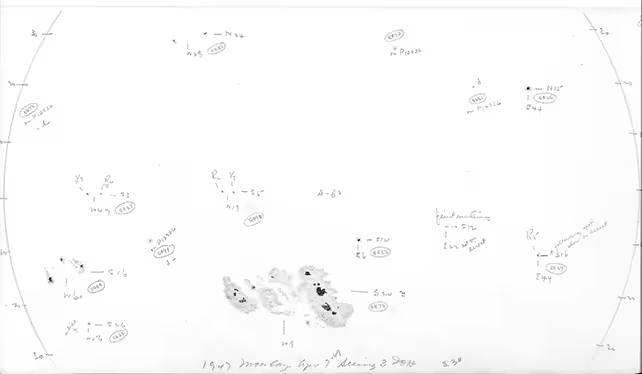
A historical hand-drawn illustration of the 1947 sunspot.
Why this research matters now
We live with ever-more complex electrical grids, satellite constellations, and global navigation systems. A sufficiently large space weather event could disrupt communications, damage satellites, and cascade into widespread infrastructure outages. The 1859 Carrington event provides a sobering example: telegraph systems failed, and auroras appeared at low latitudes. Today's technology would face far greater vulnerability.
Understanding the Sun's upper limits is therefore not an abstract academic exercise. The Max Planck-led analysis sets constraints on the maximum flare energies that historically recorded extreme sunspot groups could plausibly produce. The researchers emphasize they did not estimate how often such events occur. Frequency remains an open question, one that requires combining statistical studies with physical modeling and improved records of past solar activity.
Expert Insight
"Linking sunspot size to flare energy gives us a practical way to assess risk over centuries rather than decades," says Dr. Laura Mendes, a solar physicist at the University of California. "But size alone is not destiny. The magnetic structure around a spot, its connectivity to neighboring active regions, and the timing of flux emergence all decide whether stored energy escapes in a big, billowing blast or remains trapped. Future simulations will need to resolve those details to move from possibility to probability."
Conclusion
The Max Planck team's work does not prove the Sun has erupted with superflares within human history. It does, however, show our star is capable of producing the raw ingredients for such events. Giant sunspots—ones that dwarf Earth by a factor of dozens—have appeared before. When paired with the right magnetic circumstances, they could be the starting point for flares at the lower end of the superflare range observed on other stars.
For scientists, the path forward is clear: more detailed modeling, an effort to synthesize historical records with physical theory, and continued monitoring of the Sun's magnetic behavior. For society, the takeaway is equally practical. Space weather is a low-frequency, high-impact hazard. Knowing what the Sun can do helps engineers and planners design more resilient systems, and gives policymakers the data they need to prepare for an event that, while rare, would be consequential.

“My work centers on sustainability, energy, and environmental science — examining how innovation can lead to a greener future.”

Discussion
Leave a Comment
Comments
No comments yet. Be the first.