
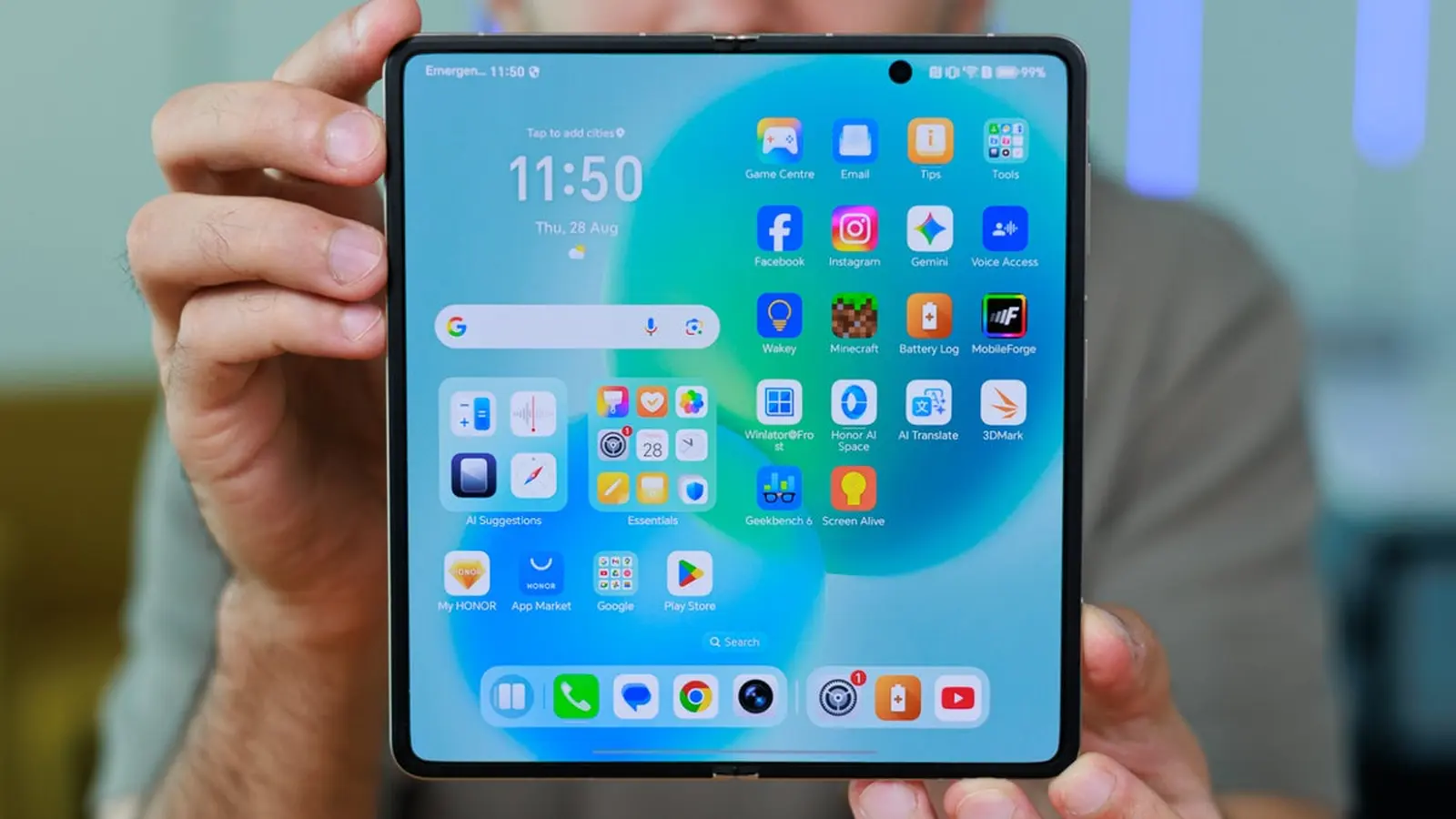
Picture a phone that unfolds into a portable slate and still manages to feel like the most powerful handset in the room. That image might be closer than you think. Leaks and insider whispers suggest Honor is testing a wide foldable that pairs a massive battery with cutting-edge silicon, and the result could shift expectations for horizontal foldables.
A wide foldable aiming for flagship speed
Sources close to the supply chain say the device is running Qualcomm's Snapdragon 8 Elite Gen 6 Pro, a 2nm-class chipset that pushes performance and efficiency into new territory. If true, this would be notable: Honor may be preparing the only wide foldable currently evaluated with that particular platform. That matters. Flagship chips like this change how a foldable handles multitasking, gaming, and the thermal tradeoffs inherent to larger displays.
Design hints point to a 7.6-inch inner panel and a roughly 5.5-inch outer screen. Expect a new manufacturing approach to the hinge and body finish, and a horizontal camera island that gives the phone a more tablet-like posture when opened. Camera hardware looks serious, too: industry chatter mentions a triple-camera array led by a 200-megapixel primary sensor, supported by Honor's computational photography stack.

Honor appears to be blending tablet-sized screens, flagship silicon, and lengthy battery life into one bold model.
Batteries that break the usual constraints
Honor's ambitions are not limited to one device. Additional leaks point to a lineup of phones packing unusually large cells. One tipster notes a single-cell unit rated around 11,600mAh with a typical capacity near 12,000mAh. Related battery candidates in testing include 11,790mAh and 12,000mAh-class cells, plus two single-cell designs in the neighborhood of 9,800mAh and 9,850mAh. Those sizes would drastically extend runtime compared with typical flagship batteries.
Expect these big batteries to appear across multiple series. The Win 2, X, and Power lines are singled out as likely hosts for the high-capacity packs. For users who prioritize uptime over pocket weight, that could be a strong selling point.
The emphasis on battery capacity raises obvious engineering questions: how will Honor balance weight, charging speed, and thermal management? The company will need to make tradeoffs, especially if fast charging and slim profiles are also on the brief.
Beyond conventional phones, Honor is also advancing its Alpha project. The company showcased a first-generation Robot Phone with a motorized gimbal camera and embodied AI earlier, and insiders now say a second-generation Alpha is in development. The hardware definition, we're told, is mature and ambitious. Whether the next Alpha stays within an established form factor or experiments anew is still unclear, but the emphasis on gimbal-style optics and on-device intelligence seems set to continue.
Taken together, these details sketch a strategy: Honor wants to lead with bold hardware experiments while solving the practical problems—battery life and performance—that often hold niche devices back. If the rumors hold, the coming cycle could deliver some of the most interesting hardware variations we've seen in mainstream phones for a while.
Will these products land globally or remain targeted to specific markets? That answer will shape whether Honor's experiments influence broader design choices across the industry or remain intriguing detours for a few select buyers.

“I cover emerging technologies, digital innovation, and the intersection of tech and everyday life. My goal is to make complex trends accessible and inspiring.”

Discussion
Leave a Comment
Comments (2)
Is this even true? Snapdragon 8 Elite Gen 6 Pro in a foldable plus 12k mAh sounds like hype. How will they keep it cool and light, lol
wow didn't expect Honor to go that big, 12k mAh?? insane battery but imagine the weight... still curious about charging speeds, and that gimbal camera sounds wild