
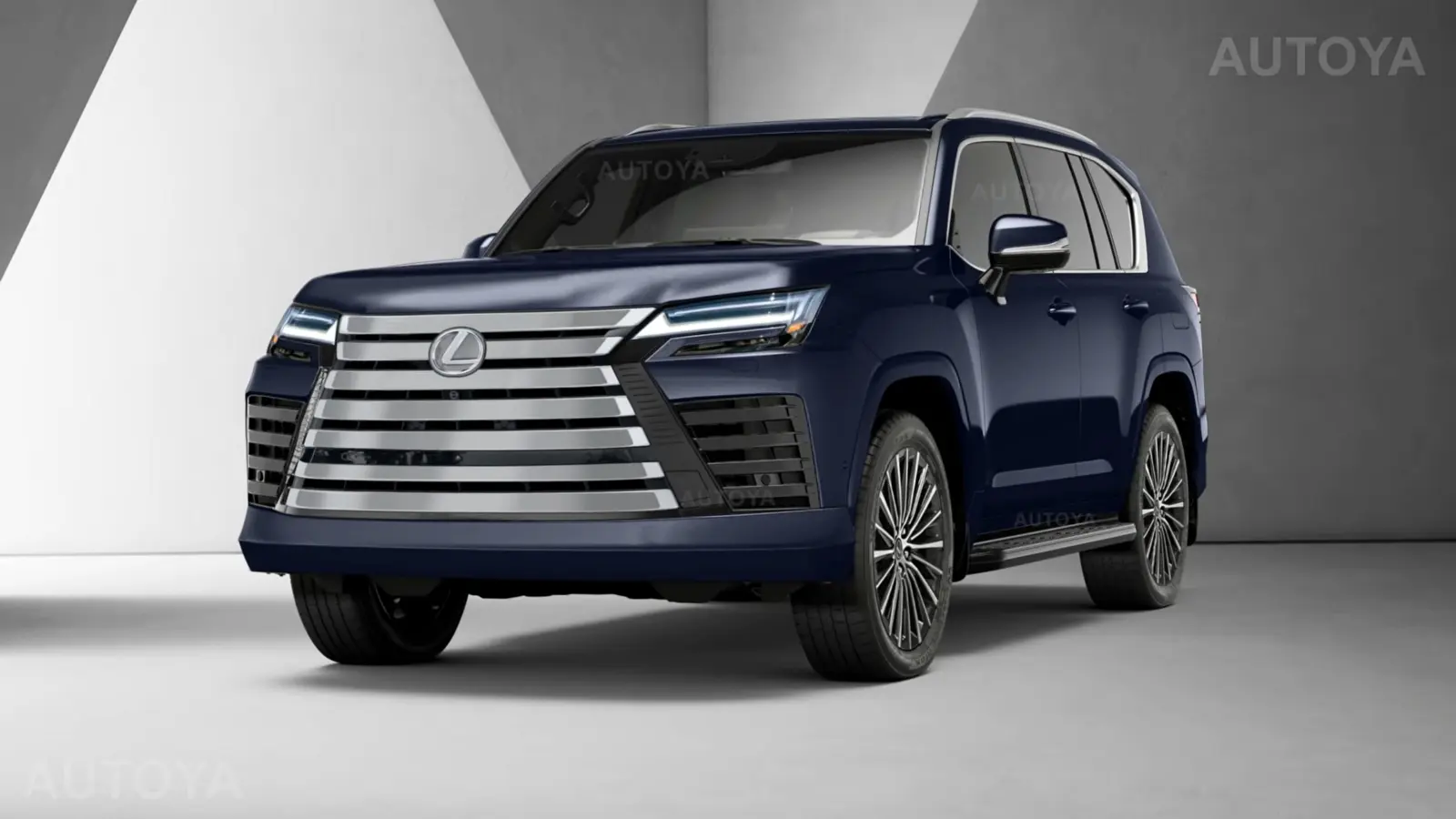
Imagine a Lexus LX you can tweak with a few clicks. Sleeker lamps. A reworked grille. A dashboard that finally feels modern. That is exactly what YouTube renderer AutoYa Interior has handed us: a 2027 LX imagined in tidy, believable detail.
The makeover is restrained. That is the point. This is not a new generation screaming for attention. It is a mid-cycle nudge, translated into pixels: slimmer headlight signatures, fresh daytime running light graphics, and a spindle grille dressed with horizontal slats rather than the busy mesh we know. The lower bumper looks chunkier, the hood gains new lines you would not usually expect on a simple facelift, and the side vents have been softened. Wheels appear slightly larger, lending the profile a planted stance without changing the silhouette.
.avif)
Small edits, clearer identity
At the rear the render tightens the design. A thicker light bar sits lower, right above the license plate well, while the Lexus badge moves up a touch. The bumper is cleaner, reflectors smaller, and the LX script remains on the tailgate where owners can still boast the name. It is all quiet refinement, the sort of change that catches your eye only after a second look.

Inside, the virtual LX swaps the tablet-like screen for a portrait-oriented unit mounted in the center stack. Air vents ride above the display and climate controls have been rearranged into a familiar layout below. Even the steering wheel gets a refresh, complete with a different Lexus emblem treatment. The renderer dresses interiors and exteriors in multiple colors and leathers, the way a designer teases buyers with options before a model hits showrooms.
Why does any of this matter? Because the real LX is still young. The fourth generation began production in October 2021 and underwent minor tweaks for 2025, yet a model turning five often prompts larger updates. Toyota’s premium arm has said nothing official, and no test mules have leaked. So we get these CGI proposals, which often reveal what designers and fans think the car could become, long before engineers commit.

For reference, the 2026 LX line up in the United States starts at about €99,900 excluding destination. The Performance Hybrid trims cost roughly €107,900, the Overtrail begins near €109,990, and the F Sport sits around €106,300. Under the bonnet, the 600 uses a 3.4-liter twin-turbo V6 paired with all-wheel drive, rated at 409 horsepower and 479 pound-feet of torque. The hybridized 700H combines a twin-turbo 3.4-liter V6 with a small motor inside a ten-speed automatic and a nickel-metal battery pack, producing 457 horsepower and 583 pound-feet. That hybrid LX is quicker to 60 mph, doing the sprint in 6.4 seconds, about half a second faster than the non-hybrid model.

Remember, the LX rides on Toyota’s TNGA-F platform, so it shares bones with the Land Cruiser, Sequoia, Tundra and other family members. The render is imaginative, but the mechanical foundation remains familiar and proven.
Do you prefer the CGI’s quieter, sharper LX to the current 2026 model? It is an easy question to ask and a harder one to answer. The pixel version nudges the design in the right direction, but whether Lexus will follow those cues for a real mid-cycle refresh is still anyone’s guess.

“Cars are evolving faster than ever. I cover electric vehicles, smart mobility, and the future of transportation worldwide.”

Discussion
Leave a Comment
Comments (2)
Is this even true? No test mules, nothing official... cool render but engineers will keep the TNGA-F bones. Still, I'd take that interior tho
Wow that CGI actually cleans it up nicely. Slimmer lights, quieter grille, feels classy not shouty. Hope Lexus listens but I doubt it.