
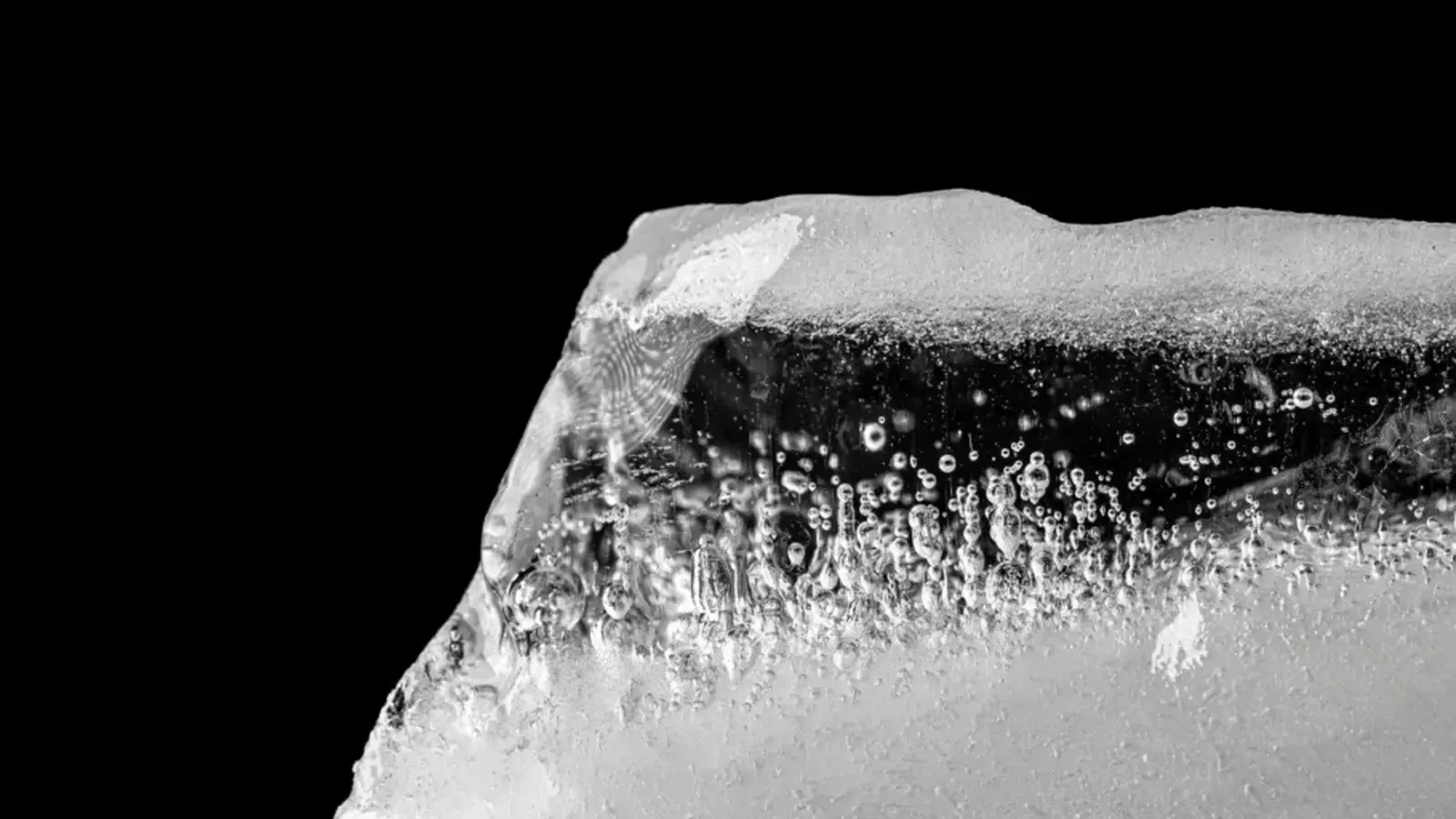
Imagine a material that looks like frozen water but behaves like building concrete. It holds shape under pressure, bends instead of shattering, and soaks up impact energy the way engineered composites do. Scientists have taken that idea from wartime makeshift to the molecular scale and created a new reinforced ice dubbed BioPykrete.
From wood-filled ice to molecular glue
The concept of strengthening ice is not new. During World War II, engineers experimented with pykrete, a mix of ice and wood pulp that resisted cracking and melted more slowly than plain ice. Modern teams revived the notion with far greater precision: instead of adding bulk fibers, they embedded cellulose nanocrystals into the ice and then used a designed protein to bind the ice and the cellulose at the molecular level.
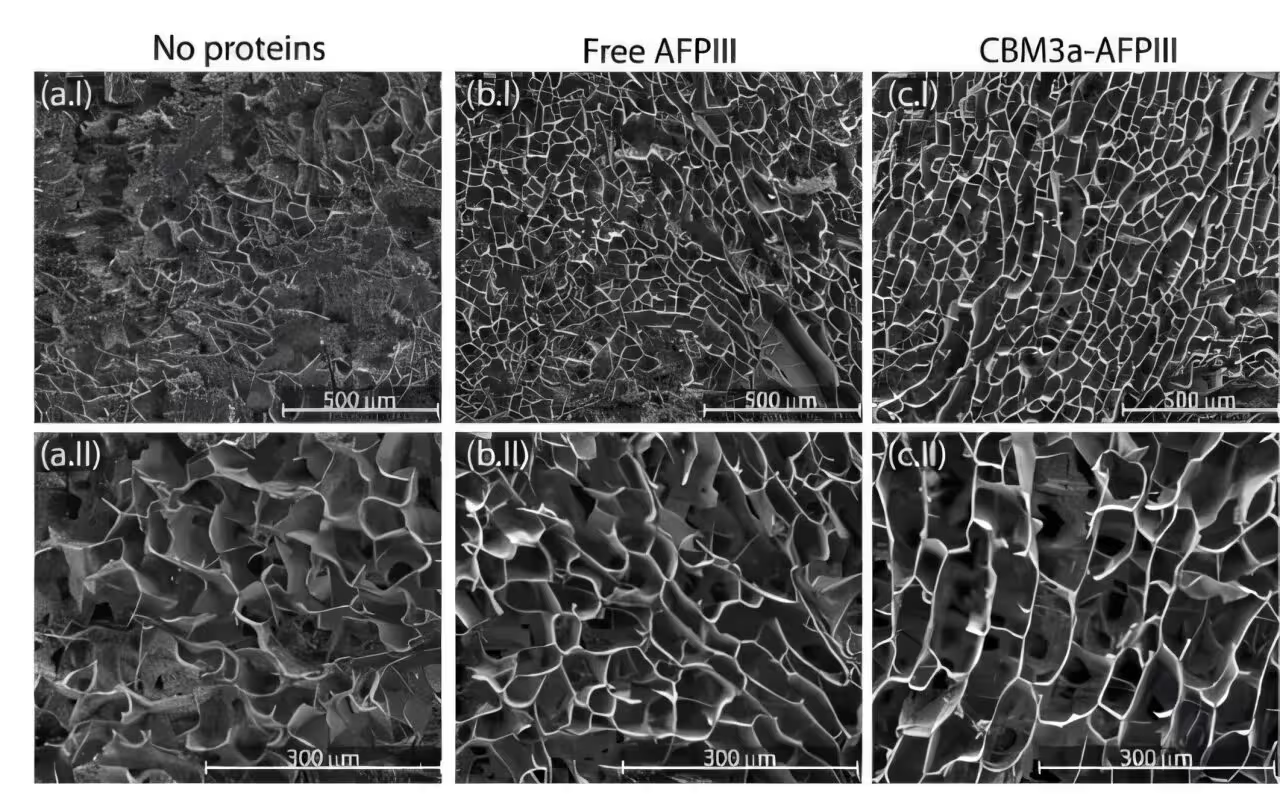
Cellulose nanocrystals are tiny, stiff particles derived from plant fibers. When a water–cellulose mixture freezes, those nanoparticles form a three-dimensional scaffold around microscopic ice domains. The researchers then introduced a bespoke protein that has two functional faces: one patch adheres to the ice lattice, the other to the cellulose. Think of it as molecular double-sided tape that ties the scaffold to the frozen matrix.
How the reinforcement changes failure modes
Plain ice is brittle. Small cracks propagate quickly and the whole structure can fail almost instantly. BioPykrete behaves differently. The cellulose network blocks crack growth. The engineered protein links dissipate stress across interfaces. The net effect: cracks either stop, are redirected, or require substantially more energy to propagate.
Laboratory tests show striking numbers. Under compressive loading, BioPykrete can be about 10 times stronger than unmodified ice and can absorb roughly 70 times more energy before breaking. Those metrics put its performance in the neighborhood of common concrete, at least for certain load conditions and temperatures.
Why does this matter? Because in high-latitude and polar regions, transporting conventional construction materials such as cement, steel, and aggregate is logistically costly and carbon intensive. A locally produced, ice-based structural material could reduce supply chain burdens and lower the environmental footprint of temporary or semi-permanent installations.
The work appears in the journal Colloids and Surfaces B: Biointerfaces. The authors emphasize that BioPykrete is far from a universal substitute for conventional materials. Temperature sensitivity, long-term creep, melting risks, and biological degradation under changing climates are real concerns. Still, for cold, stable environments it offers intriguing advantages: low embodied carbon when made from water and plant-derived cellulose, and potential biodegradability at end of life.
Applications could range from polar staging platforms and remote field stations to temporary runways or protective berms. The technology also points toward hybrid approaches: combining BioPykrete elements with traditional materials to exploit local resources while maintaining critical performance where needed.
There are engineering hurdles. Scaling the controlled protein–ice bonding from lab samples to structural volumes will require new manufacturing methods. Researchers must also validate weathering behavior, joint design, and repair strategies, and quantify lifetime emissions compared with imported concrete and steel.
Still, the broader lesson is clear: sometimes old ideas become new when scientists work at the right scale. Reinforced ice is no longer just a historical curiosity. With nanoscale scaffolds and molecular adhesives, ice can be engineered to stretch, absorb, and hold like the materials used in modern construction. The polar regions, where resources are scarce and the climate is unforgiving, may be the first places to see whether BioPykrete can move from the bench to the field.


“My work centers on sustainability, energy, and environmental science — examining how innovation can lead to a greener future.”

Discussion
Leave a Comment
Comments
No comments yet. Be the first.