
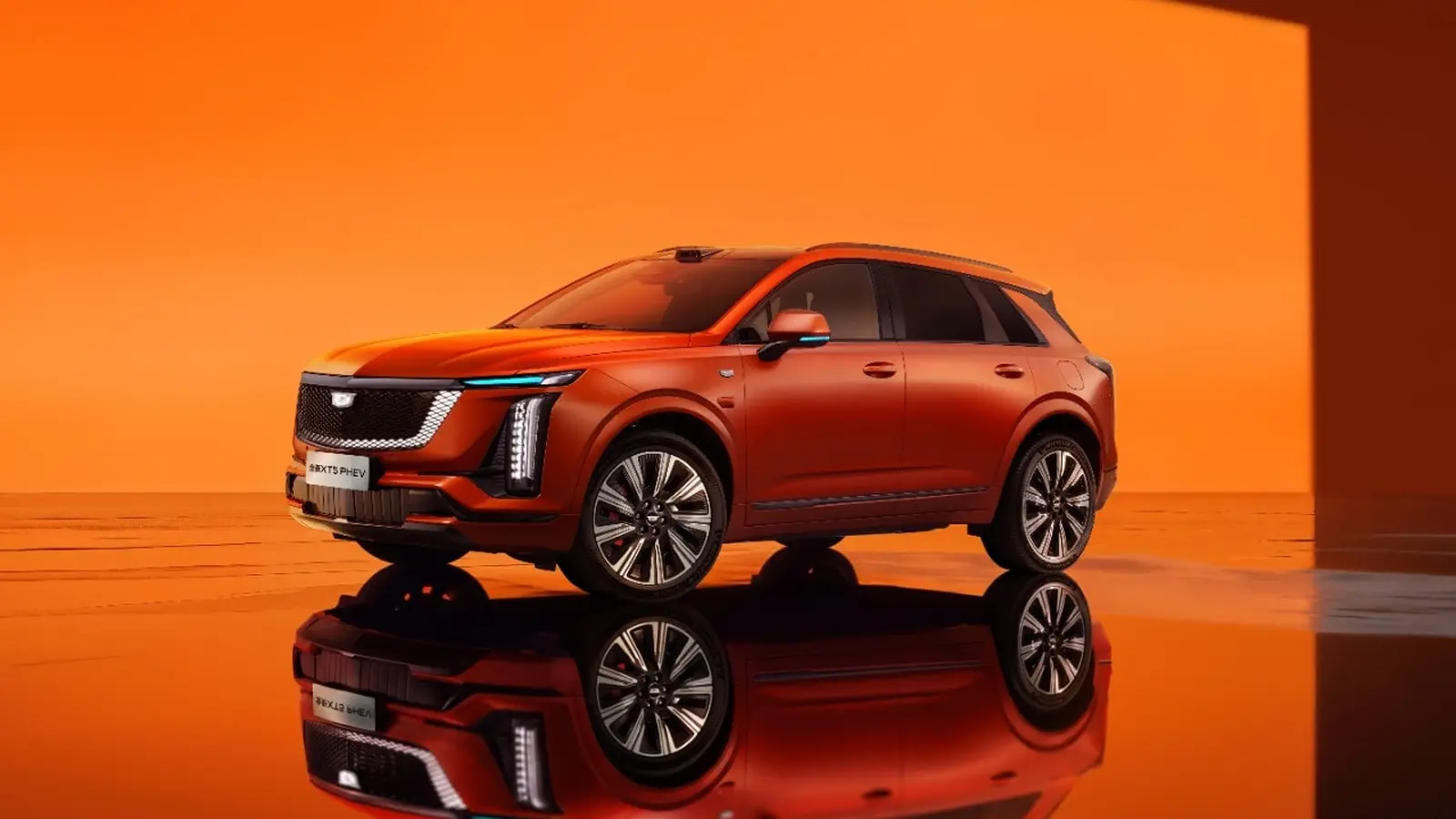
Pull up outside a Shanghai showroom and the new XT5 PHEV could slip past you as just another refreshed crossover. Look closer and the story changes. This is Cadillac retooled for the Chinese market, produced by SAIC-GM in Shanghai, and hiding a lot more under a familiar face than you might expect.
On the outside the cues are subtle but deliberate. A blacked-out shield grille with illuminated trim meets vertical, split headlights. Active grille shutters hunt for the most efficient airflow. Gloss-black accents tidy the profile. At 4,888 millimeters long with a 2,863 millimeter wheelbase, the XT5 PHEV keeps the proportions buyers recognize. The rear favors a cleaner silhouette, with T-shaped lamps, a chrome strip, and a hidden tailpipe that refuses to shout its combustion roots.

Step inside and the tech claim hits you first: a sweeping 33-inch curved display that blends gauges and infotainment into one uninterrupted surface. It’s a modern cabin flourish, yes, but the real headline is what the display connects to. This XT5 is the first Cadillac built on the brand’s locally developed electrical architecture in China. That matters.
Under the skin the layout mixes old-school mechanical sense with electric ambition. A direct-injected 1.5 liter turbo four-cylinder provides the combustion backbone. It makes about 156 PS and 230 Nm of torque. Complementing it are two electric drive units, a front motor rated at 214 horsepower and a rear motor rated at 147 horsepower. Cadillac’s local arm hasn’t published a single combined-system horsepower figure, a quiet omission that leaves some guessing.

Battery details are less coy. A 35.5 kilowatt-hour pack, tipping the scales at 194 kilograms, powers the electric motors and supports vehicle-to-load use if you want to run appliances from the car. The cells are rated at 5C for charge and discharge, meaning they accept relatively high currents for quicker energy transfer. Under China’s CLTC cycle the XT5 PHEV manages an electric-only range of about 155 kilometers, a useful stretch for daily commuting without touching the pump. When the small gasoline engine runs, official fuel consumption sits at roughly 6.05 liters per 100 kilometers.
The vehicle’s curb weight ranges from about 2,170 to 2,200 kilograms, which explains the need for stout hardware and careful chassis tuning. Cadillac calls its setup the Hummingbird suspension. Electronically controlled valves inside the dampers adjust damping force in real time, a feature aimed at keeping ride and control in balance whether you’re gliding on electric power or pushing for a rapid merge.

The mind behind the move
If the drivetrain is the body, Momenta’s R7 World Model is the brain. Built by Momenta and tuned with GM, the software reportedly learned from more than 15 billion kilometers of real-world data. But this isn’t simple object recognition. R7 uses physical AI and reinforcement learning to predict how a scene will evolve — the probable trajectories of pedestrians, other cars and cyclists, even how motion and physics will interact a few seconds ahead.
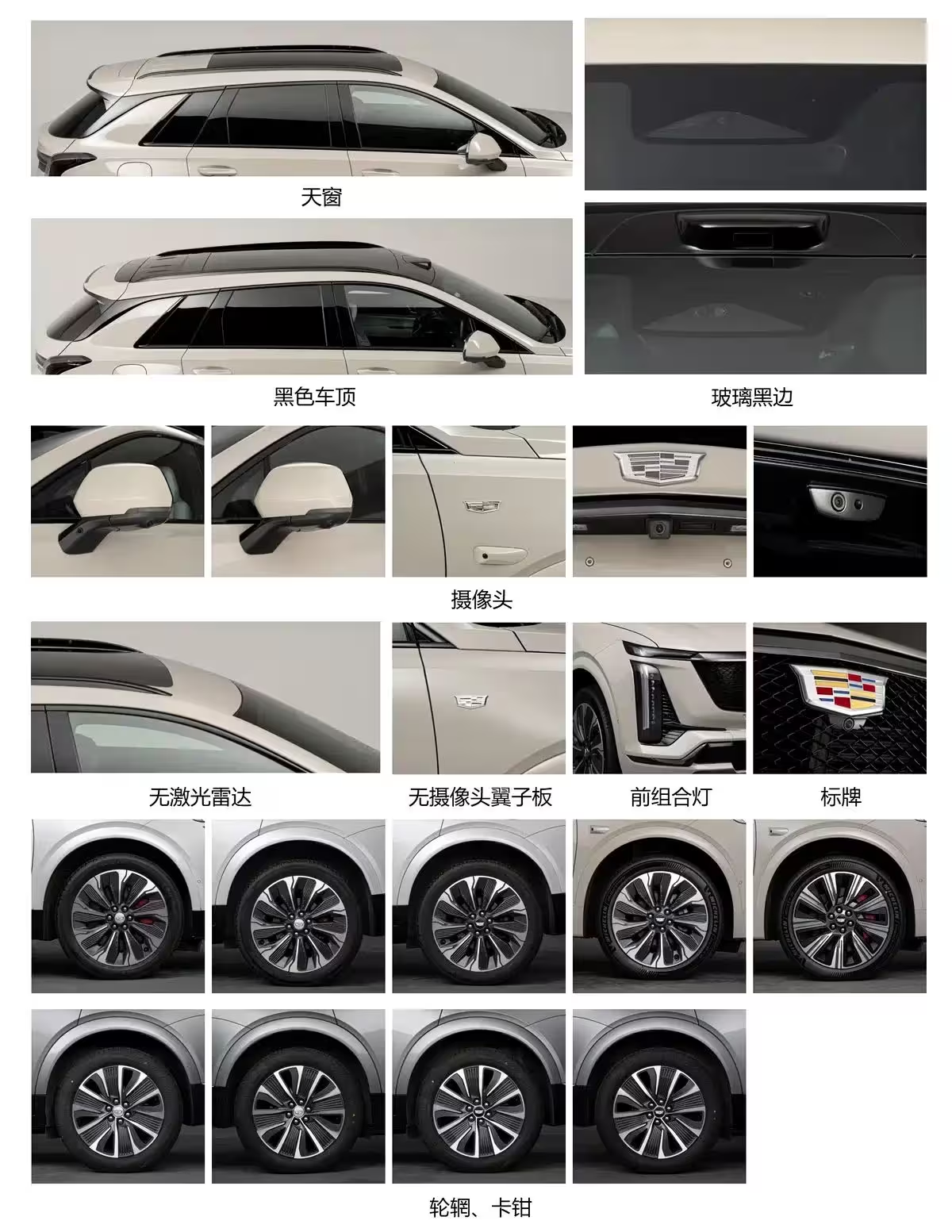
Think of it like a chess player who runs millions of moves in a simulation before deciding. That virtual engine lets the system reason through what-if scenarios, pick a preferred line, and then execute. Sensors include roof-mounted lidar and a dense camera array. The package currently presents as Level 2++ in capability, with an architecture designed to scale toward conditional and higher levels of automation as regulations and validation permit.
Why does that matter? Because semi-autonomous systems that predict behavior rather than merely label it tend to be safer and smoother in complex traffic. In congested urban centers where split-second decisions matter, the R7 approach gives the XT5 a clearer view of what happens next, not just what’s visible now.
So where does this leave buyers? You get a visually familiar Cadillac with a heavy dose of local engineering, a substantial battery that enables meaningful electric travel, and an advanced AI driving assistant that aims to change how the car thinks. The package isn’t perfect; some headline power figures remain undisclosed and the curb weight is significant. Still, the XT5 PHEV feels like a deliberate step: Cadillac adapting American luxury instincts to Chinese technical ambitions.
Will buyers reward the mix of range, tech and local production? That answer will come from showrooms and city streets. For now the XT5 PHEV stands as a clear marker of how established brands are reinventing themselves where future mobility is being written, and the pen in this case is more algorithm than chrome.

“I cover automotive innovation, electric vehicles, and the future of mobility — where technology meets sustainability.”

Discussion
Leave a Comment
Comments (2)
Is Cadillac hiding combined hp on purpose? nice battery and AI but why keep power quiet, odd...
wow didn't expect Cadillac to go full tech for China. 33-inch screen, V2L, lidar... feels futuristic but also kinda heavy, hmmm