
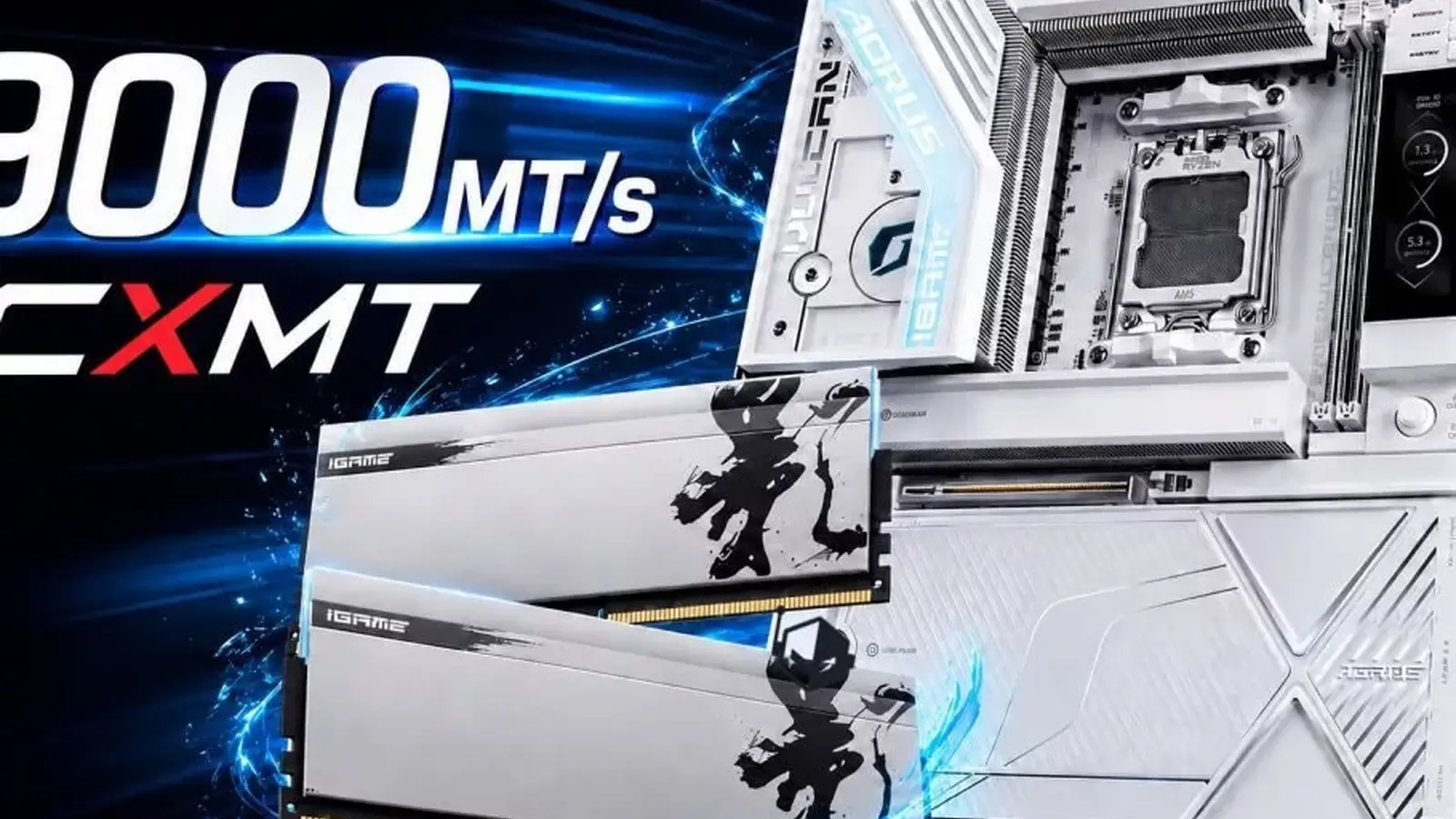
Plug a CXMT-powered DDR5 stick into the right board and the numbers shock you. 9000 MT/s. That is not a theoretical spec or a lab curiosity. Colorful has shown it in a live demo, with timings tight enough to make enthusiasts sit up and take notice.
Small tweaks, big consequences
Not long ago CXMT chips struggled to clear 6400 MT/s. Now those same silicon blocks are in kits hitting 9000 MT/s with surprisingly reasonable timings. The change did not come from a single miracle. It arrived as a sequence of tweaks: firmware and BIOS updates from motherboard makers, careful module engineering by Chinese vendors, and iterative calibration of IMC and secondary timings. The result feels less like a sprint and more like a steady, technical climb.
Colorful’s latest demo used the X870E Vulcan W OC, a board built for two-slot memory overclocking, paired with an AMD Ryzen 7 9800X3D. The iGame Shadow II kit—two 24 GB modules running CXMT DRAM—was set to an EXPO baseline of 6000 MT/s but pushed to 9000 MT/s at CL46-58-58-126-216. In RunMemtestPro that configuration reported an average coverage score of 114.6 percent and remained stable throughout the run.
There was a second, steadier demonstration on the same board using an AMD Ryzen 5 9600X. The same memory kit ran at its EXPO profile: 6000 MT/s, 1.4 V, CL30-38-38-76-144. In AIDA64 this setup produced 58.7 GB/s read, 81.1 GB/s write and 54.7 GB/s copy, with a measured latency of 76.6 ns. Those numbers show that CXMT modules can be both fast and reliable across different operating points.

Colorful is not alone. ASUS has shown multiple AMD and Intel boards running Chinese-sourced modules at tight CL28 and CL30 timings above 6000 MT/s. Vendors are shipping kits in dual 16 GB, dual 24 GB and mixed 16/24 GB configurations, giving builders options beyond the usual singlesize offerings.
Why should any of this matter to gamers or creators? Because memory latency, after raw frequency, is the most important factor for real-world performance. Dropping from CL36 to CL28 can translate into measurable gains in minimum frame rates, sometimes shaving up to one percent off 1% lows in competitive titles. For editors and AI workloads, lower RAM latency can reduce processing time in tight loops. Achieving both higher clocks and tighter timings required makers to look past simple frequency chasing. They tuned secondary timings, improved calibration routines and coaxed better signal behavior from IMCs. That work closed the last performance gaps that had kept domestic chips from competing with established foreign dies.
Historically, lower latencies such as 6000C30 and 6000C28 were mostly the domain of Hynix A-die and M-die. Buyers often paid a premium for those chips. Chinese-sourced modules typically landed at DDR5-6000 C36—solid but not spectacular. Now those boundaries are shifting. Suppliers in China are sourcing higher-quality CXMT DRAM for premium modules and pairing them with motherboard firmware that understands how to unlock the best timings.
There is a larger industry backdrop to this technical progress. Global memory shortages and shifting priorities at the major foundries have changed the landscape. Micron, SK hynix and Samsung have redirected a noticeable portion of their capacity toward high-margin AI memory products. CXMT has carved out a role by continuing to supply general-purpose DDR5 in volume. That availability is its strongest selling point. Price parity with foreign modules means buyers get similar costs but greater stock and easier access.
Still, the future is not guaranteed. CXMT has begun signing longer-term contracts with domestic AI companies, which could consume its DRAM inventory faster than expected. If that happens, the current advantage in availability could narrow.
This moment demonstrates that Chinese DDR5—led by CXMT—can now match top-tier performance while offering the market a more reliable supply option.


“I love exploring gadgets, apps, and trends that redefine how we connect, work, and play in a digital world.”

Discussion
Leave a Comment
Comments (2)
Cool demo, but is CXMT gonna get snapped up by AI contracts? stock advantage might vanish fast, feels risky for buyers...
Whoa 9000 MT/s with CXMT? didnt expect that! CL46 sounds wild but the stability numbers are convincing, curious about temps..