
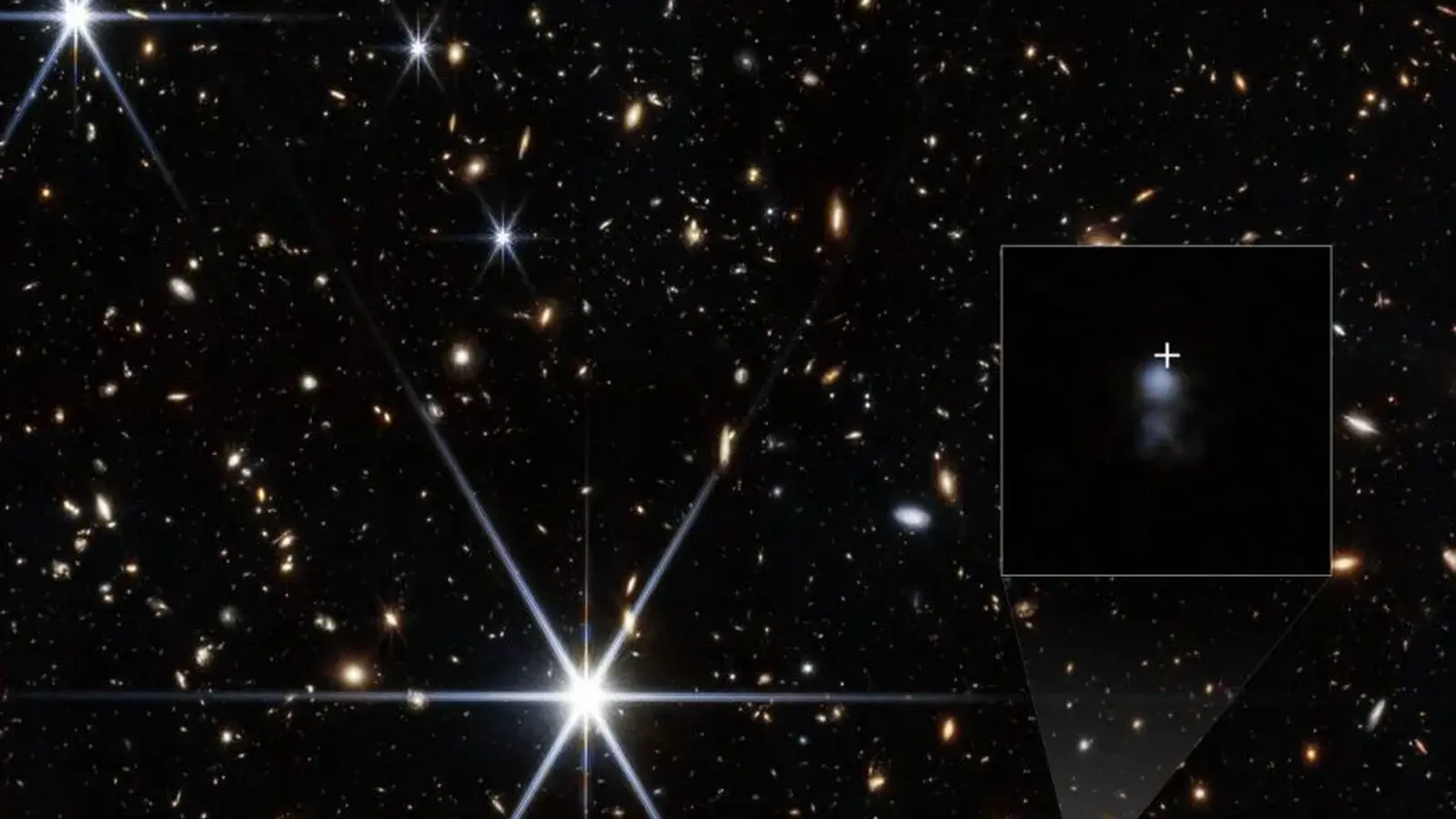
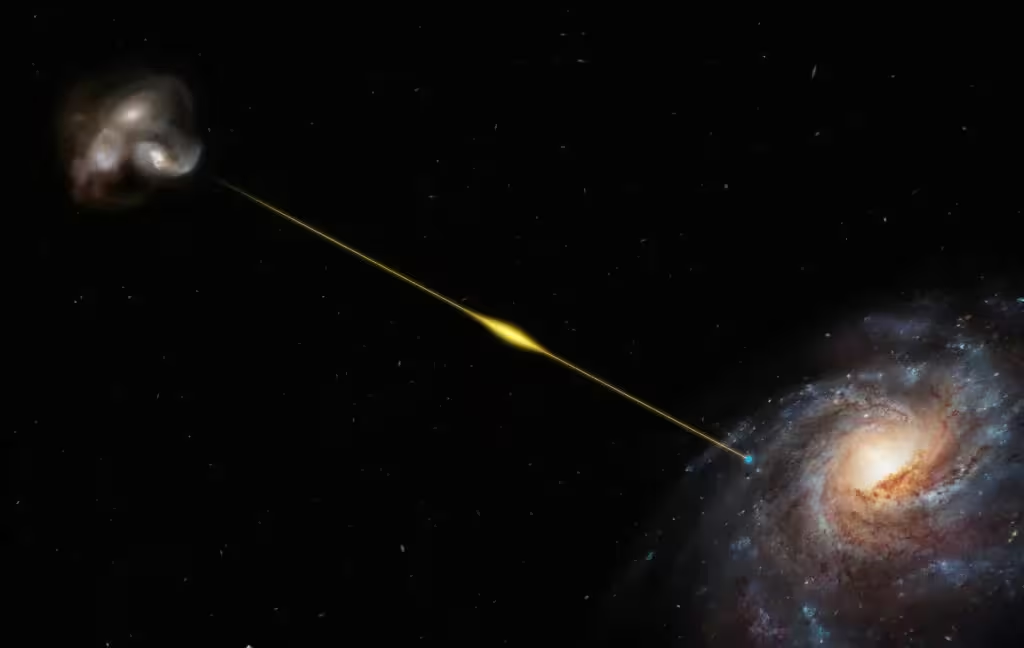
When a single, blink-fast radio flash lit up a MeerKAT detector in 2024, astronomers had a problem and an opportunity in the same instant. The signal lasted only a fraction of a second, yet carried the energy of days of solar output. That fleeting burst—one of the most distant fast radio bursts ever recorded—has now been traced to its galactic home by the James Webb Space Telescope, altering how scientists think about the engines that produce these cosmic radio flashes.
How Webb pinpointed a surprising host
Radio arrays on the ground can detect fast radio bursts with exquisite sensitivity, but localizing them to a precise galaxy often requires follow-up at other wavelengths. Webb’s near-infrared instruments imaged a compact galaxy at the position indicated by MeerKAT. Spectroscopic measurements of the galaxy’s redshift place the event roughly three billion years after the Big Bang, meaning the burst occurred during an epoch when the universe was busy building stars.
That timing is notable. Previous localized fast radio bursts tended to come from much later eras and from large, actively star-forming galaxies. This new host, however, is far smaller than expected—about one thousand times less massive than models had predicted for a source at this distance. The discovery flips a tidy assumption: FRBs do not all come from large, mature galaxies.
Clues about the engine: merger or magnetar?
Fast radio bursts are still an open astrophysical puzzle. Two leading scenarios dominate the debate. One proposes that FRBs arise from the mergers of compact objects, such as two neutron stars. Those collisions can deliver immense energy, but they typically require billions of years of orbital decay, so they ought to occur in older stellar populations.
The other scenario points to young, highly magnetized neutron stars called magnetars—remnants left behind after a massive star dies in a core-collapse supernova. Magnetars can flare repeatedly and do so on short timescales after their birth, making them plausible engines for FRBs found in youthful or compact galaxies.
Manisha Kalb of the University of Sydney, lead author on the Science paper reporting the result, summarized the implication plainly: "Our analysis makes it very unlikely that this particular burst arose from a compact-object merger." In other words, the Webb+MeerKAT discovery leans toward a supernova-to-magnetar pathway for this event.
That does not close the case. The diversity of FRB host environments seen so far suggests multiple formation channels—some bursts may come from old-merger systems, others from young magnetars born in star-forming clumps. What Webb’s observation does is demonstrate that the engines behind FRBs are varied, and that sensitive infrared imaging is essential to read the local cosmic context.
Follow-up is already planned. More precise localizations from radio arrays combined with Webb’s deep infrared spectroscopy will allow astronomers to build a catalog of host types and ages. Upcoming facilities—like the Square Kilometre Array—will add detection firepower, while Webb and other space telescopes will continue to characterize the galaxies themselves.
This result strengthens the link between at least some fast radio bursts and young magnetars born in rare, compact galaxies.
As the sample grows, the question will shift from whether FRBs can arise from different channels to how frequently each channel contributes. For now, Webb has given astronomers a critical datapoint: some of the universe’s most dramatic radio flashes come from unexpectedly small places.

“My work centers on sustainability, energy, and environmental science — examining how innovation can lead to a greener future.”

Discussion
Leave a Comment
Comments (1)
wow didn't expect that... a tiny galaxy with days-of-sun energy in a blink. magnetars? mind blown gonna read more.