
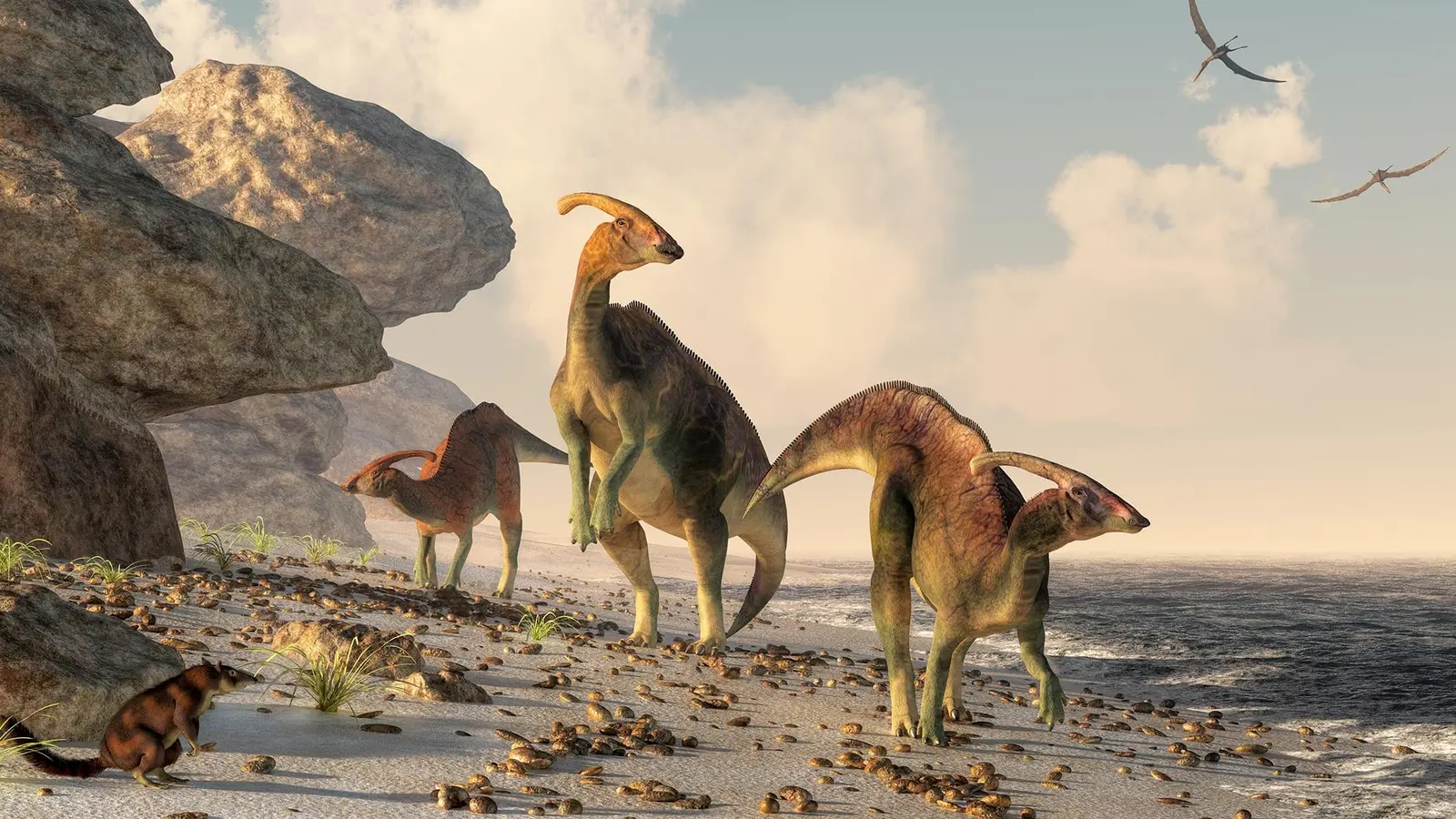
The image of a dinosaur grazing on a shoreline seems odd but plausible: after a violent storm, a beach piled high with rotting seaweed and drowned fish becomes a temporary larder. Today, many coastal mammals and birds take advantage of those marine windfalls. New chemical evidence suggests that more than 100 million years ago, dinosaurs and other Cretaceous animals did the same.
Coastal pantries: storms, seaweed, and hungry dinosaurs
Paleontologists have long debated how tightly linked land and sea were in deep time. The Western Interior Seaway, a vast arm of ocean that split North America during the mid Cretaceous, created long stretches of coastline where terrestrial and marine realms met. Those margins were not static boundaries. They were dynamic places where tides and storms moved organic matter from sea to shore, creating opportunities for land animals to exploit marine-derived food.
A team of researchers, publishing in Frontiers in Ecology and Evolution, tested whether that exchange—what ecologists call marine subsidization—left a measurable trace inside fossilized tooth enamel. The idea is simple in concept: seaweed and other marine plants carry a different carbon isotope fingerprint than most land plants. If that marine carbon worked its way into terrestrial food chains, the teeth of coastal animals should show a distinct signal.
Reading diets in enamel: δ13C and the fossil record
.avif)
Five specimens from the Cloverly Formation assemblage after destructive sampling for isotopic composition and laser ablation analysis. The specimens from left to right are three specimens of crocodilian teeth, the fourth tooth is a Deinonychus antirrhopus tooth, and, finally, on the far right is a Sauropelta edwardsi tooth. The specimens are mounted on adhesive putty attached to a glass slide with specimen labels below them.
To track the source of carbon in ancient diets, scientists measure the ratio of two stable carbon isotopes, carbon 12 and carbon 13. That ratio is expressed as δ13C. Plants that make food in marine environments tend to have higher δ13C values than the bulk of terrestrial plants. Because consumers inherit the isotopic composition of their food, tooth enamel can act as a durable time capsule of diet.
The research team sampled tooth enamel from a suite of fossils collected across sites that once bordered the Western Interior Seaway and other coastal margins, alongside specimens from inland, landlocked environments. The fossils came from two Cretaceous intervals: the early Albian, about 113 to 107 million years ago, and the early Cenomanian, roughly 100 to 96 million years ago. Powdered enamel was analyzed for δ13C and then compared across localities and taxa.
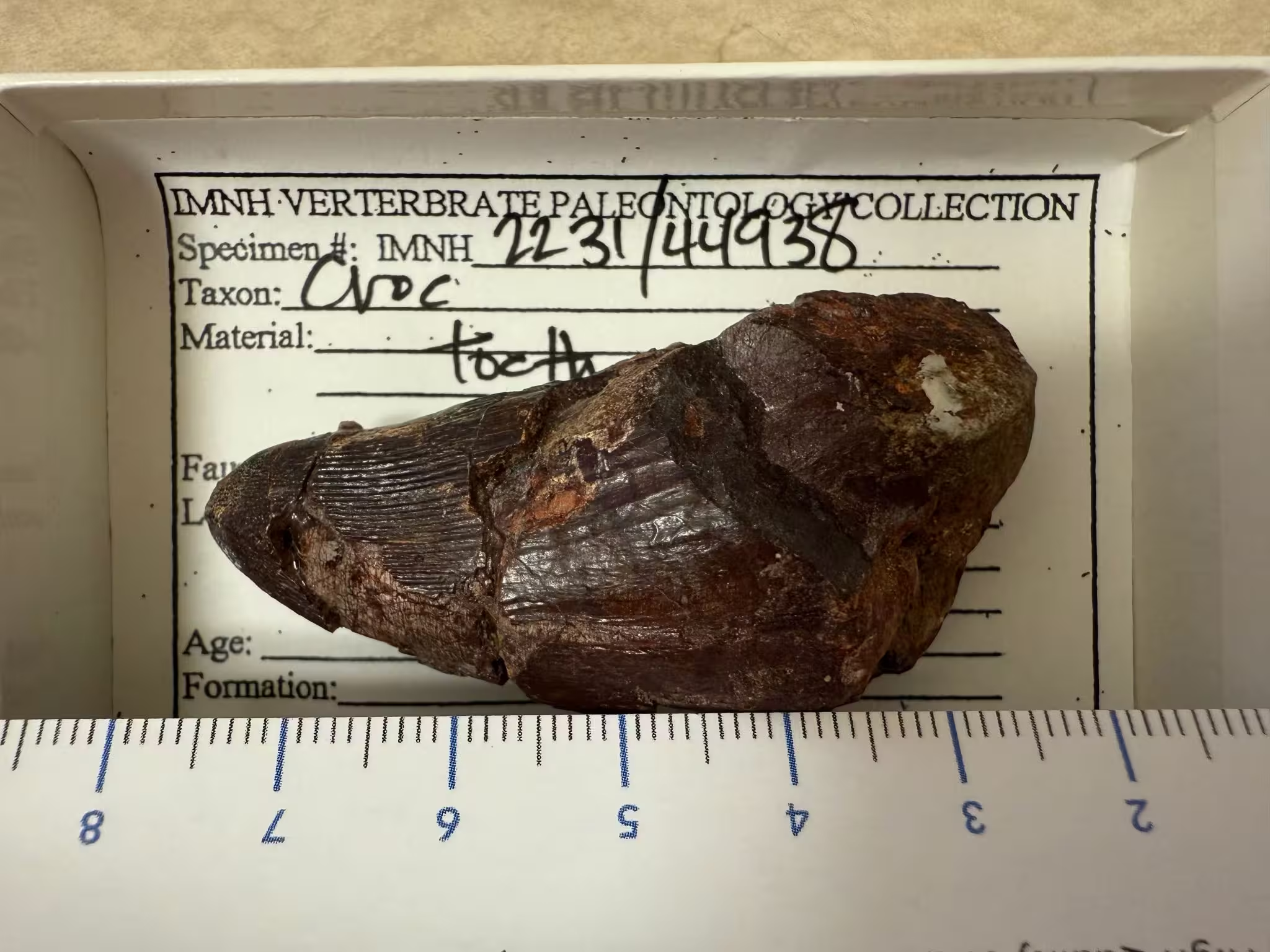
A large crocodilian tooth from the Wayan Formation. The specimen is shown next to a centimeter ruler in a specimen box on top of its specimen information card.
Patterns emerged. Fossils from coastal deposits consistently carried higher δ13C values than those from inland deposits. That pattern held across latitudes and across both time slices sampled. Crucially, the variation was not limited to a single group. Fish, crocodilians, turtles, and dinosaurs from coastal sites all showed the enriched carbon signature, implying that marine-derived carbon was reaching multiple levels of the food web.
Seaweed as a low-level subsidy and ecological ripple effects
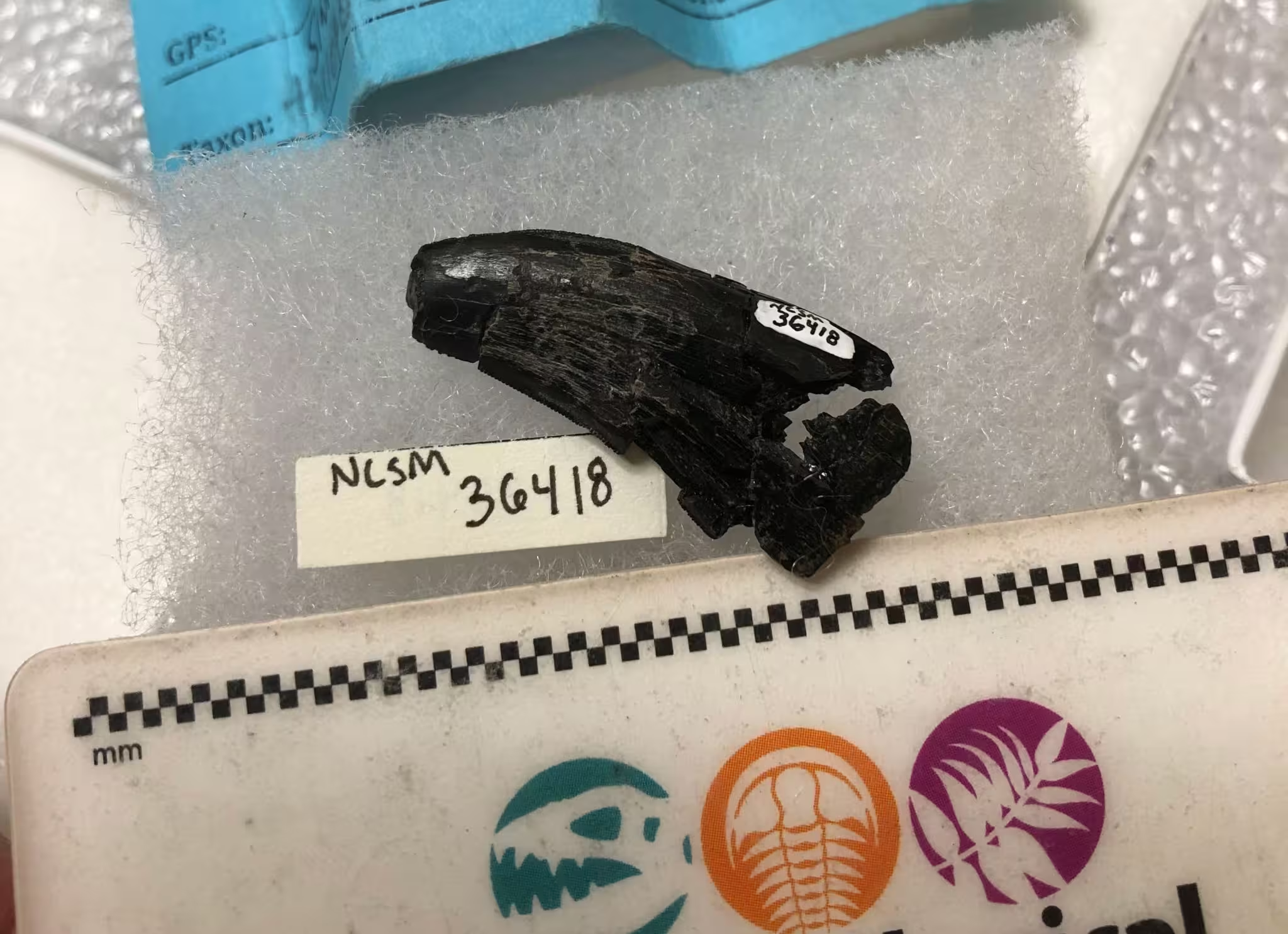
Theropod tooth from the Mussentuchit Member assemblage on a foam block next to a scale card.
What could provide a persistent marine carbon source that is both abundant on coastlines and low in the food chain so it affects many consumers? The researchers make a strong case for marine macroalgae, commonly called seaweed. Seaweeds are produced in large quantities along shores, break down easily, and can be carried inland by tides and storms. Modern coastal herbivores often supplement their diets with washed-up algae. The new isotopic signals suggest ancient coastal herbivores did similarly.
Not every species mirrored this trend. Tenontosaurus tilletti, a widespread herbivore in the study, showed δ13C values typical of terrestrial plant consumption, even where coastal fossils otherwise displayed marine influence. That contrast strengthens the dietary interpretation because it argues against a single diagenetic process altering all coastal fossils uniformly after burial. Instead, the signal appears to record genuine ecological differences.
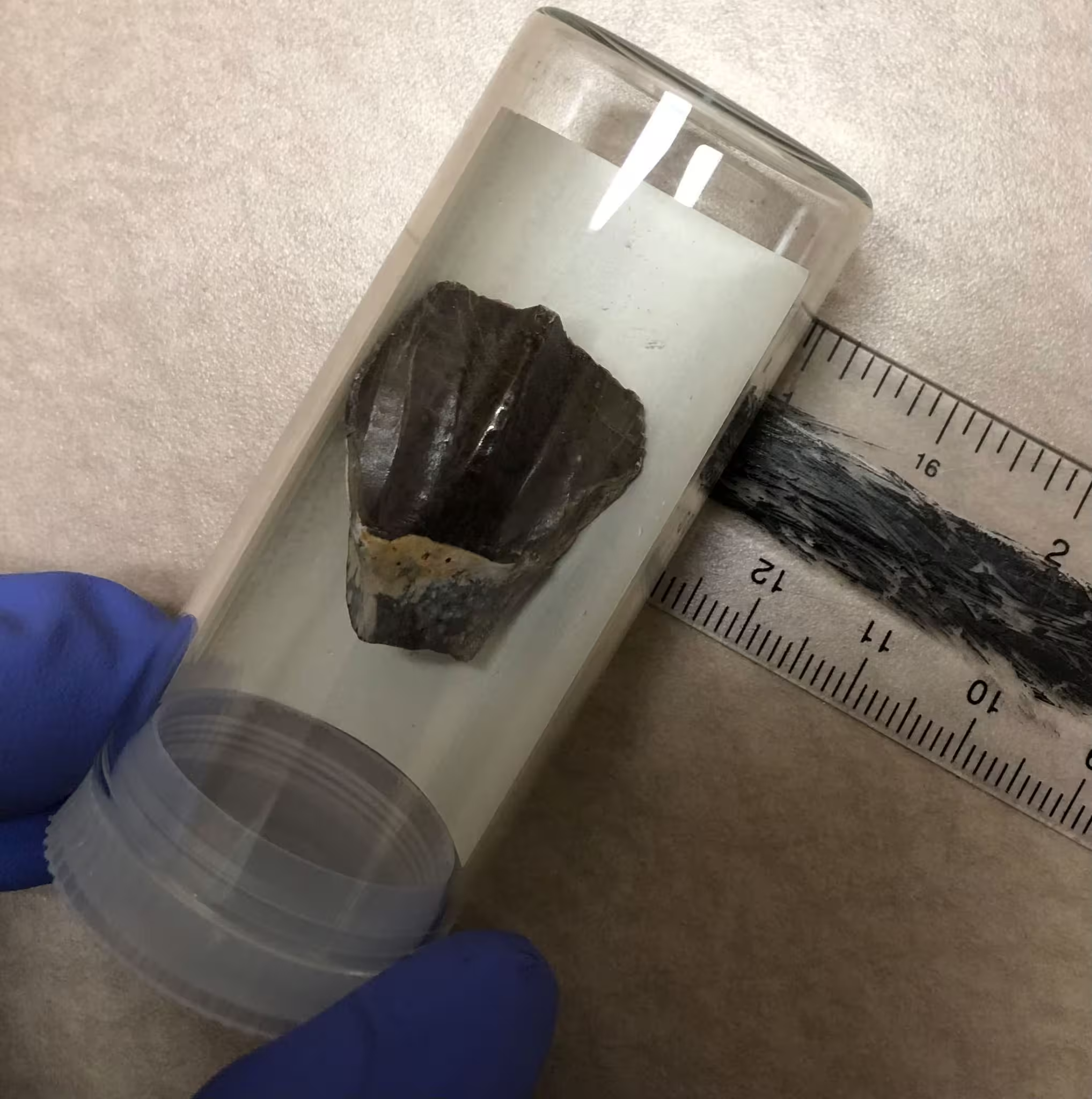
A Tenontosaurus tilletti tooth from the Cloverly Formation assemblage in a glass sample vial.
The broader implications are notable. If coastal dinosaur communities relied seasonally or opportunistically on marine subsidies, that would affect estimates of energy flows, body condition, and even migration behavior. Marine inputs can buffer terrestrial food webs against drought and seasonal scarcity, and they can change the isotopic baseline researchers use to infer trophic relationships.
Expert Insight
"This paper reinforces a simple but powerful idea: ancient ecosystems were interconnected in ways we are only now quantifying," says Dr. Mira Santos, a paleoecologist at the University of Lisbon who was not involved with the study. "By reading isotopes preserved in enamel, we get direct evidence of resource fluxes across the land-sea boundary. Those fluxes may have been crucial for the survival and distribution of some species during greenhouse climates of the mid Cretaceous."
Santos adds that expanding sampling to higher and lower latitudes, and to other time periods such as the Jurassic and the early Cenozoic, will test how general the pattern of marine subsidization was. "If seaweed-based subsidies were global, they could reshape our thinking about coastal paleoenvironments and their resilience," she says.
Conclusion

The isotopic fingerprints preserved in tooth enamel open a window onto ancient coastal food webs. They reveal that marine-derived carbon, probably from seaweeds, entered terrestrial diets and left a measurable mark on animals ranging from fish and crocodiles to large dinosaurs. That insight reframes shorelines as ecological hotspots where ocean and land traded resources, not simply as edges between two disconnected worlds. As more fossil teeth are analyzed and geographic sampling widens, scientists will refine how often and how strongly the sea fed ancient terrestrial life. For now, the surprising takeaway is straightforward: coastlines were pantries, and dinosaurs sometimes ate what washed up.

“The cosmos has always fascinated me. I write about space missions, astronomy, and the technologies pushing humanity beyond Earth.”

Discussion
Leave a Comment
Comments (1)
whoa, dinosaurs snacking on seaweed? That mental image stuck with me. odd but kinda brilliant, nature finds a way. now want beach fossil picnic vibes lol