
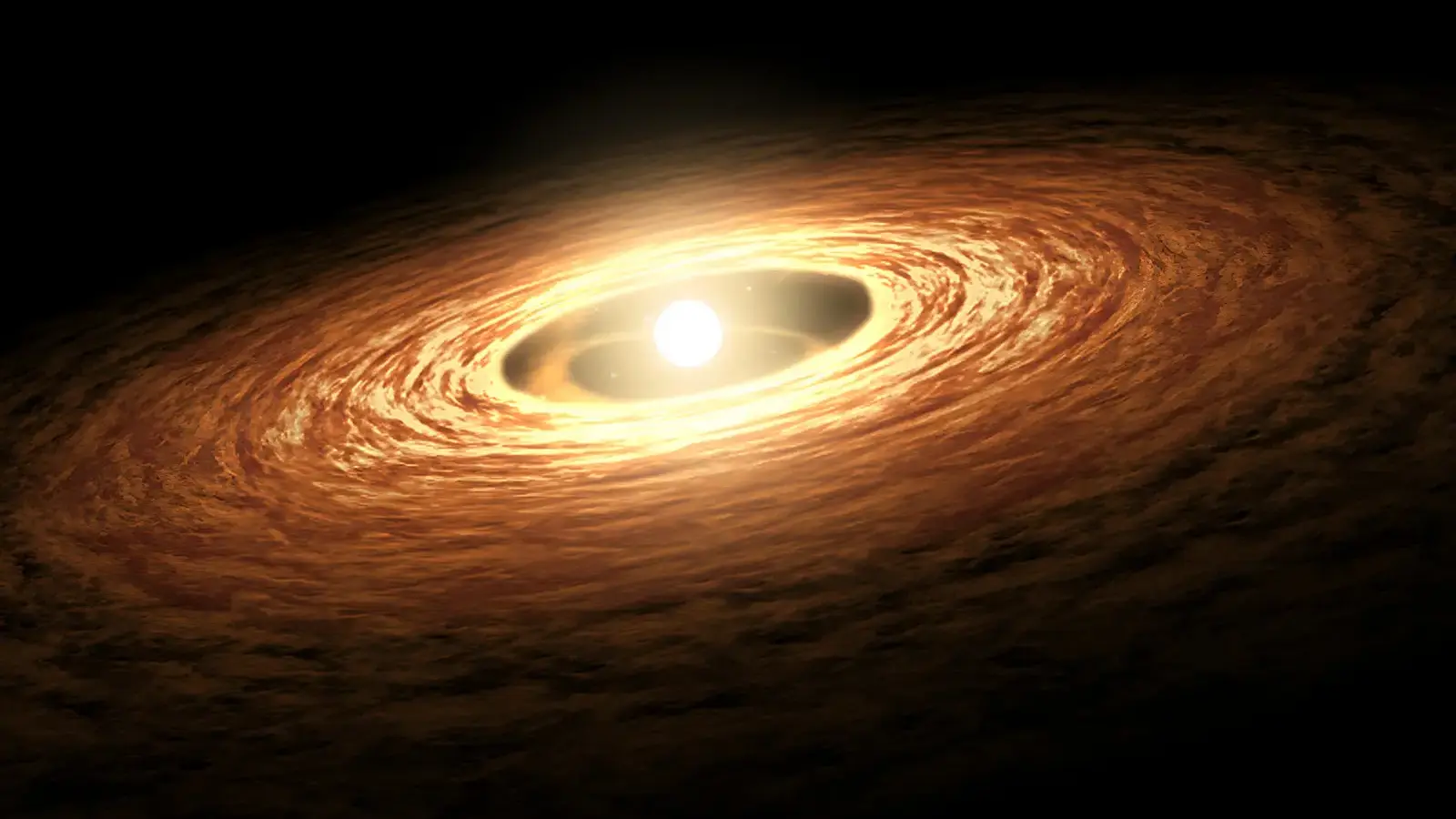
Picture a lonely cloud of stellar debris, cooling in a universe barely out of infancy. Within that dusty smear, the raw ingredients for rocky worlds — iron, silicon, carbon — begin to clump. Fast. In a new set of computer simulations, astronomers found that explosions from some of the very first massive stars could have created pockets dense and metal-rich enough to seed Earth-size planets only about 100 million years after the Big Bang.
How stellar wreckage can become planetary building blocks
Early cosmology usually treats the universe as homogeneous when averaging heavy elements over large volumes. But reality is messier. When a very massive early star ends its life in a pair-instability supernova, it ejects vast amounts of heavy elements into the surrounding medium. The new simulations track how those ejecta mix with the primordial gas, cool, and then collapse into smaller structures.
Rather than a smooth enrichment, the models show isolated, dust-rich pockets forming a low-mass star surrounded by a protoplanetary disk. Inside that disk the expected sequence of growth — from dust grains to meter-scale bodies to kilometer-scale planetesimals — can proceed. The researchers report enough solid material in some simulated disks to assemble multiple worlds comparable in mass to Earth, and some of those forming bodies sit at orbital distances where temperatures permit liquid water under the right conditions.
Pair-instability supernovae originate from stars with tens to about a hundred times the Sun's mass. They are especially efficient at synthesizing and dispersing heavy elements. The simulations do not assume uniform enrichment across the cosmos; they instead resolve local enrichment and the hydrodynamics of mixing, which turns out to be crucial to producing compact, metal-rich disks quickly.
Why this changes our picture of early planet formation
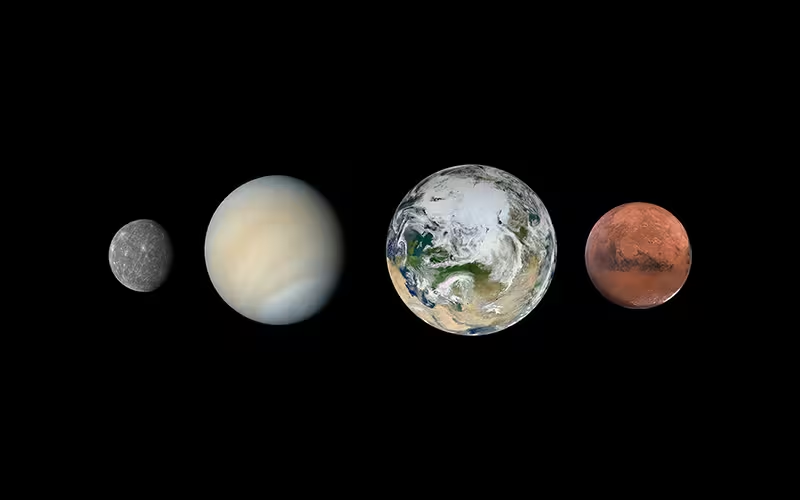
Until now, large-scale simulations suggested rocky planets could not emerge until the universe had accumulated heavy elements over longer timescales, perhaps several hundred million years later. By homing in on these over-enriched niches, the new work argues for an accelerated timeline. In plain terms, the seeds for habitable planets may have appeared almost as soon as the first generation of massive stars died.
That does not mean life sprang up immediately. Planet formation is one step in a long chain that includes stable atmospheres, retention of volatiles like water, and a long stretch of geological and chemical evolution. Yet the mere existence of early rocky planets widens the temporal window for when prebiotic chemistry could eventually begin.
Daniel Whalen of the University of Portsmouth, a co-author of the study, summarized the implication like this: "On paper, habitable worlds could have existed billions of years earlier than we previously imagined, even before the first galaxies were fully assembled." Observationally, finding such relic systems inside our Galaxy would be possible because they should retain distinctive elemental fingerprints.
What the simulations actually show
The models followed the collapse of supernova-enriched regions into a new generation star roughly 0.7 times the Sun's mass, surrounded by a dusty disk. Within that disk, the team identified populations of small solid bodies — from meter-sized aggregates up to kilometer-scale planetesimals — which are the classical precursors to planets. Importantly, some of these formed at distances that intersect the star's liquid-water zone, hinting at the early availability of water alongside rock-forming elements.
Jarrett Johnson, an astrophysicist at Los Alamos National Laboratory who was not part of the study, commented on the broader significance: "This work opens a new window on what may have been happening during the first 100 million years of cosmic history. Even if these early planets were sterile, the ingredients for life were being set up very early on."
Expert Insight
"Local enrichment changes everything," says Dr. Elena Vega, an astrophysicist specializing in early star formation. "When you stop averaging the universe and start resolving neighborhoods, you find that islands of richness can appear almost immediately after the first supernovae. Those islands are prime sites for rapid planet assembly. The next step is to predict observational signatures we can search for with current and upcoming instruments."
Next steps and observational prospects
The research team plans to extend their simulations to later stages of planetary growth to see whether early planetesimals can assemble into fully formed planets and how much water such planets could retain. They will also simulate enrichment from other supernova types that were likely common in the early universe.
Detecting bona fide survivors from this epoch inside the Milky Way would require careful chemical forensics. A star born from supernova-enriched material should display unusual abundance patterns in heavy elements and dust-related isotopes. High-resolution spectroscopic surveys of ancient, low-mass stars in the Galactic halo and bulge are a practical place to start.
Conclusion
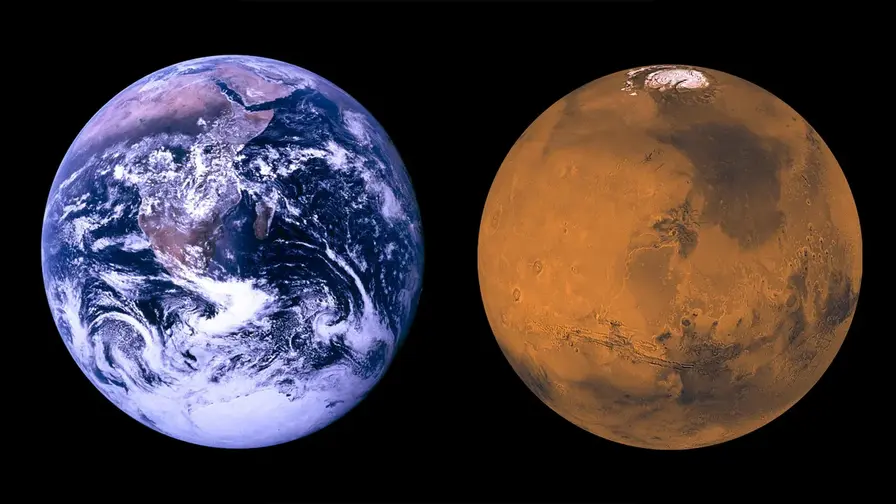
The new simulations do not prove that life emerged early, but they do force a rethink of when the first terrestrial planets could have formed. By showing that localized enrichment from pair-instability supernovae can deliver enough solid material to build rocky worlds within a cosmic heartbeat, the study pushes the origin story of planets closer to the universe's opening chapters. The findings appear in Astrophysical Journal Letters and prompt both theorists and observers to search older, metal-rich pockets of the cosmos for planetary relics.

“The cosmos has always fascinated me. I write about space missions, astronomy, and the technologies pushing humanity beyond Earth.”

Discussion
Leave a Comment
Comments (1)
Wow, planets 100 million yrs after the Big Bang? mind blown. If thats true, whole timeline shifts. But how common are those pockets, really?