
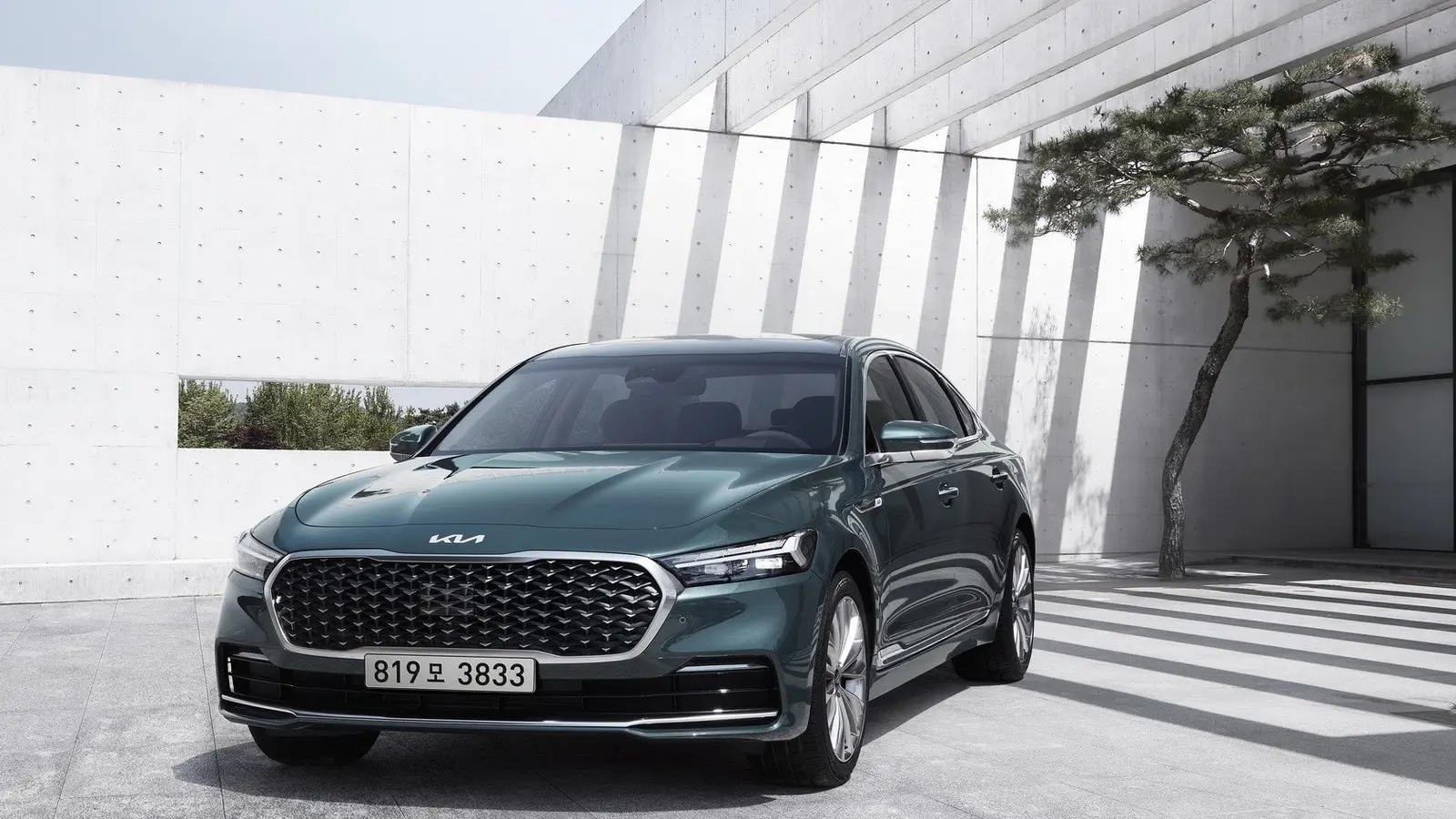
Walk into a Kia showroom and the K9 feels like a chapter quietly closing: plush leather, stretched proportions, and the faint echo of ambition. Reports from industry insiders and union memos say Kia will stop making its top-of-the-line sedan this year, a move that looks less like a surprise and more like the inevitable final act of a very expensive experiment.
When numbers speak louder than badges
The K9 debuted in 2012 as Kia's answer to executive sedans—big, rear-wheel drive, and dressed to compete with European rivals. It shared bones with Hyundai's flagship at launch, and later underpinned by Genesis platforms. Still, styling and engineering alone couldn't dismantle decades of premium badge psychology. Sales tell the story plainly: from roughly 13,931 units in its debut year to just 1,581 in 2025, demand evaporated. So far this year the model managed only 734 deliveries from January through June.

Pulling the K9 from the United States in 2021 foreshadowed the end. Hyundai's own Grandeur sold 71,775 units in South Korea in 2025, making the K9's tiny output look even smaller by comparison. Faced with such math, the decision reads as a factory-level calculus—free up assembly time, shift R&D funds, and focus on higher-volume cars and SUVs.
The K9 no longer justified its production costs, so the company is reallocating resources to more profitable lines.
Don’t expect a one-for-one successor. The K8, a smaller, front-bias sedan with design nods to Kia's SUVs, will soften the hole in the lineup but won’t replace the K9’s rear-drive luxury positioning. That territory now belongs to Genesis.
Price was never the only barrier, but it mattered. The K9’s range equated to about €39,600 at its entry point and rose to roughly €52,300 for the top trims—figures that make profitability a stretch when production volumes are low and buyers are migrating en masse to SUVs.

Under the bonnet the K9 tried to offer variety: V6s and a V8 in past years, the 5.0-liter naturally aspirated V8 was retired in 2021, leaving buyers with either a 3.8-liter naturally aspirated V6 or a 3.3-liter turbo V6. Those engines proved capable, but capability alone doesn't overcome market momentum shifting toward crossovers and electrified options.
There’s a paradox here. On paper, the K9 proved Kia could build to luxury standards—materials, ride quality, and engineering that matched many European rivals. In practice, altering perceptions built over generations is a mountain few brands conquer quickly.

Think of the K9 as an expensive advert for what Kia can do. It showcased the brand’s engineering reach and willingness to challenge the status quo, but it also exposed the limits of ambition when buyers prioritize utility and brand cachet over value-packed luxury.
What happens next is practical: assembly lines get repurposed, R&D shifts to higher-return products, and corporate strategy doubles down on segments where buyers are actually shopping. For enthusiasts who wanted a full-size Kia sedan to sit in the same showroom as a German executive car, the K9 will be remembered as a bold, if short-lived, statement.

“Cars are evolving faster than ever. I cover electric vehicles, smart mobility, and the future of transportation worldwide.”

Discussion
Leave a Comment
Comments (2)
Makes sense tbh, but feels like they bailed too fast. Could've tried a hybrid or EV K9, or a limited niche run? Market is ruthless, still curious tho.
wow kinda sad to see the K9 go. Felt like Kia trying something bold, interior was top class, but yeah buyers went SUV crazy. if only perception changed...