
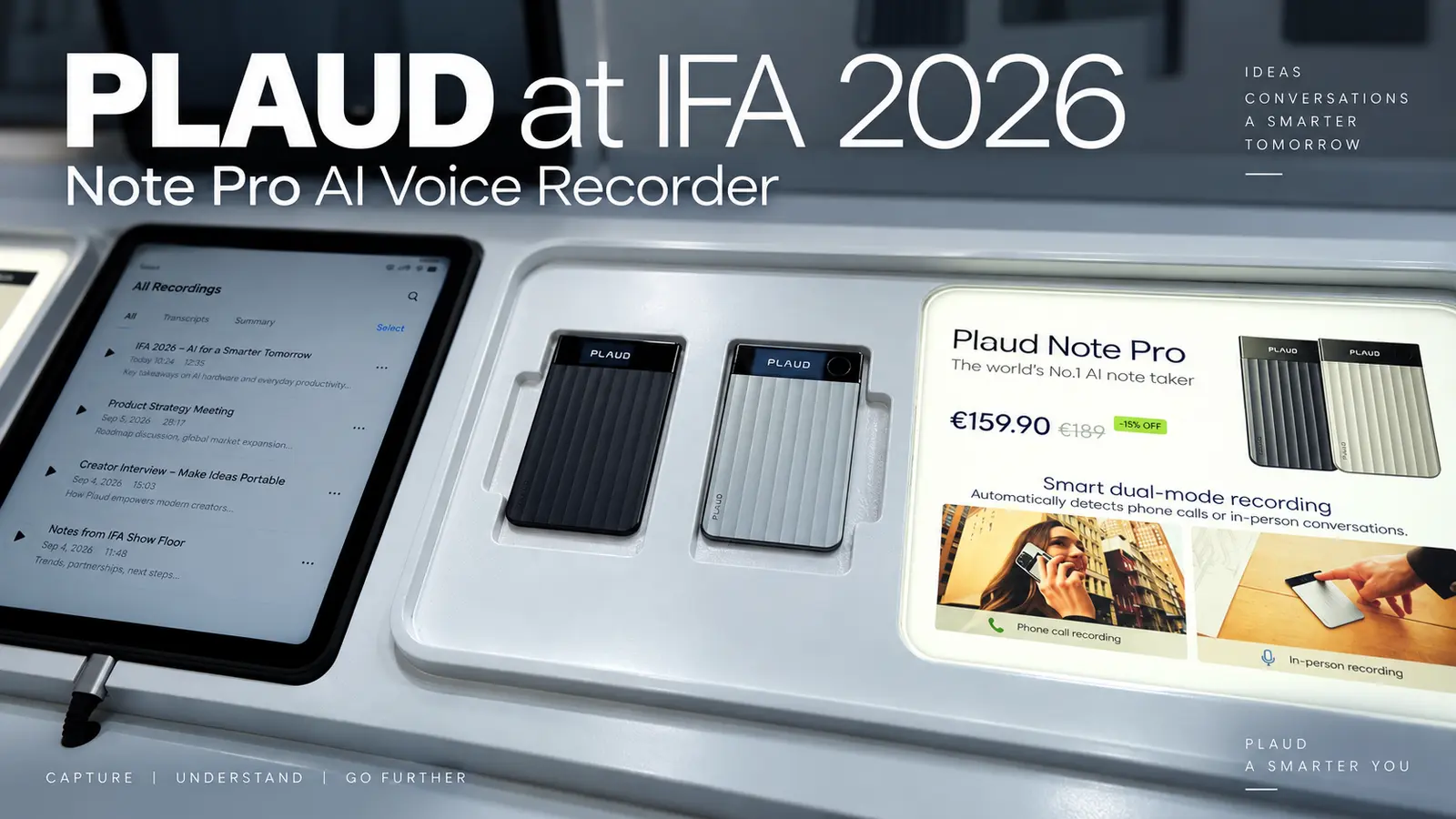
Plaud used IFA 2026 to showcase how its AI recording ecosystem is evolving from dedicated voice recorders into a broader personal productivity platform. At the company’s booth in Berlin, we were shown three different approaches to capturing conversations: the ultra-thin Plaud Note Pro, the wearable Plaud NotePin, and the newly announced Plaud One, which combines earbuds, always-connected AI and a built-in eSIM.
While all three products can capture conversations and turn them into searchable transcripts and summaries, they are designed for noticeably different situations.
Plaud Note Pro is built around meetings and phone calls
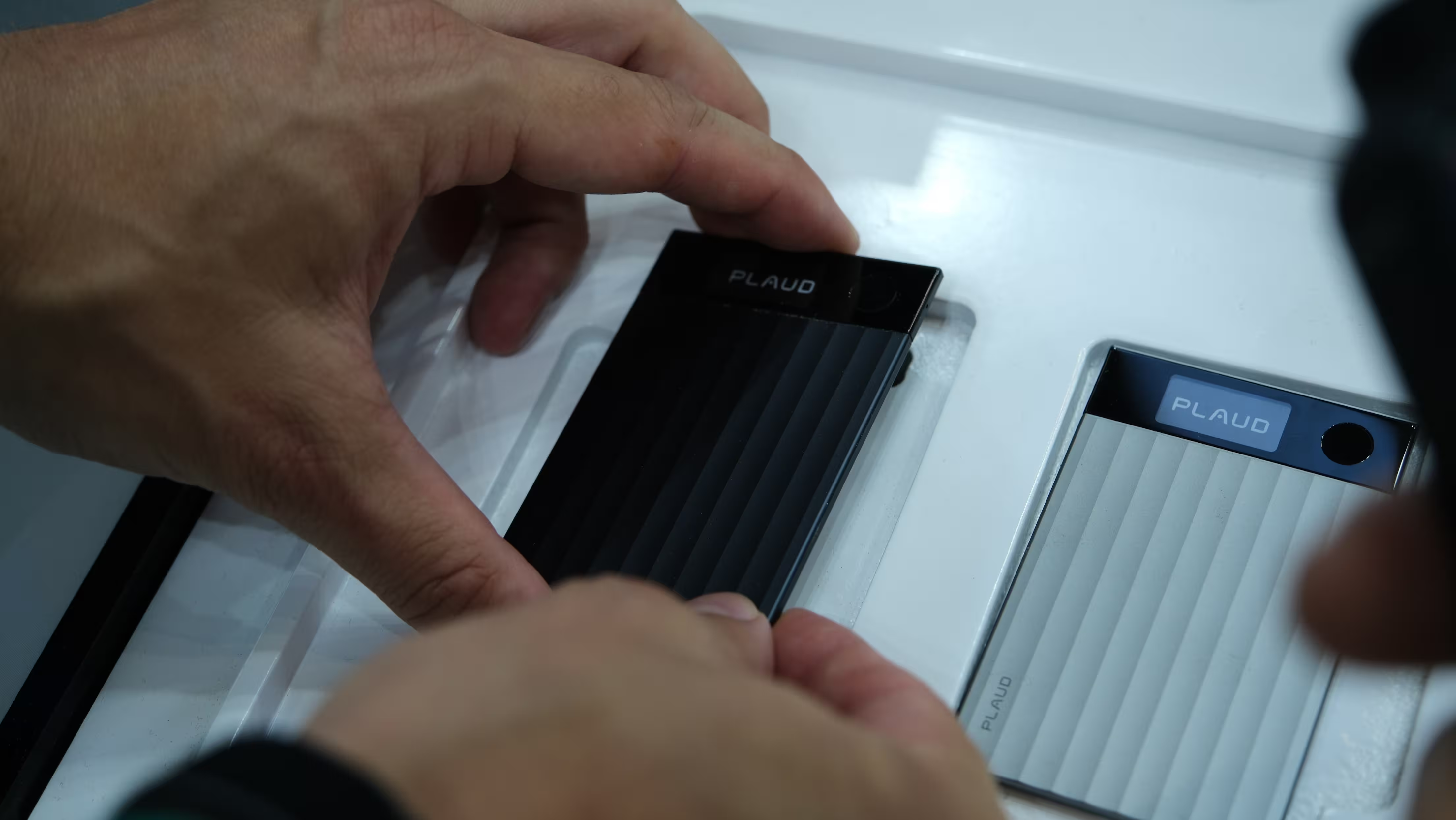
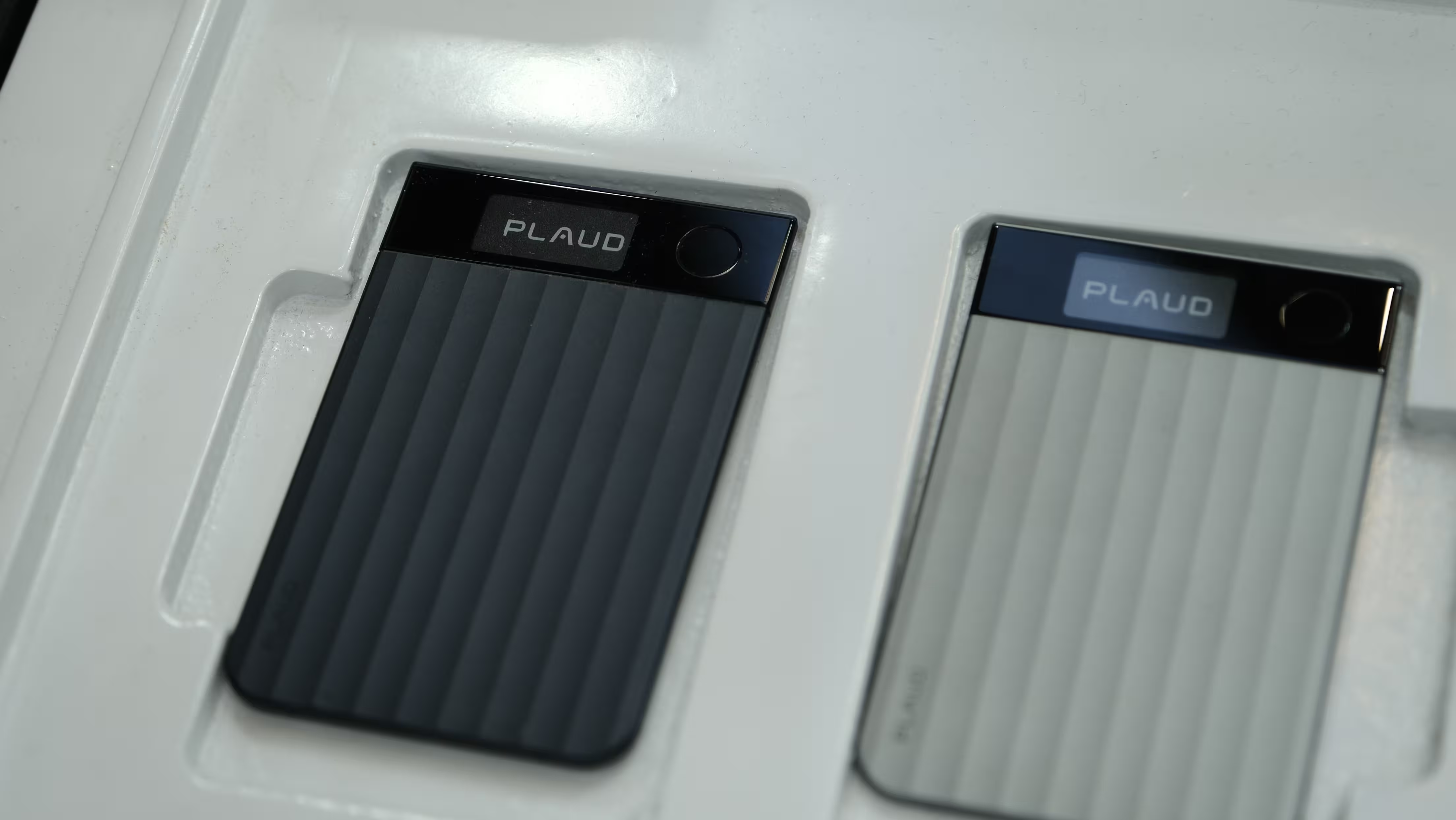
The first device demonstrated to us was the Plaud Note Pro, a slim AI voice recorder that can be magnetically attached to the back of a smartphone.
Its main job is straightforward: record conversations and then use Plaud Intelligence to automatically transcribe, summarize and organize them.
Plaud Note Pro uses four MEMS microphones plus a VPU and can capture voices from up to 5 metres away in its higher-quality Enhance mode. It also supports up to 50 hours of continuous recording in Endurance mode, although the maximum pickup range in that mode is reduced to around 3 metres.
The device can automatically distinguish between in-person conversations and phone calls, eliminating the need to manually switch recording modes.
A physical highlight button marks the important moments
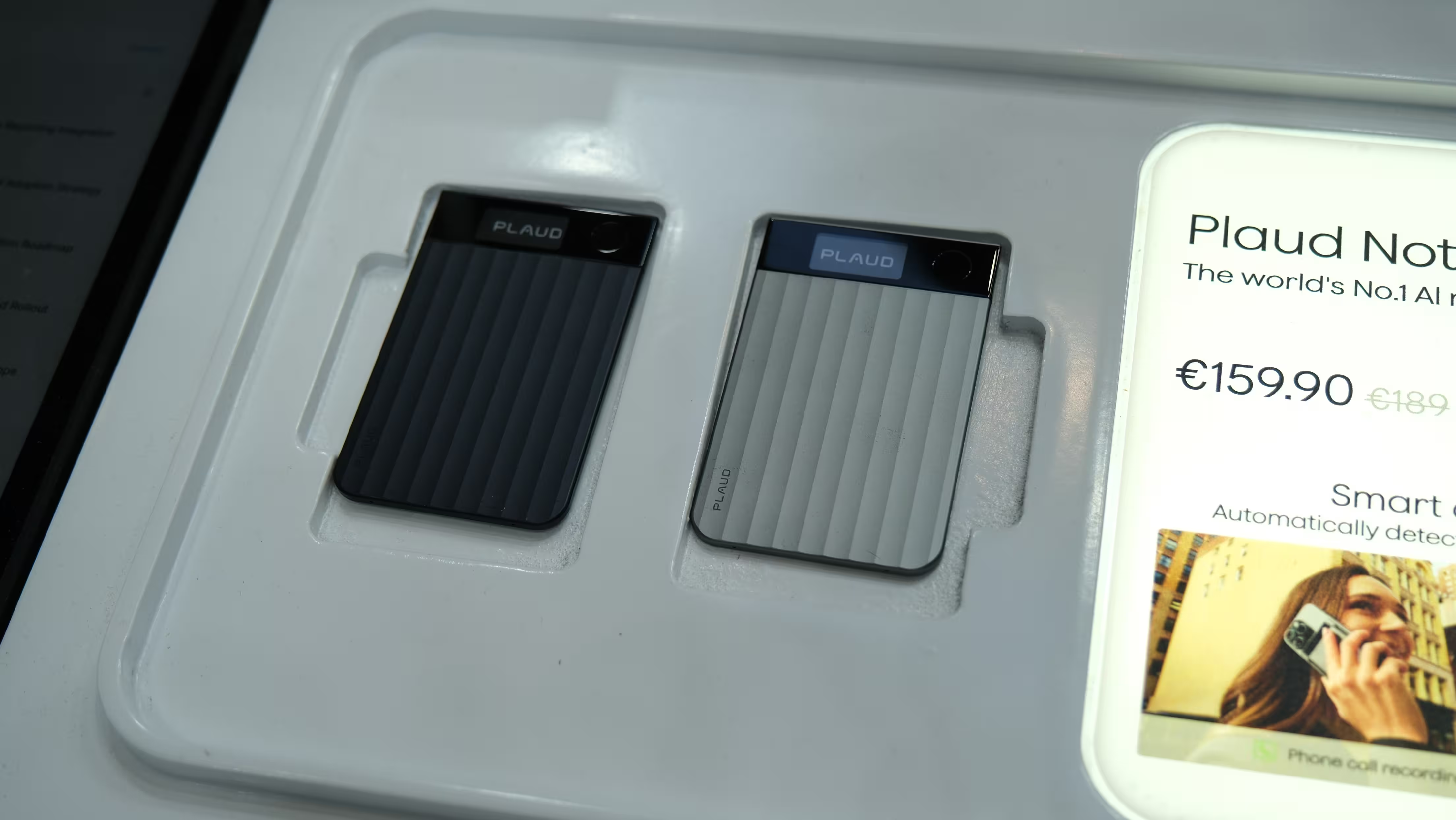
One of the more practical features demonstrated at the booth was Plaud’s Press to Highlight function.
While recording a meeting, users can press the device’s button to mark a particularly important moment. Those highlights are then taken into account when Plaud processes the conversation and creates its summaries.
This is useful in longer meetings where only a handful of decisions, numbers or comments may actually matter later.
Once a recording is synchronized with Plaud, the platform can automatically generate transcripts and structured summaries rather than leaving the user with hours of raw audio.
Ask Plaud turns old meetings into a searchable knowledge base
Recording is only one part of the system.
The representative also demonstrated Ask Plaud, which lets users ask questions about previously captured conversations.
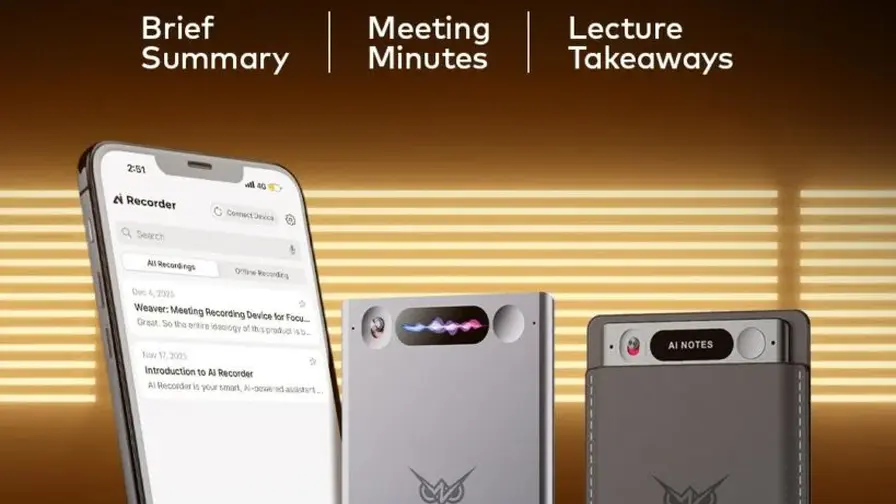
Instead of remembering exactly which meeting contained a particular discussion, users can query their accumulated recordings and retrieve the relevant information later.
Plaud currently supports transcription in 112 languages, speaker labeling and AI-generated summaries, while its software is designed to make captured meetings searchable after the fact.
For professionals who spend much of their working week in meetings, the value proposition is less about recording everything and more about being able to retrieve the important parts months later.
The Starter Plan includes 300 transcription minutes per month
Plaud’s hardware does not require users to immediately purchase an additional subscription.
Every Plaud AI note taker comes with a free Starter Plan providing 300 transcription minutes per month. The company also offers a Pro plan with 1,200 minutes per month and an Unlimited tier for users with significantly heavier recording requirements.
Plaud devices can also be used with Plaud Desktop, allowing online meetings on a computer to become part of the same recording and knowledge-management ecosystem.
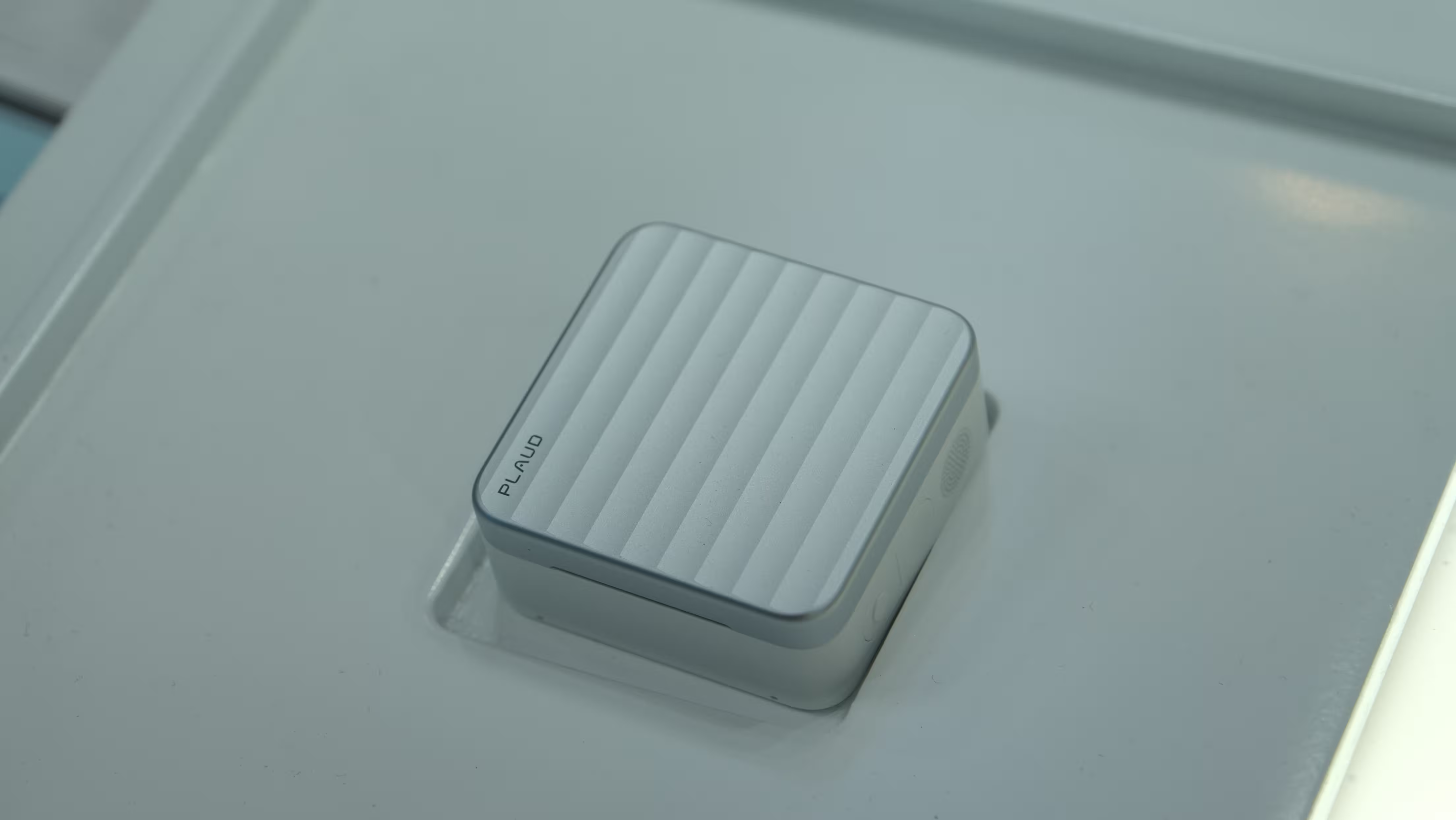
Plaud One is the bigger story at IFA 2026
The most interesting product at the booth, however, was the newly announced Plaud One.
Rather than another card-shaped recorder, Plaud One combines wireless earbuds with an AI-enabled case and a built-in eSIM.
Plaud officially introduced the product shortly before IFA, and the company positioned it at the show as a new category of wearable AI device rather than simply another recorder.
The important difference is independence.
Because the system includes its own connectivity, Plaud One is designed to interact with the Plaud agent even when the user does not want to constantly rely on a smartphone interface.
Conversations can be captured in several different ways
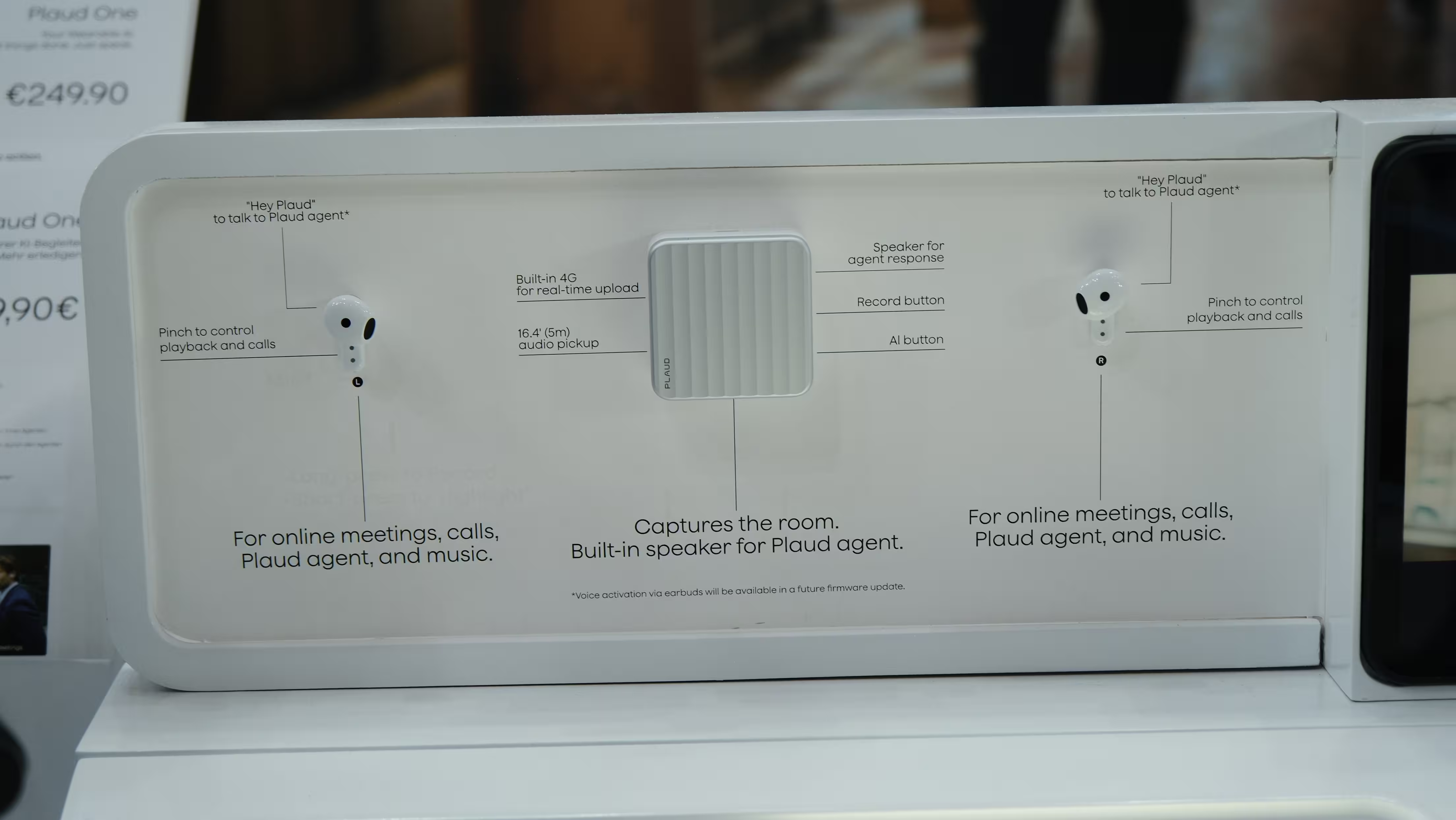
Plaud One can capture audio from in-person conversations, phone calls and online meetings.
The case itself can be used to record a room, while conversations happening through the earbuds can also become part of the same Plaud context. The official specifications indicate that it can capture room audio from up to 5 metres away.
During our booth demonstration, the representative explained that users could also listen to content such as podcasts through the earbuds and retain useful information for later transcription and summarization.
The overall concept is that more of the audio a user considers important can become part of one searchable knowledge base.
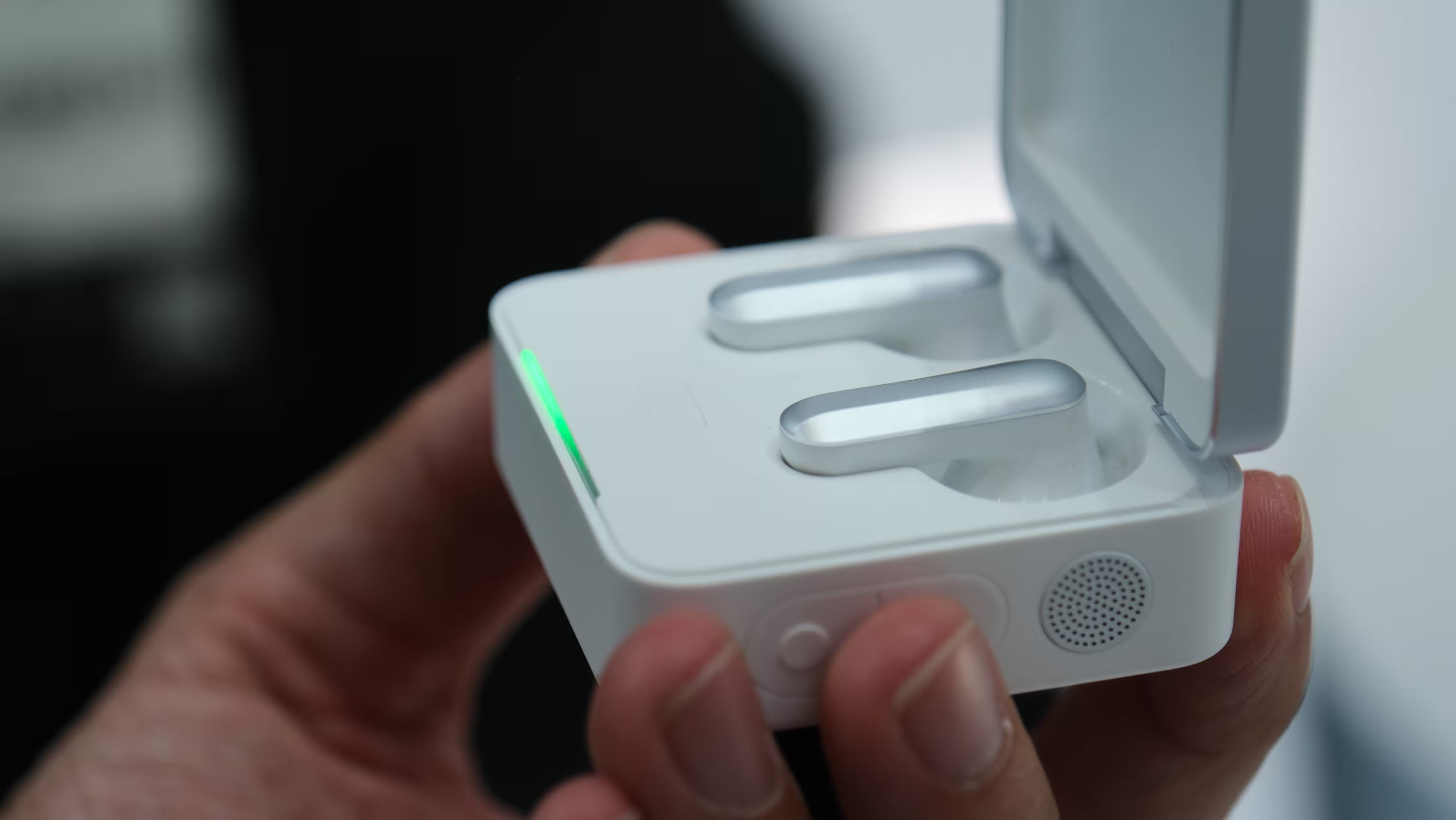
Built-in eSIM lets Plaud Agent stay connected
The integrated eSIM is central to the Plaud One concept.
Plaud says it keeps the AI agent connected and its context updated, allowing users to access information and interact with the assistant while on the move.
Users can activate the system either through a physical control or by saying “Hey Plaud.”
Responses can then be delivered through the earbuds or through the speaker built into the case.
That turns Plaud One from a passive recorder into something closer to a conversational AI assistant.
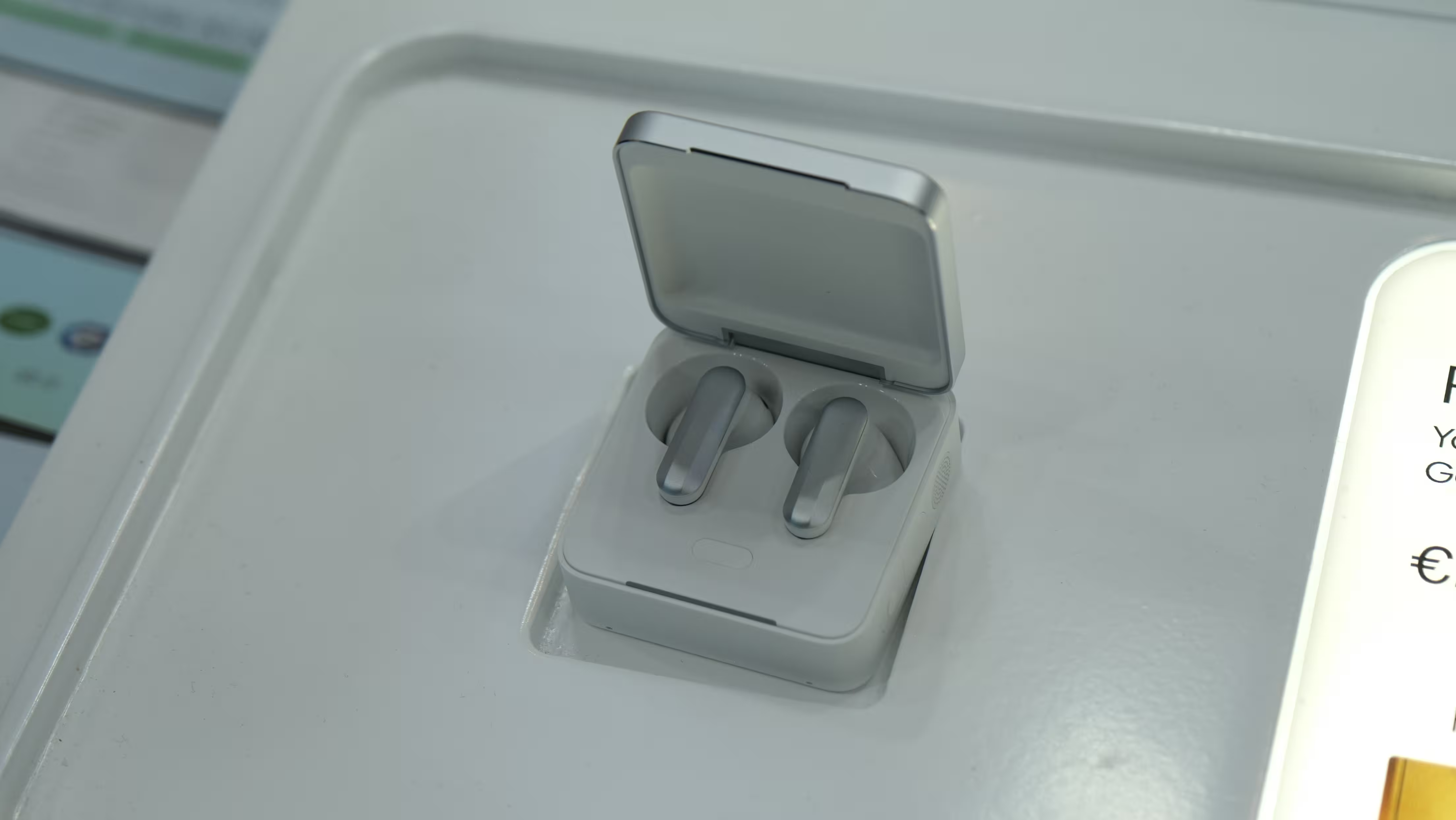
Plaud Agent is designed to act, not just summarize
Plaud’s ambition for the new device goes beyond asking what happened during yesterday’s meeting.
The company describes Plaud Agent as an AI system that can understand a request, plan the required steps and use different tools to complete it.
During our demonstration, the representative gave an example in which a user could finish a meeting and simply ask Plaud to generate a document summarizing it and prepare an email for selected recipients.
The representative also said Plaud is working with integrations for services such as Slack, Google Drive and Microsoft Teams, although the exact availability of individual connectors may vary as the Plaud One platform develops.
Plaud’s own product page describes a wider system of Agents, Artifacts, Connectors, Skills and Routines, with tasks such as research, document creation and meeting scheduling forming part of the longer-term concept.
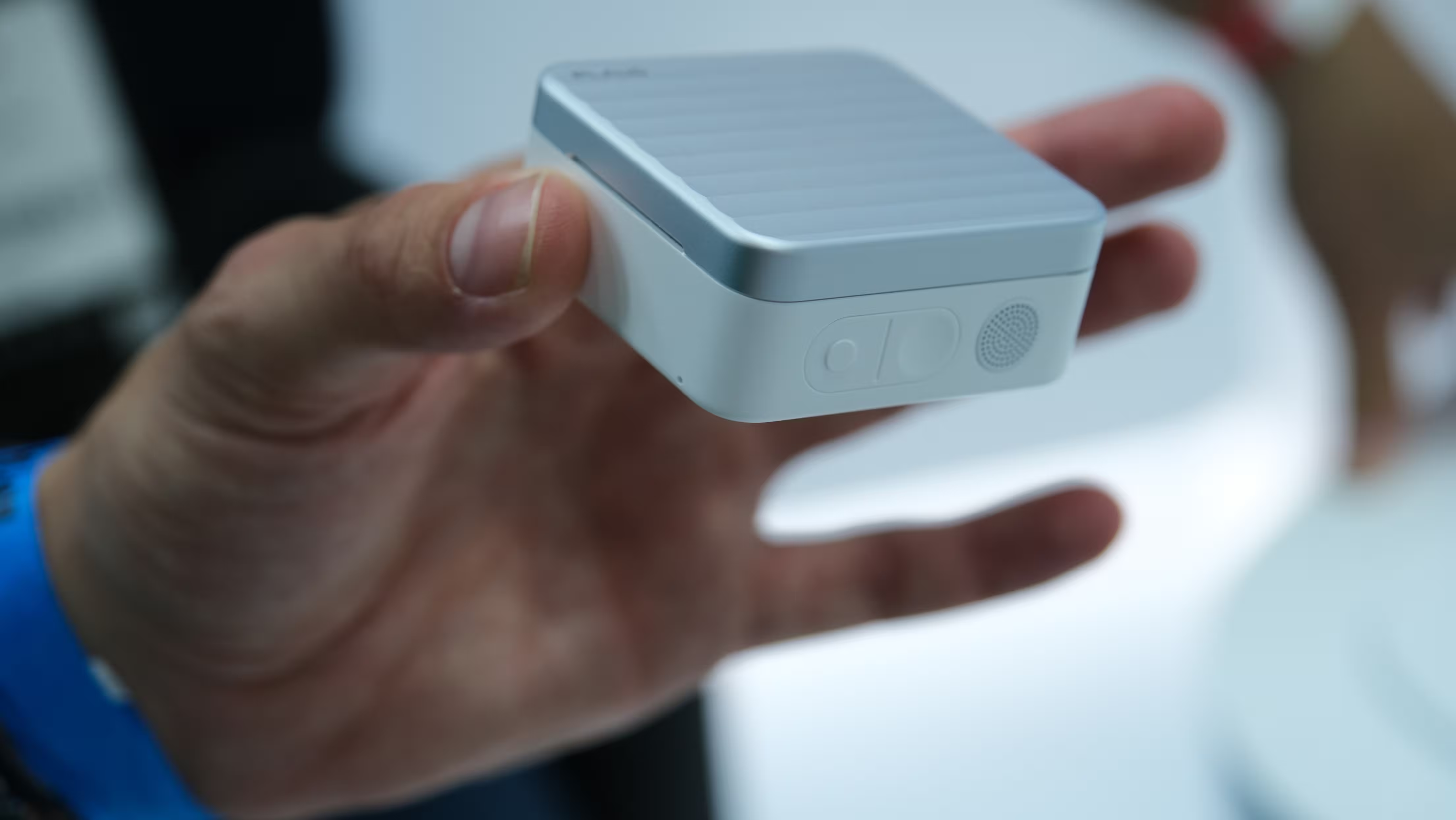
AI requests use a separate credit model
Plaud One still uses transcription minutes for processing recorded conversations.
However, the representative explained that interactions with the Plaud Agent use a separate credit-based system, with more complex tasks potentially consuming more credits than simpler questions.
That makes sense given that Plaud One is intended to perform broader AI tasks rather than simply turn speech into text.
The company has not yet exposed every detail of this system publicly, so pricing and exact credit consumption will be important to evaluate once the product becomes more widely available.
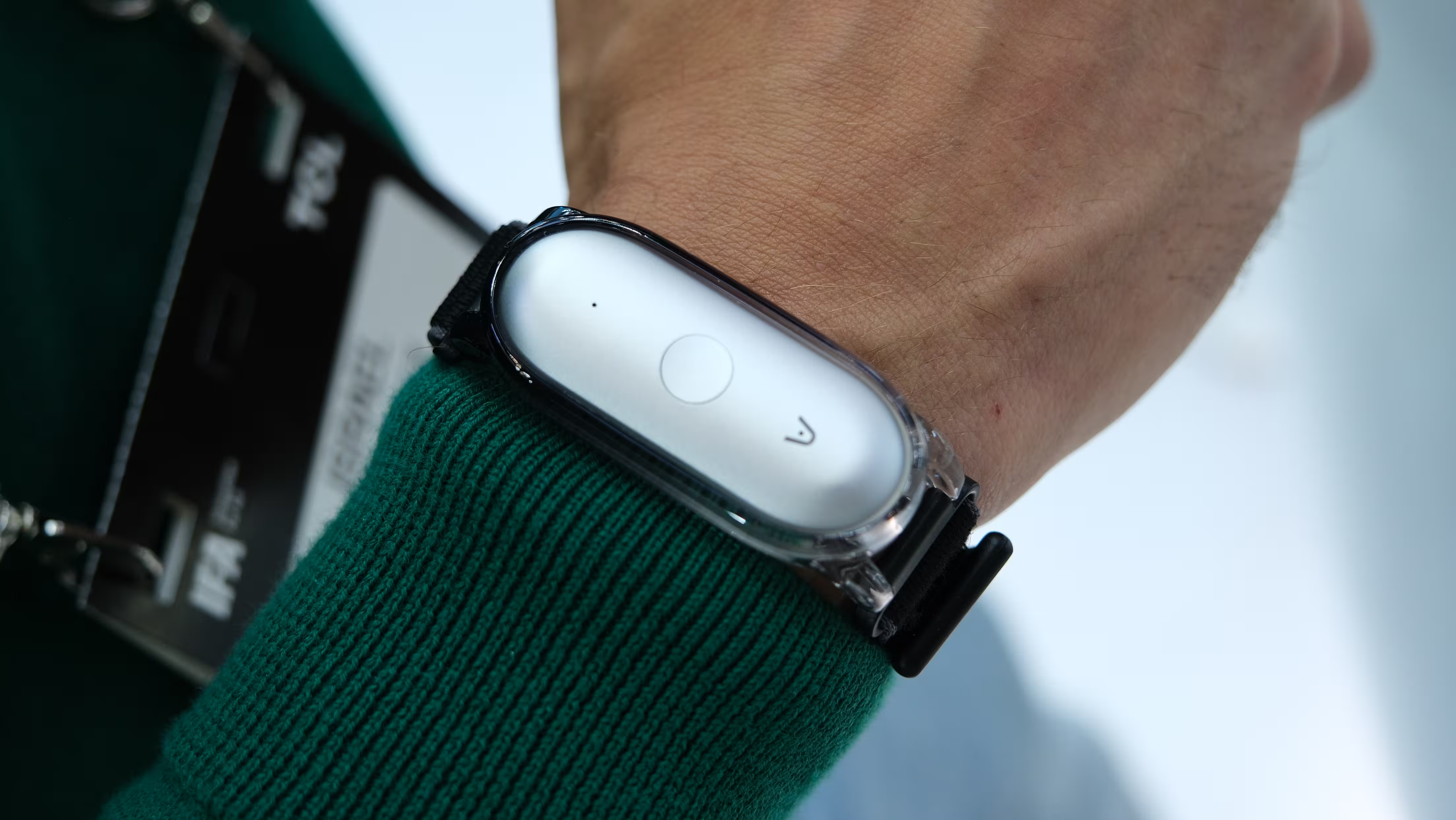
NotePin remains the simplest wearable option
The third product demonstrated was the Plaud NotePin, designed for users who want hands-free recording without wearing earbuds or attaching a recorder to a phone.
Its small body can be worn in several ways, including as a lanyard, clip, magnetic pin or wristband.
The NotePin supports up to 20 hours of continuous recording, with recordings synchronized into the same Plaud ecosystem used by the company’s other devices.
This makes it particularly suited to people who move frequently during their working day and want conversations captured without repeatedly taking out another device.
Three devices, one Plaud workspace
What became clear during our IFA demonstration is that Plaud is no longer building isolated voice recorders.
Note Pro is optimized for meetings and phone calls. NotePin makes recording wearable and largely hands-free. Plaud One takes the idea further by adding earbuds, independent connectivity and direct interaction with an AI agent.
Regardless of which device is used, the recordings ultimately feed into the same Plaud software environment.
That shared context may ultimately be more important than any individual piece of hardware. The real goal is to turn conversations into something searchable, structured and actionable rather than allowing useful information to disappear as soon as a meeting ends.
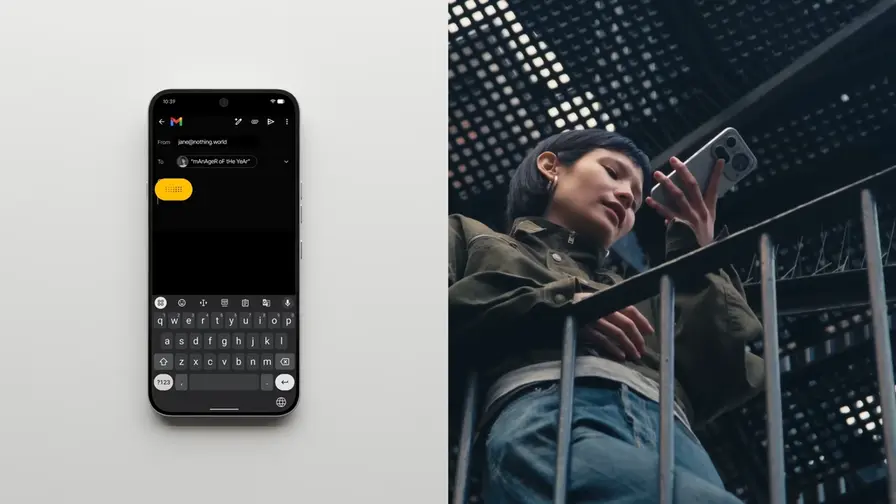
At IFA 2026, Plaud One showed where the company wants to take that idea next: from AI that remembers what was said to an AI assistant that can potentially do something about it.

“Some times I write about breakthrough startups, digital ecosystems, and how innovation is changing the way we build businesses.”

Discussion
Leave a Comment
Comments (3)
Nice concept, but separate credit system for AI tasks sounds like a cash grab. Also hope transcripts are accurate with accents. Still neat tho
Is the always-on eSIM idea safe? Feels powerful but how do they handle privacy, local laws, consent? Asking cuz this could get messy
Wow Plaud One sounds wild, earbuds that remember meetings? If it really sends summaries on the fly i'd buy one. Battery life tho…