
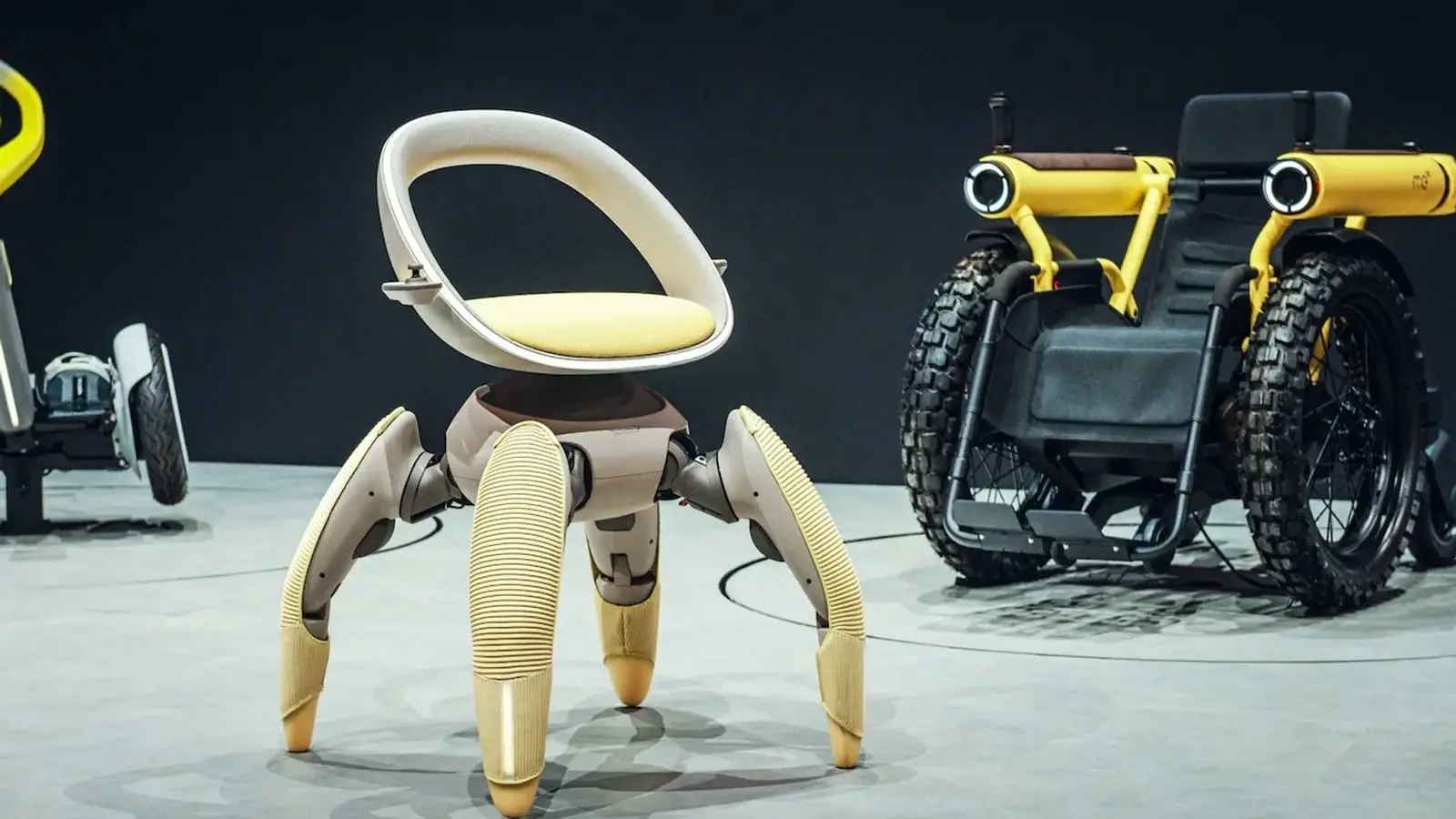
Picture a mobility aid that rises, steps, and sidesteps obstacles the way a small animal would. It doesn't roll. It walks. Toyota's Walk Me is a concept wheelchair that swaps wheels for four robotic legs, and the effect is strangely liberating.
Why legs instead of wheels?
Wheels are brilliant on smooth roads. They struggle on stairs, curbs, and rough ground. Walk Me aims to erase those limits. The four-legged design promises access where traditional wheelchairs can't go: climbing steps, crossing uneven terrain, and handling thresholds without a second thought. It can even lift a user higher to make getting into a car or onto a raised platform far easier.
Sensors do the thinking. LiDAR scans the path ahead. Collision-detection radar watches for sudden hazards. Weight-distribution sensors and onboard algorithms adjust each leg's motion and the seat angle in real time. The result is a machine that senses and adapts, lowering the cognitive load on the person using it.

Controls are flexible. Manual joysticks sit beside voice commands and a touchscreen interface. You can guide it with your hands, your voice, or a few taps. Small nudges translate into stable, deliberate steps. The balance systems work quietly in the background so the user feels secure rather than managed.

Walk Me belongs to Toyota's Me series of mobility concepts and sits under the broader Mobility for All initiative. That context matters: this isn't a product aimed at novelty. It's part of a larger push toward independence for people with limited mobility. Toyota is experimenting, iterating, and learning from prototypes.
This is a glimpse of how assistive devices might behave—less like tools and more like helpful companions.

Still, don't expect it in every showroom tomorrow. Walk Me remains a development project. Technical, regulatory, and user-experience questions remain to be solved before mass production—if it reaches that stage. But as a concept, it sketches a future where mobility devices adapt to complex environments instead of forcing users to adapt to them.
So what changes if wheelchairs can walk? For many, everyday barriers might shrink. Curbs, steps, and thresholds become negotiable. Independence grows. And design shifts from simple transport to intelligent assistance. Small steps. Big implications.


“I cover automotive innovation, electric vehicles, and the future of mobility — where technology meets sustainability.”

Discussion
Leave a Comment
Comments
No comments yet. Be the first.