
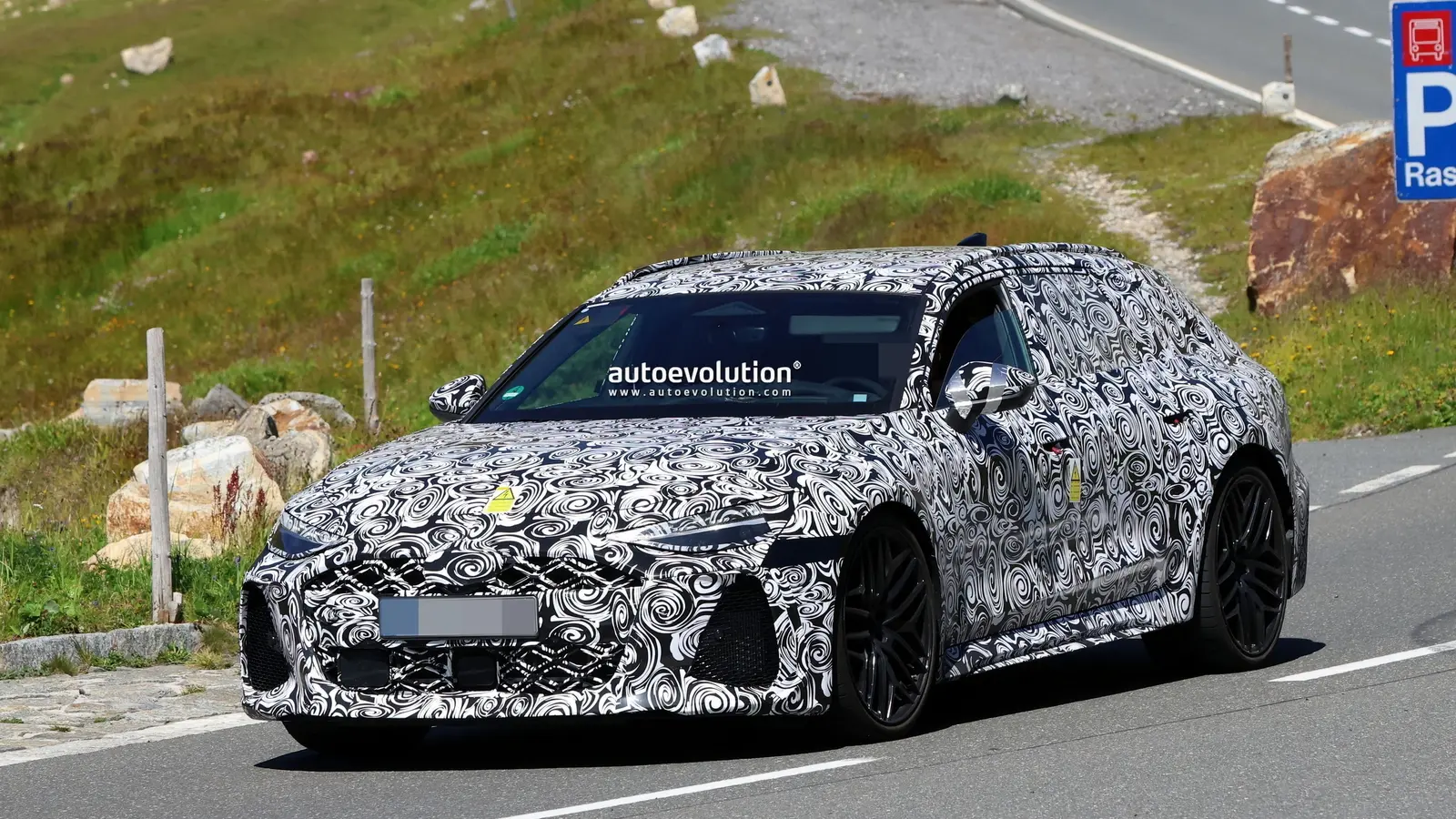
You can almost hear the exhaust through the photos: a planted, angry-sounding estate threading hairpins in the Austrian Alps. Spy shots don’t lie when the backdrop is a jagged skyline, plenty of photographers and a few curious bikers standing by. This is the RS 6 Avant on its final summer shakedown, and the clues are getting harder to ignore.
Alpine dress rehearsal and the yellow sticker giveaway
At first glance it’s the usual cloak-and-dagger routine. Heavy camouflage. Hidden vents. But small details tell the real story. Those mandatory yellow stickers on the front and flanks are the kind of regulatory markers that flag electrified drivetrains during EU testing. In plain terms: Audi’s hot wagon is unlikely to skip hybrid help this time around.

Fans had hoped Audi would keep the RS 6 purely combustion-driven, but the latest images suggest otherwise. Expect a plug-in hybrid layout, probably following the pattern set by the RS 5: a twin-turbocharged V6 paired with electric assistance. Quick question: does that sound like a compromise, or a tactical upgrade? With rivals packing high-output hybrid systems, the Avant needs both torque and electrified punch to stay competitive.

There has been noise from the rumor mill about power figures too. Talk of roughly 750 horsepower is bold, perhaps audacious. If true, Audi Sport would leap past the Mercedes-AMG E 53’s combined output and nudge ahead of the BMW M5 family. Numbers aside, what matters is delivery: usable thrust across the rev range and the kind of tractable shove that suits a fast wagon hauling passengers and luggage.

Platform-wise, the new RS 6 rides on Audi’s PPC architecture shared with the sixth-generation A6 and the updated A5. That foundation should help the Avant balance weight, dynamics and packaging for batteries without destroying its character. And yes, Audi kept the RS 6 name despite the brand’s recent renaming experiments. Call it continuity where it counts.

These cars have already been heard at the Nu?rburgring Nordschleife, where test teams tune dampers, calibrate systems and let engineers find the edge. The Alps shots feel different though. They’re civil, almost cinematic. Mountain light. Airstreams. It’s where an Avant proves it can be both fast and civilized on a long trip.
So what to expect when Audi pulls the covers in spring 2027? A high-performance Avant with plug-in hybrid tech, likely a twin-turbo V6 hybrid for a weight-to-power balance, sharp chassis tuning from Audi Sport and a cabin that blends A6 refinement with RS aggression. Styling will be evolutionary rather than radical: wider haunches, more aggressive intakes, and functional aero where it counts.

In the end, this is a numbers-and-feel game. Horsepower headlines grab attention; torque curves and drivability win day-to-day loyalty. If the RS 6 Avant lands near the rumored 750 hp and pairs it with believable hybrid efficiency and usable range, it won’t just chase the M5 and AMG models. It might set the benchmark for what a modern performance wagon should be: loud when you want it, refined when you don’t, and alarmingly quick either way.

“Cars are evolving faster than ever. I cover electric vehicles, smart mobility, and the future of transportation worldwide.”

Discussion
Leave a Comment
Comments (2)
are those yellow stickers a guaranteed PHEV sign? or could it be mild hybrid testing? weight, battery range.. curious if 750hp is realistic
Wow, 750 hp AND a plug-in? that sounds mental. Hope they don't neuter the exhaust note, hybrids can be mufflers sometimes. Bring it on!